Ship-Use Hydrogen 4-Stroke Engine and Hydrogen Engine Compatible Large Coastal Tanker Development Consortium
Project overview
This consortium is developing a ship-use “hydrogen single-fueled 4-stroke[1] high-speed power generation engine” that uses hydrogen as fuel and does not emit CO2 during combustion and a “hydrogen engine-compatible hybrid electric propulsion vessel.”[2] Manuals for handling hydrogen are being prepared with an emphasis on safety, and training will be held for crews and onshore support crew in the operation of ship-use hydrogen engine power generators. A hydrogen engine-compatible 5,000-kiloliter coastal tanker (more than 100 meters in length) with hybrid electrical propulsion is being newly designed and built, and will be equipped with an on-deck hydrogen engine power generation system and hydrogen fuel supply system, with demonstration testing targeted for 2026. In addition, as a prototype for future coastal hydrogen-fueled vessels, the consortium will obtain Approval in Principle (AiP) from a classification society for a ship design capable of accommodating a hydrogen engine in the engine room.
- 1.An engine with one cycle comprising four strokes: intake, compression, expansion (including combustion), and exhaust.↩︎
- 2. A vessel that is driven by a propulsion motor using a combination of a hydrogen engine power generator and batteries.↩︎
Development highlights
- Hydrogen is extremely combustible compared with conventional fossil fuels, making the reliable control of combustion one of the main issues with hydrogen engines. Ship-use engines, which require particularly high output, use large amounts of hydrogen fuel, creating the possibility of unintentional (abnormal) combustion. This project is creating technologies to avoid and control abnormal combustion, to develop a hydrogen single-fueled engine with unprecedentedly high output.
- Hydrogen engine ignition methods are roughly categorized as either “spark ignition” or “pilot ignition,” with the following respective features:
Spark ignition: Use of hydrogen as a single fuel for zero emissions
Pilot ignition: A mixture of a small amount of ignition-use biofuel and hydrogen for zero emissions Taking into account vessel operations including the proliferation of hydrogen infrastructure, the project is simultaneously developing both types of high-speed hydrogen engines. Demonstration testing will be done using a vessel equipped with two roughly 500kW-output pilot ignition-type engines for total output of 1,000kW. - With a view toward demonstration testing, the hydrogen engine power generator and fuel supply system (including high-pressure hydrogen tanks) will be fitted into a container-type package (40 feet (12.192 meters) in length), and a large coastal tanker with a deck large enough to accommodate the package is being developed and designed. As a prototype for future coastal hydrogen-fueled vessels, the ship will obtain AiP for Japan’s first ship design concept in which the engine room houses a hydrogen engine.
Development status
1. Ship-use hydrogen 4-stroke high-speed engine
Abnormal combustion avoidance technologies for a pilot ignition-type hydrogen engine needed to achieve both near-100%[3] hydrogen combustion and high output are currently being developed.
- Visualization testing to clearly identify the hydrogen combustion mechanism is being carried out at Kyoto University using a rapid compression and expansion machine.[4] This is one of few tests of this type globally, and the information gained from the combustion process will be used to develop a pilot ignition-type 6-cylinder hydrogen engine.
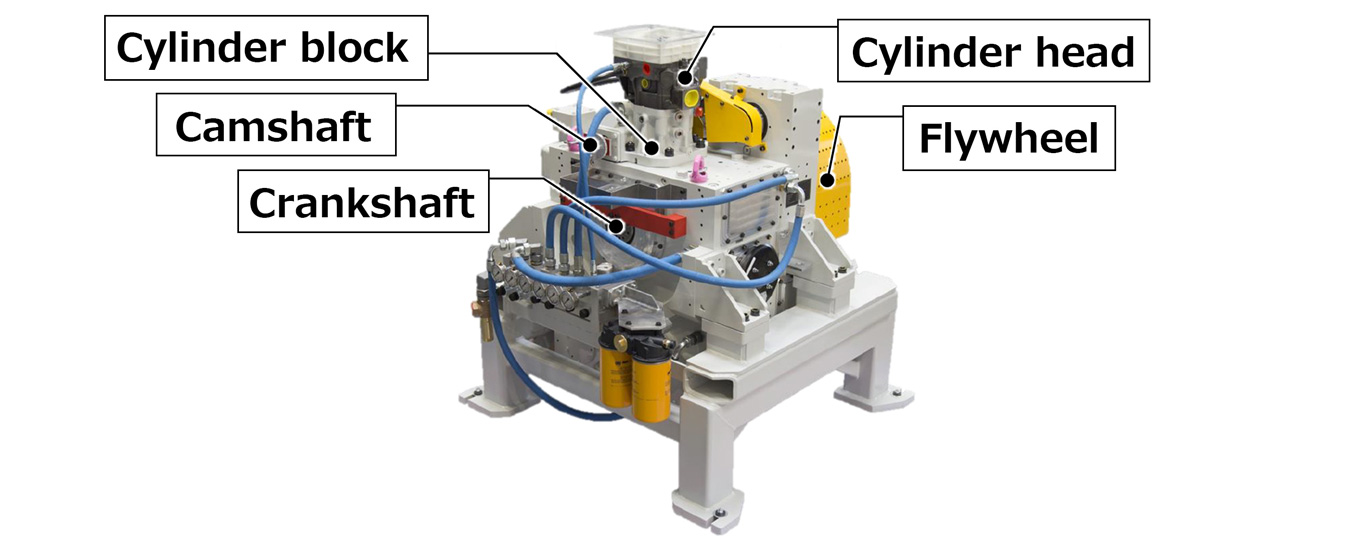
- To verify the abnormal combustion avoidance technology, a single-cylinder engine (Diagram 1) is being used to conduct elemental testing. This has resulted in the hydrogen engine operating normally under high-output conditions while also achieving zero emissions using a type of biofuel (HVO)[5] as the pilot fuel. This abnormal combustion avoidance technology has been applied to a pilot ignition-type 6-cylinder hydrogen engine.
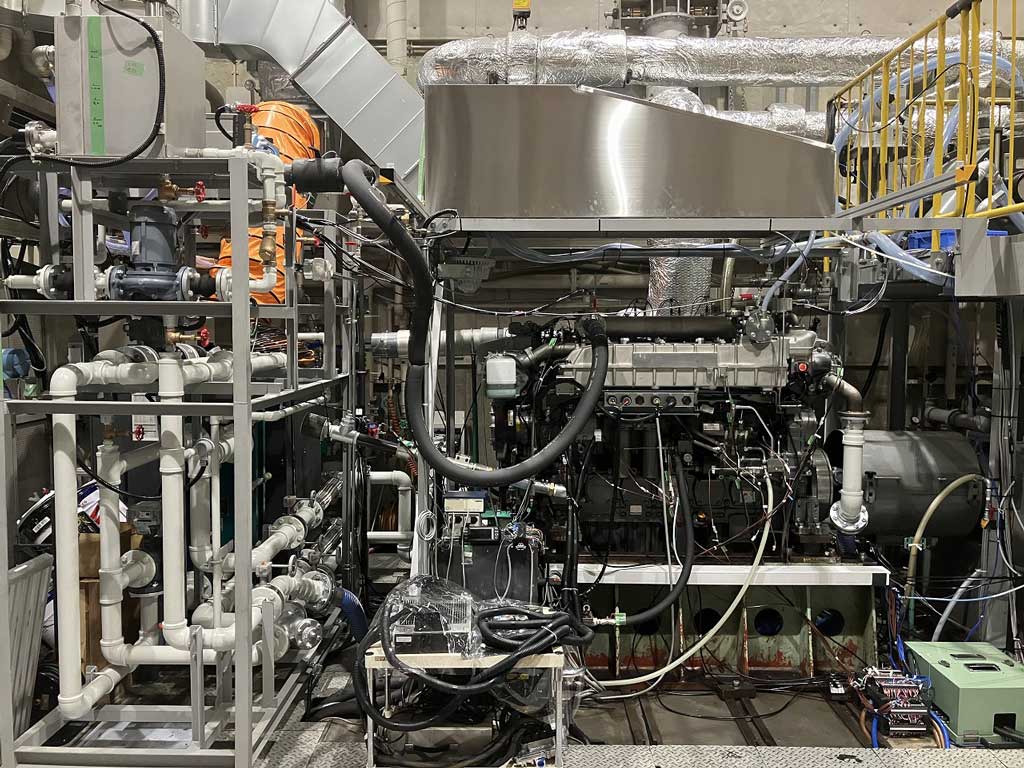
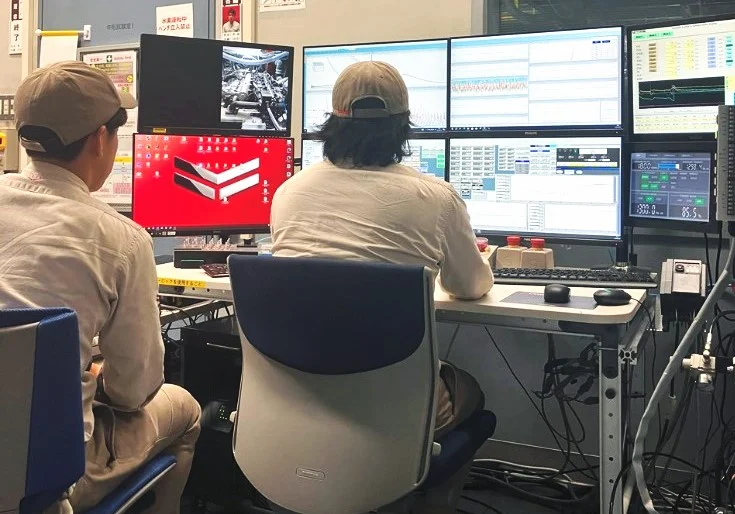
- Demonstration testing of a pilot ignition-type 6-cylinder hydrogen engine has begun on land (Diagram 2 and 3) with dual-fueled operation using hydrogen and a small amount of pilot fuel at a 100% load (roughly 500kW), achieving a globally high level of hydrogen combustion efficiency and output for a pilot ignition-type hydrogen engine (according to Yanmar Power Technology).
- Working with Japan’s National Maritime Research Institute, the consortium has begun developing abnormal combustion avoidance technology using a spark ignition-type 6-cylinder hydrogen engine.
- With a view toward demonstration operations, design operations are underway for a container-type package to house high-pressure hydrogen tanks and hydrogen engine power generators. In addition to the systems needed to operate a hydrogen engine, systems are being incorporated to ensure a high level of safety with the hydrogen fuel.
2. Design and construction of a hydrogen engine-compatible vessel
- This project is starting with fundamental design operations for the vessel. There are currently no coastal tankers able to house a hydrogen container unit, and loading a hydrogen container unit on an existing tanker as is would cause it to lose balance, making the ship unable to function. The consortium is therefore designing a completely new vessel for hydrogen-fueled demonstration testing.
- In addition to designing the test vessel, AiP as a vessel on which the engine room can house a hydrogen engine power generator is being obtained from a classification society. Along with the adaption for the use of hydrogen as fuel and construction of hydrogen supply infrastructure, this will make it possible to quickly build a ship equipped with appropriate systems for the use of hydrogen fuel with a high level of safety.
- 3. Meaning that except for a small amount of hydrocarbon fuel used for ignition, the engine can operate using only hydrogen fuel.↩︎
- 4. A testing system that simulates an engine’s compression, combustion, and expansion processes.↩︎
- 5. HVO: Hydrotreated vegetable oil, a type of plant-derived biofuel.↩︎
Looking ahead
- In the onshore demonstration testing of the pilot ignition-type 6-cylinder hydrogen engine, the consortium plans to expand the scope of stable operation, reduce the nitrogen oxide in the exhaust gas, and achieve zero emission using HVO as the pilot fuel. Ahead of demonstration testing in 2026, the consortium aims to obtain classification society verification for the hydrogen engine and hydrogen container unit.
- In addition, onshore demonstration testing of a similar spark-ignition hydrogen single-fueled engine will be conducted at the same time. This is intended to lead the way toward the popularization of hydrogen engine-compatible electrically propelled vessels. This is set to contribute to the achievement of zero emission coastal shipping based on hydrogen energy by roughly 2030.
- Propulsion engines (main engines) for small, high-speed vessels are also seen as a potential application for the hydrogen single-fueled engines the project is developing.
- The acquisition of proper knowledge and experience in methods for handling hydrogen fuel stably and safely will also be needed for the operation of hydrogen engine power generators. To prepare for the social implementation of hydrogen, training for onboard and onshore support crew will be held in cooperation with related parties and manuals for the use of hydrogen fuel and various operations will be prepared, with the aim of using the knowledge gained from the testing in the hydrogen society of the future.
- Many possibilities and issues exist in terms of the construction of hydrogen supply infrastructure going forward, including hydrogen supply chains and bunkering (supplying hydrogen fuel to ships). This demonstration testing will be able to contribute to the construction of safe, practical systems for social implementation.
Participants’ comments
Yuki Kobayashi, Yanmar Power Technology Co., Ltd.
I am working on a wide range of hydrogen engine development operations that will become the heart of the zero emission vessel, from designing various components using various verification and analytical methods for avoidance of abnormal combustion to the construction of control systems for safe engine operations. I find it both appealing and exciting that the entire consortium is working as one to overcome major obstacles in pursuing the challenge of developing a high-speed generator engine with maximum output for use in hydrogen-fueled coastal shipping. I will strive to lead the consortium toward the achievement of these goals.
Shota Tsuboi, Uyeno Transtech Ltd.
Coastal tankers have limited space for fuel tanks, and the issues of how to apply hydrogen fuel-driven systems and reduce the environmental impact of coastal shipping are particularly difficult with tankers handling dangerous materials. To address this, the consortium’s Yanmar Power Technology, a shipyard, other companies, and people within companies are working together to find solutions. The coastal tanker industry, which transports the energy that underpins people’s daily lives, wants to contribute to the more widespread use of hydrogen fuel and the creation of a sustainable society. We are working toward demonstration testing of a large coastal tanker using hydrogen fuel in 2026.