Awareness Survey of 18-Year-Olds – ‘My Number’ Personal Identification CardsResults of 56th installment announced – Roughly 80% of respondents have cards, close to 60% call government response to problems ‘inappropriate’

Awareness Survey of 18-Year-Olds

The 56th installment of the Awareness Survey of 18-Year-Olds, launched by The Nippon Foundation in October 2018, was carried out from July 14 to 17 on the subject of “My Number” personal identification cards. The Japanese government began issuing these cards to all residents in 2016, with a personal identification number used for taxes and social security, similar to a social security number in the United States, as well as the holder’s photograph and an IC chip that allows certain procedures like filing taxes to be done using a smartphone or card reader without the need to visit a government office in person. The initial introduction experienced a number of problems including data errors and system glitches, however, slowing the adoption of the cards by the general public.

More than 60% of all survey respondents replied that government procedures “should be” digitalized, while close to 80% replied either that they “have a My Number card” or “have applied for a My Number card,” which is higher than the rate of possession/application that the government has announced for the population as a whole.  The top reason given for obtaining a card was to receive “points” that can be used for cashless payments under a program introduced to encourage people to apply for a My Number card. More than 70% of respondents were aware of the problems the rollout encountered, with close to 60% saying that the government’s response was “inappropriate.” The most-cited responses regarding hopes for the cards going forward were that they could be used as a student ID card, that they could be loaded onto all smartphone models, and that they could be used as a driver’s license.

Highlights of the 56th Awareness Survey of 18-Year-Olds – ‘My Number’ Personal Identification Cards

Digitalization of Japanese government procedures

  • Should progress – 63.8%
  • Current level is satisfactory – 16.6%
  • Should not progress – 6.0%
  • “Should progress” is the total of “Should progress significantly” and “Should progress,” and “Should not progress” is the total of “Should not progress” and “Definitely should not progress.”

Possession of My Number cards

  • Have a My Number card – 78.5%
  • Don’t have a My Number card – 16.3%
  • “Have a My Number card” includes respondents who have applied for, but not yet received, their card.
  • “Don’t have a My Number card” refers to respondents who did not have a card at the time of the survey, including responses like “I want to obtain one soon.”

Top 3 reasons for obtaining a My Number card

  • To be able to receive My Number points – 64.1%
  • To be able to use as personal identification – 49.2%
  • Family and people around me encouraged me to – 28.2%

Evaluation of Japanese government’s handling of the rollout

  • Appropriate – 18.1%
  • Inappropriate – 57.1%
  • “Appropriate” is the total of “Appropriate” and “Somewhat appropriate”
  • “Inappropriate” is the total of “Inappropriate” and “Somewhat inappropriate”

Survey Excerpts

My Number card possession

Do you have a My Number card?
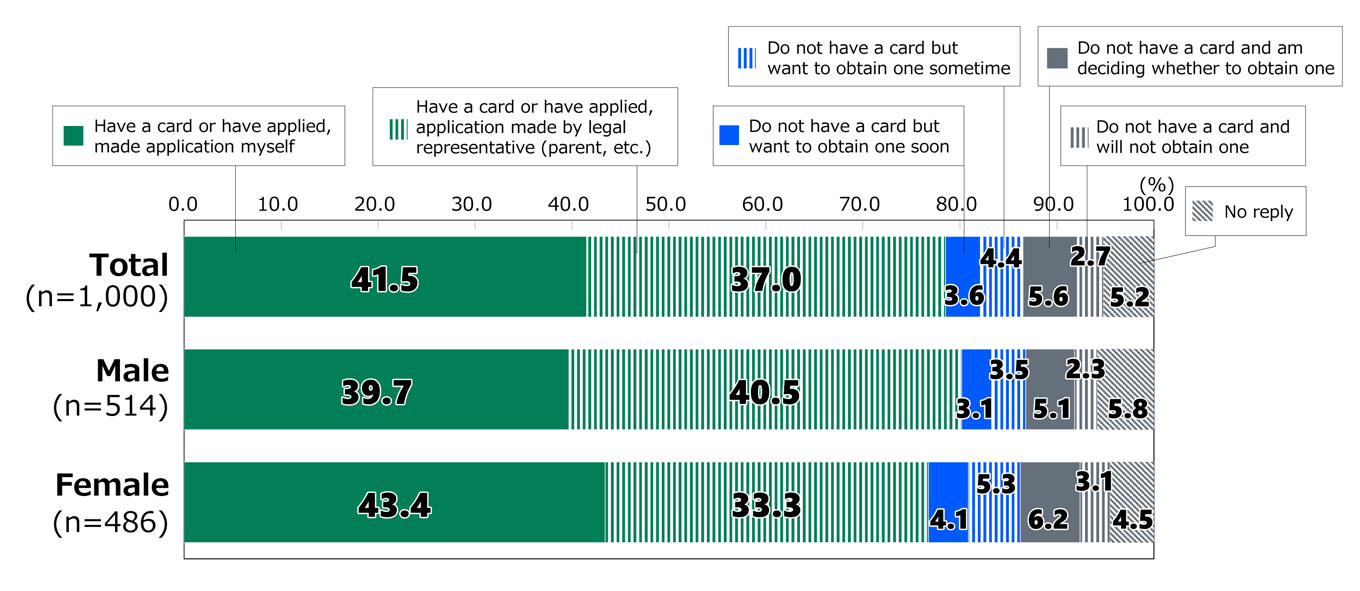
Bar chart showing results from Awareness Survey of 18-Year-Olds: In response to the question, “Do you have a My Number card?”,  among all respondents (n = 1,000), 41.5% replied “Have a card or have applied, made application myself,” 37.0% replied “Have a card or have applied, application made by legal representative (parent, etc.),” 3.6% replied “Do not have a card but want to obtain one soon,” 4.4% replied “Do not have a card but want to obtain one sometime,” 5.6% replied “Do not have a card and am deciding whether to obtain one,” 2.7% replied “Do not have a card and will not obtain one,” and 5.2% gave no reply. Among male respondents (n = 514), 39.7% replied “Have a card or have applied, made application myself,” 40.5% replied “Have a card or have applied, application made by legal representative (parent, etc.),” 3.1% replied “Do not have a card but want to obtain one soon,” 3.5% replied “Do not have a card but want to obtain one sometime,” 5.1% replied “Do not have a card and am deciding whether to obtain one,” 2.3% replied “Do not have a card and will not obtain one,” and 5.8% gave no reply. Among female respondents (n = 486), 43.4% replied “Have a card or have applied, made application myself,” 33.3% replied “Have a card or have applied, application made by legal representative (parent, etc.),” 4.1% replied “Do not have a card but want to obtain one soon,” 5.3% replied “Do not have a card but want to obtain one sometime,” 6.2% replied “Do not have a card and am deciding whether to obtain one,” 3.1% replied “Do not have a card and will not obtain one,” and 4.5% gave no reply.

Reasons for obtaining My Number card

Why did you obtain a My Number card (covering those who replied “Have a card or have applied, made application myself,” up to three responses allowed)?
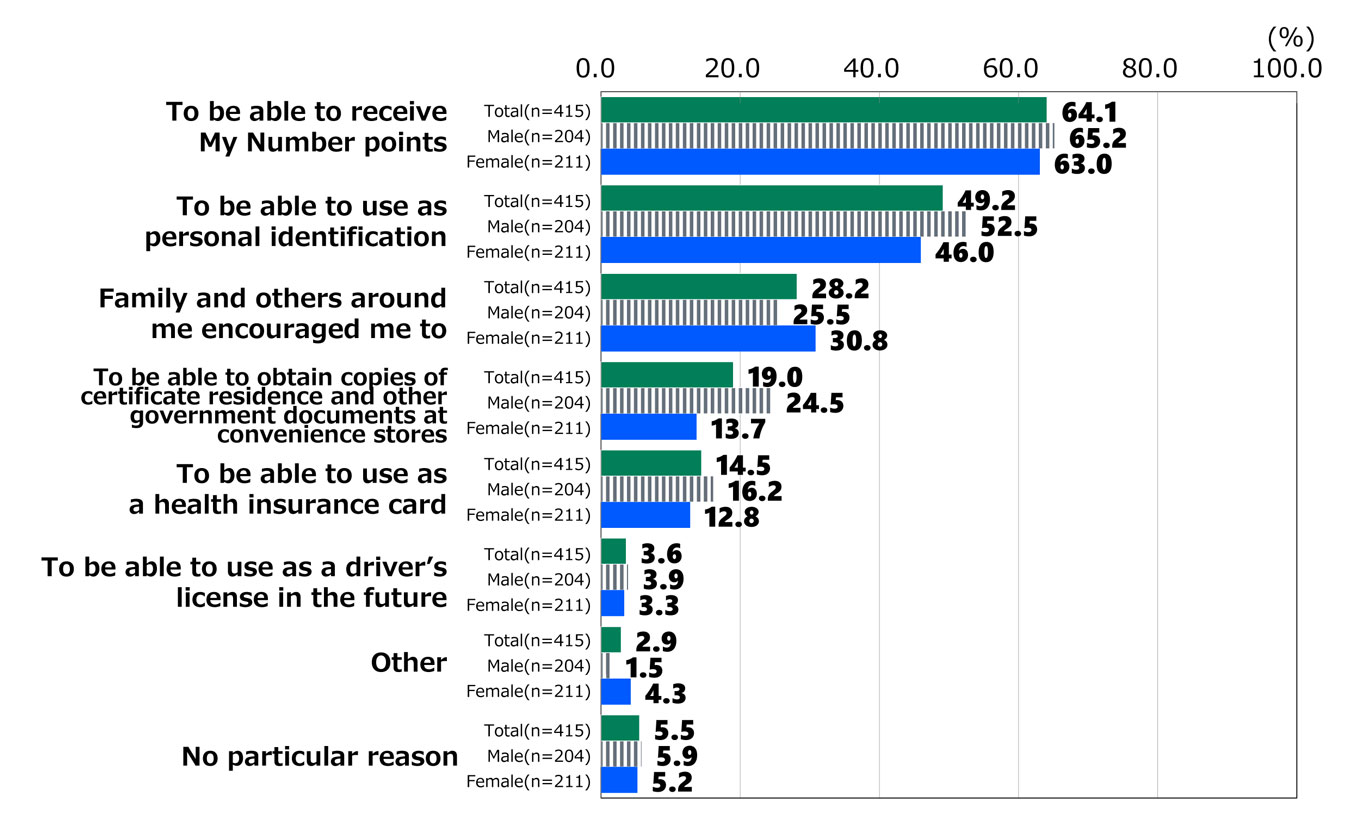
Bar chart showing results from Awareness Survey of 18-Year-Olds: In response to the question, “Why did you obtain a My Number card (up to three responses allowed)?”, among all respondents who replied “Have a card or have applied, made application myself” (n = 415), 64.1% replied “To be able to receive My Number points,” 49.2% replied “To be able to use as personal identification,” 28.2% replied “Family and others around me encouraged me to,” 19.0% replied “To be able to obtain copies of certificate residence and other government documents at convenience stores,” 14.5% replied “To be able to use as a health insurance card,” 3.6% replied “To be able to use as a driver’s license in the future,” 2.9% replied “Other,” and 5.5% replied “No particular reason.” Among male respondents who replied “Have a card or have applied, made application myself” (n = 204), 65.2% replied “To be able to receive My Number points,” 52.5% replied “To be able to use as personal identification,” 25.5% replied “Family and others around me encouraged me to,” 24.5% replied “To be able to obtain copies of certificate residence and other government documents at convenience stores,” 16.2% replied “To be able to use as a health insurance card,” 3.9% replied “To be able to use as a driver’s license in the future,” 1.5% replied “Other,” and 5.9% replied “No particular reason.” Among female respondents who replied “Have a card or have applied, made application myself” (n = 211), 63.0% replied “To be able to receive My Number points,” 46.0% replied “To be able to use as personal identification,” 30.8% replied “Family and others around me encouraged me to,” 13.7% replied “To be able to obtain copies of certificate residence and other government documents at convenience stores,” 12.8% replied “To be able to use as a health insurance card,” 3.3% replied “To be able to use as a driver’s license in the future,” 4.3% replied “Other,” and 5.2% replied “No particular reason.”

Evaluation of Japanese government’s handling of problems during the rollout

How do you evaluate the Japanese government’s handling of problems encountered during the rollout (covering those who were aware of the problems encountered)?
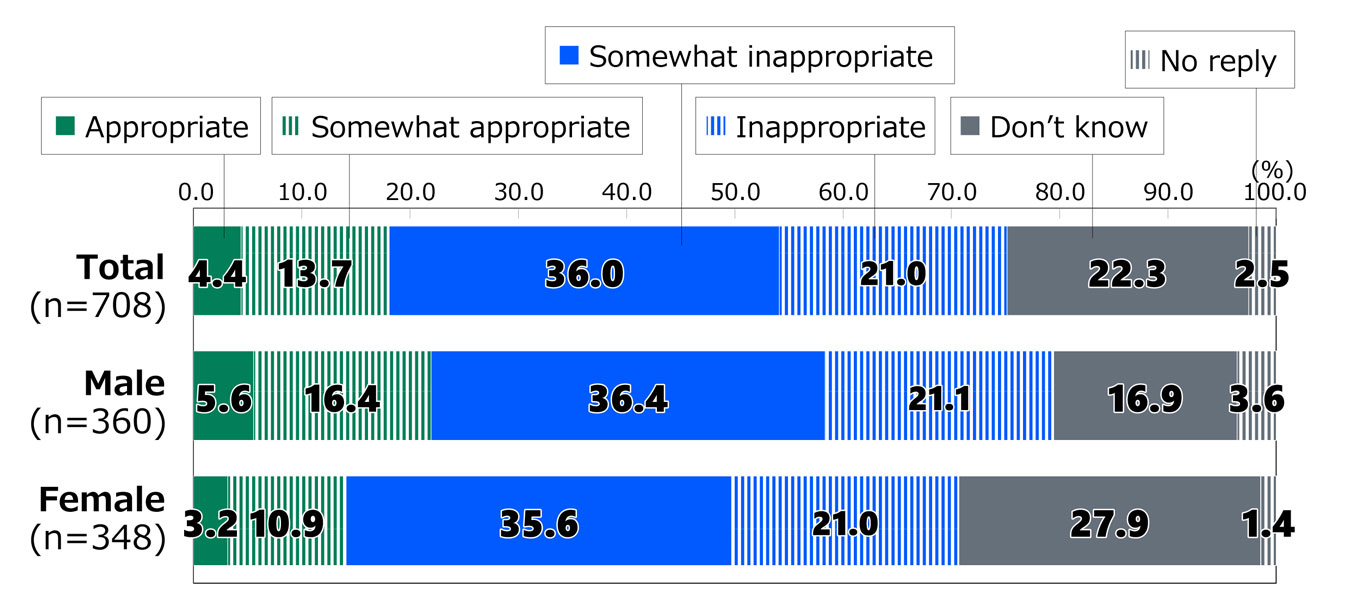
Bar chart showing results from Awareness Survey of 18-Year-Olds: In response to the question, “How do you evaluate the Japanese government’s handling of problems encountered during the rollout?”, among all respondents who were aware of the problems encountered (n = 708), 4.4% replied “Appropriate,” 13.7% replied “Somewhat appropriate,” 36.0% replied “Somewhat inappropriate,” 21.0% replied “Inappropriate,” 22.3% replied “Don’t know,” and 2.5% gave no reply. Among male respondents who were aware of the problems encountered (n = 360), 5.6% replied “Appropriate,” 16.4% replied “Somewhat appropriate,” 36.4% replied “Somewhat inappropriate,” 21.1% replied “Inappropriate,” 16.9% replied “Don’t know,” and 3.6% gave no reply. Among female respondents who were aware of the problems encountered (n = 348), 3.2% replied “Appropriate,” 10.9% replied “Somewhat appropriate,” 35.6% replied “Somewhat inappropriate,” 21.0% replied “Inappropriate,” 27.9% replied “Don’t know,” and 1.4% gave no reply.

About the Awareness Survey of 18-Year-Olds

Revisions to Japan’s Civil Code lowering the age of adulthood to 18 for a range of activities, including voting, took effect in April 2022, making it even more important to understand and record the awareness of the 18-year-olds who represent Japan’s next generation. With this in mind, in October 2018 The Nippon Foundation launched the Awareness Survey of 18-Year-Olds as an ongoing survey of young men and women across Japan aged around 18, to survey their values, attitudes toward politics and elections, understanding of social issues, and other current themes on an ongoing basis.

Notes:

  1. From the 13th survey, the number of respondents, comprising men and women aged 17 to 19, has been increased to 1,000 from 800.
  2. With the exception of the 20th and 46th installments, “Awareness Survey of Society and Country,” all surveys cover respondents in Japan only.

Related Link

Contact

The Nippon Foundation

  • Email: cc@ps.nippon-foundation.or.jp