World’s 1st Successful ‘Zero-Carbon’ VoyageUsing Japan’s 1st dual-fueled hydrogen tugboat with biomass fuel
With a view toward achieving carbon neutrality in Japan’s coastal shipping by 2050, The Nippon Foundation launched the Zero Emission Ships project in January 2022 with the aim of developing ships fueled by hydrogen, a next-generation fuel known as the “ultimate clean energy” that does not emit greenhouse gasses while the ship is operating. The project has set up three consortia to develop and install engines and supply infrastructure.
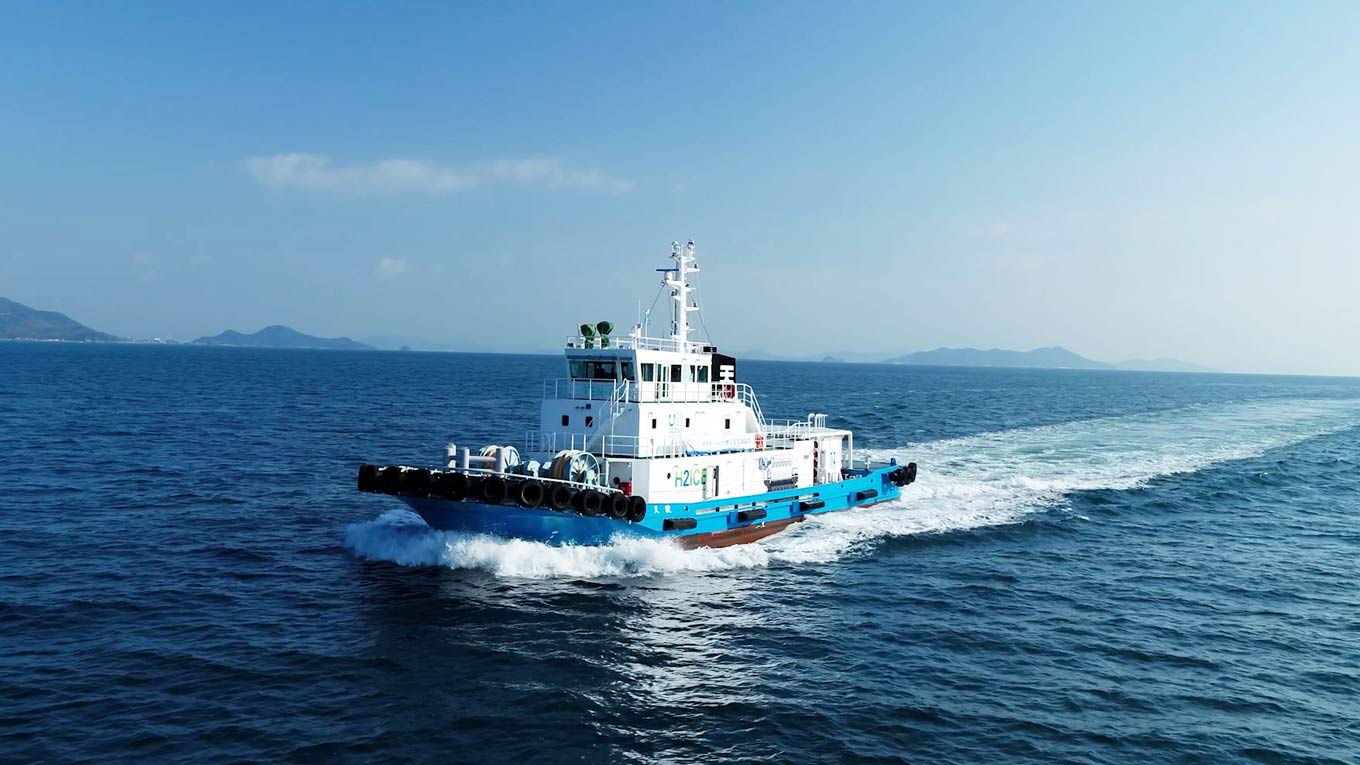
On December 24, 2025, the consortium that includes JPN H₂YDRO Co., Ltd. successfully conducted the world’s first zero–carbon voyage* using a mixture of hydrogen and biodiesel fuel that does not emit greenhouse gasses using the TEN-OH, Japan’s first tugboat equipped with hydrogen dual-fueled engines. This success is expected to lead to the creation of demand for hydrogen and the spread of carbon-neutral navigation going forward.
The TEN-OH, delivered by Tsuneishi Shipbuilding Co., Ltd. in October 2025, is a tugboat that uses superior operability and high engine output to supplement the rudders and propellors of large ships, and is equipped with hydrogen dual-fueled engines and a high-pressure, large-capacity hydrogen gas storage and supply system provided by JPN H₂YDRO. Using the traditional fossil fuel marine gas oil (MGO) mixed with hydrogen makes it possible to reduce CO2 emissions by roughly 60% compared with tugboats using conventional fossil fuels only. This demonstration test was successfully carried out using biodiesel fuel (B100), a carbon-neutral fuel that produces essentially zero CO2 emissions, in place of the fuel oil.
- Note: Based on our research (as of January 2026), this is the world’s first zero-carbon voyage conducted using a dual-fuel mixture of hydrogen and biodiesel, regardless of vessel type. Test voyages have previously been conducted with other types of vessels using electric propulsion (powered by a battery and motor) fueled by hydrogen and biodiesel fuel, as well as tugboats using alternative fuels like ammonia.

Speakers’ comments (January 14 press event)
Mitsuyuki Unno, Executive Director, The Nippon Foundation
The success of this demonstration was a result of cooperation across sectors. It is a first step toward achieving carbon neutrality by 2050, and will accelerate decarbonization in Japan’s coastal shipping industry going forward. In addition to being a major advance in carbon neutrality, I believe the use of hydrogen and engine technologies to develop a zero-emission ship will support Japan’s “future industries.” We will build on this success going forward with steady development and demonstrations using a car ferry and tankers, with the aim of achieving a future in which zero-emission ships crossing the ocean are a matter of course.
Mitsuo Kambara, Representative Director and President, JPN H₂YDRO
We have already commercialized ships equipped with hydrogen-fueled engined, and I am confident that these represent one possible solution that can be used immediately for the decarbonization of Japan’s marine transport and ports. This zero-carbon voyage using a mixture of hydrogen and bio fuel was the first if its kind anywhere in the world, and marks a major step toward decarbonization using hydrogen dual-fueled engines. We will continue to promote the adoption of hydrogen engines in ships and port facilities, where they provide added value in terms of economy and safety.
The Nippon Foundation Zero Emission Ships project: Developing ships of the future that emit no greenhouse gases
To achieve carbon neutrality in Japan’s coastal shipping industry by 2050, the project has established three consortia with the aim of creating world-leading hydrogen-fueled ships (zero-emission vessels). In April 2024, the project successfully conducted a zero-emission voyage with the HANARIA, a hydrogen fuel cell-powered crew transfer vessel (CTV) for offshore wind farms. Following the success of the current tugboat project, demonstration tests for a car ferry and a tanker are scheduled to be conducted by the end of fiscal 2026. In addition to providing a strong boost toward the realization of carbon neutrality, a pressing issue worldwide, the development of zero-emission ships is also expected to become a “future industry” that can utilize Japan’s world-class hydrogen and engine technologies.
About JPN H₂YDRO Co., Ltd.
JPN H₂YDRO is a joint venture by the Tsuneishi group, which has a proven track record in maritime industries, and the Compagnie Maritime Belge (CMB) group, Belgium’s largest comprehensive marine transport company. Established in 2019, its main businesses are the development and sales of products that use hydrogen engines, other hydrogen-related business development, and ship ownership and management. JPN H₂YDRO has already commercialized hydrogen engines, and is confident that these will represent one decarbonization solution going forward. With a wealth of experience and expertise, it is proposing solutions that use hydrogen engines on ships and in port facilities to add value in terms of economy and safety.
Related Links
Contact
Ocean Affairs Team
The Nippon Foundation
- Email: Zeroemission2050@ps.nippon-foundation.or.jp