Awareness Survey of 18-Year-Olds – Crime, Recidivism, and ImprisonmentResults of 80th installment announced – More than half of respondents feel that crime around them is increasing, 80% approve of redefined ‘imprisonment’

The 80th installment of the Awareness Survey of 18-Year-Olds was carried out in early May on the subject of “Crime, Recidivism, and Imprisonment,” asking young people about their views related to recidivism, which accounts for close to half of all crimes committed, and “imprisonment” as redefined in June 2025 for the first time in 118 years. Previously, Japan’s Penal Code used the terms “imprisonment” and “imprisonment without work,” but with the revision, intended to facilitate inmates’ rehabilitation, this distinction was removed and “imprisonment” redefined as “confinement in a penal institution,” with work or guidance assigned with a view toward their rehabilitation.
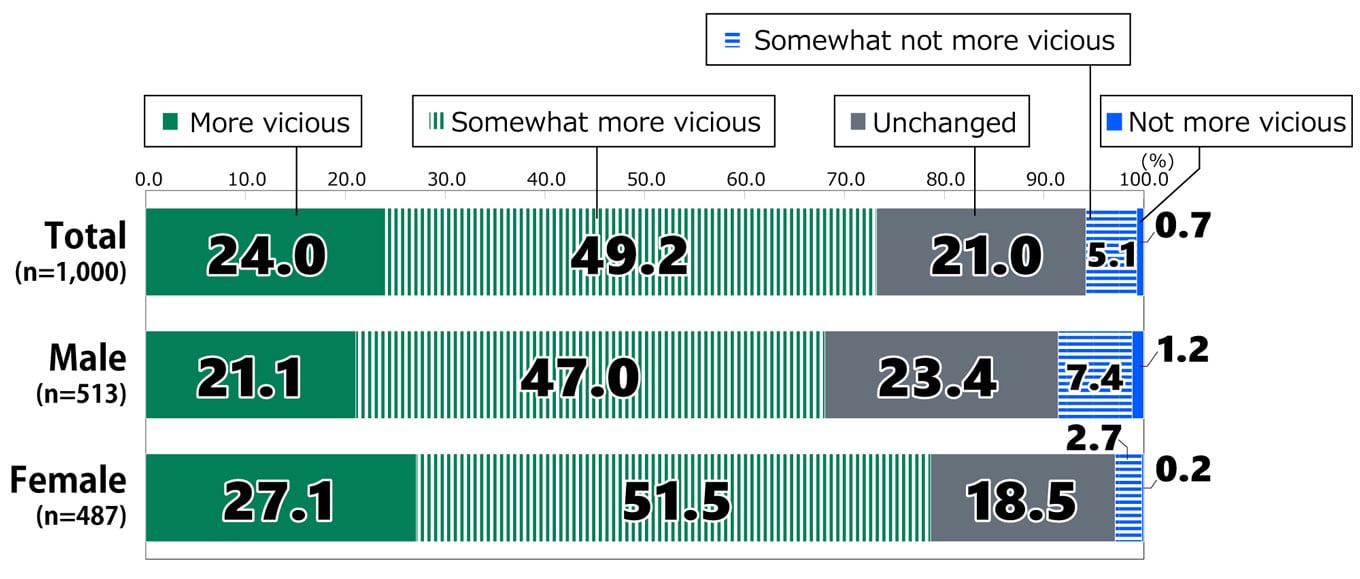
First, the survey looked at the current state of crime, which has been increasing since 2021. More than 70% of respondents replied that crime is becoming either “More vicious” or “Somewhat more vicious.” Half of all respondents also replied that either “In recent years, I feel that crime immediately around me is increasing” or “In recent years, I feel that crime immediately around me is increasing somewhat,” with the rate among female respondents roughly 12 percentage points higher than for male respondents.
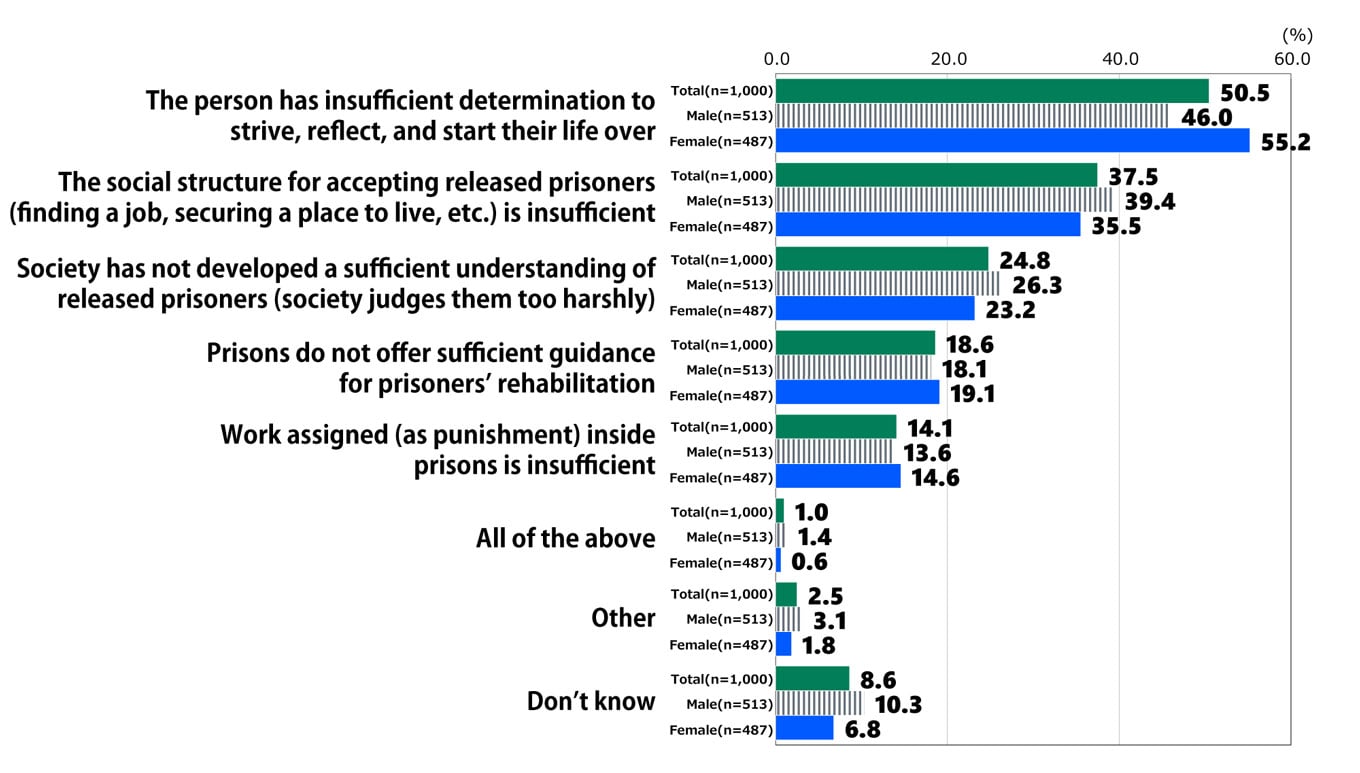
When asked for the reasons repeat offenders account for close to half of all arrests (with up to two replies allowed), roughly half of all respondents cited “The person has insufficient determination to strive, reflect, and start their life over,” while close to 40% cited “The social structure for accepting released prisoners is insufficient.”
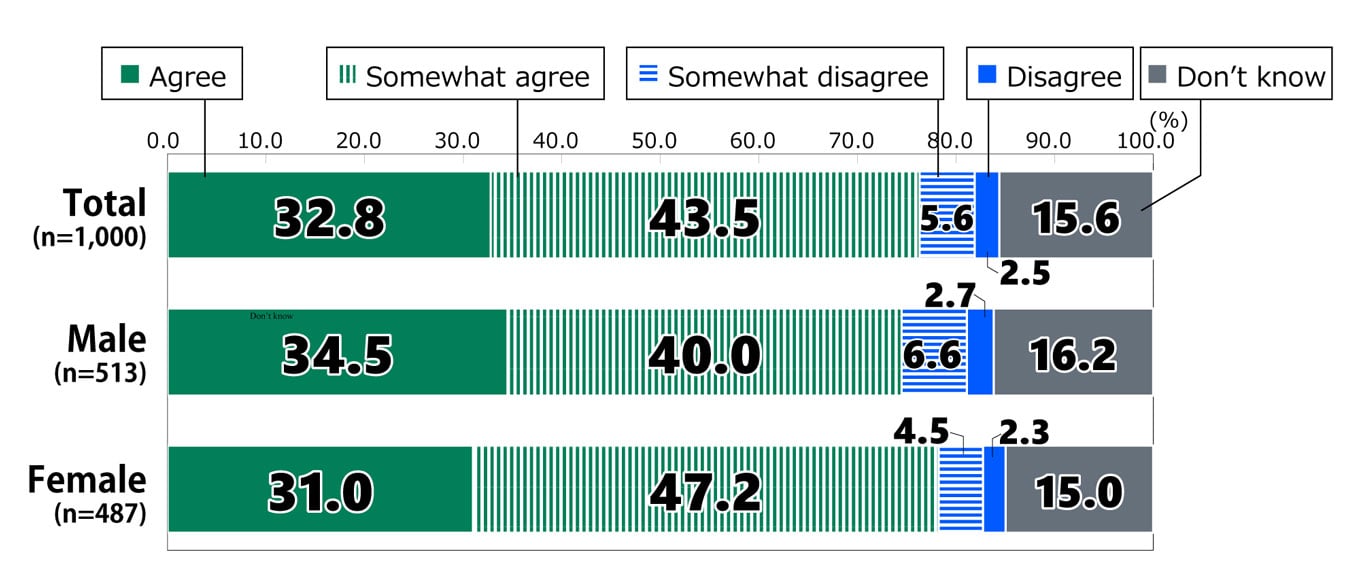
Although more than 60% of all respondents were unaware of the 2025 redefinition of “imprisonment,” close to 80% of respondents either agreed or somewhat agreed that work assigned to prisoners was “A method of supporting rehabilitation and return to society,” while less than 10% either somewhat disagreed or disagreed. When asked their reasons, the top reply among those who agreed was “Support for returning to society should be tailored to each individual’s characteristics,” while the top reply among those who disagreed was “It is insufficient as ‘punishment.’”
Regarding the redefinition of imprisonment, roughly 40% of respondents felt that it could be expected to lead to a decrease in recidivism rates while 5% saw it leading to an increase.
Highlights of the 80th Awareness Survey of 18-Year-Olds – Crime, Recidivism, and Imprisonment
Change in number of criminal cases
- Increasing – 27.8%
- Increasing somewhat – 44.8%
- Not changing – 22.4%
- Decreasing somewhat – 4.2%
- Decreasing – 0.8%
Awareness of redefinition of “imprisonment” –
- Aware of the revision including specific changes – 12.6%
- Aware of the revision but do not know what specifically changed – 25.8%
- Not aware of the revision (hearing about it for the first time) – 61.6%
View on concept of imprisonment with work assigned to prisoners as a method of rehabilitation
- Agree – 32.8%
- Somewhat agree – 43.5%
- Somewhat disagree – 5.6%
- Disagree – 2.5%
- Don’t know – 15.6%
Survey Excerpts
Change in viciousness of crimes (Single reply)
Reasons repeat offenders account for close to half of all arrests
(Up to two replies allowed)
Idea that work assigned to prisoners is a method of supporting rehabilitation
(Single reply)
About the Awareness Survey of 18-Year-Olds
Revisions to Japan’s Civil Code lowering the age of adulthood to 18 for a range of activities, including voting, took effect in April 2022, making it even more important to understand and record the awareness of the 18-year-olds who represent Japan’s next generation. With this in mind, in October 2018 The Nippon Foundation launched the Awareness Survey of 18-Year-Olds as an ongoing survey of young men and women across Japan aged around 18, to survey their values, attitudes toward politics and elections, understanding of social issues, and other current themes on an ongoing basis.
About the 80th Installment – Crime, Recidivism, and Imprisonment
| Survey coverage | 1,000 respondents comprising male and female respondents aged 17-19 from across Japan |
|---|---|
| Survey period | May 8-10,2026 |
| Survey method | Internet survey |
Related Link
Inquiries
Public Relations Division
The Nippon Foundation
- Email: pr@ps.nippon-foundation.or.jp