Training Fundraisers in Asia
Project to train fundraisers in Asia
The project to train fundraisers* in Asia is working to build a framework to enable nonprofit organizations operating in Asia to secure their own funding. By developing teaching materials based on the local laws and legal systems of each country, the project is working in cooperation with universities to create a sustainable model for human resource training. The first model was launched in Kyrgyzstan, and the project aims to roll out the program to other Asian countries in the future.
- For the purposes of this project, “fundraiser” refers to people in the specialist occupation of collecting donations and grants to fund activities carried out by nonprofit organizations.
Increasing complexity of social issues in Asia and the private sector’s role
As the economies of Asian countries grow and markets develop, capitalism is becoming more deeply entrenched in the social structure. Although economic development is raising living standards, it is also creating new social issues including income gaps, regional disparities, and unequal access to education and medical care.
As long as these social frameworks remain in place going forward, these issues cannot be expected to go away naturally, and there are limits to what national governments alone can do to address them. This means that the private sector needs to become involved, and the role of nonprofit organizations is becoming increasingly important.
Funding structure that has relied on international support
Nevertheless, in many Asian countries to date, overseas assistance and international organizations have provided the funding to address these issues. As the donor pool has shrunk and regulations have been tightened in recent years, this framework can no longer be relied upon. Creating a framework for circulating funds within the region and training specialist human resources to carry this out is a common issue for all of Asia.
Specific historical background in Central Asia and structure of reliance
While viewing this issue as a need that spans the entire region, the project is using Kyrgyzstan as a starting point. During the time of the Soviet Union, Kyrgyzstan and other Central Asian countries operated under government-planned economies, but since becoming independent they have transitioned to market economies. In that process, the role of nonprofit organizations in supplementing social services that had been provided by the government has grown.
However, the fact that the funding to address social issues has historically come from international assistance means that a donation culture and framework for circulating funds from the private sector do not exist in these countries. This has resulted in an entrenched structure with a high reliance on outside funds.
Danger to the funding base brought about by shrinking donor pool
Against this backdrop, international foundations have been withdrawing from Kyrgyzstan and ending assistance programs in recent years, which is causing a rapid deterioration in the base underpinning the activities of nonprofit organizations that have relied on outside funds. The combination of historically relying on these funds and the shrinking donor pool is causing strong concern about securing funding at many organizations.
Recently, these organizations have begun building up their own sustainable funding structures. In addition to clearly identifying the issues, the project is building a framework for coordination with a university, which is why we view the country as an optimal first step for creating a model.
Year 1: Developing locally rooted teaching materials
Given that no teaching materials for systematically learning about fundraising existed in Central Asia, during the project’s first year new teaching materials that reflected the country’s culture and legal framework were created. These materials were developed in cooperation with nonprofit organization specialists in Central Asia and a fundraising expert at a leading U.S. university, integrating local considerations with international expertise. The materials are not simply translations or imports, and were created as practical materials taking into account Central Asia’s regulatory frameworks, culture, and donation environment.
Year 2 onward: Developing human resource training in cooperation with a university
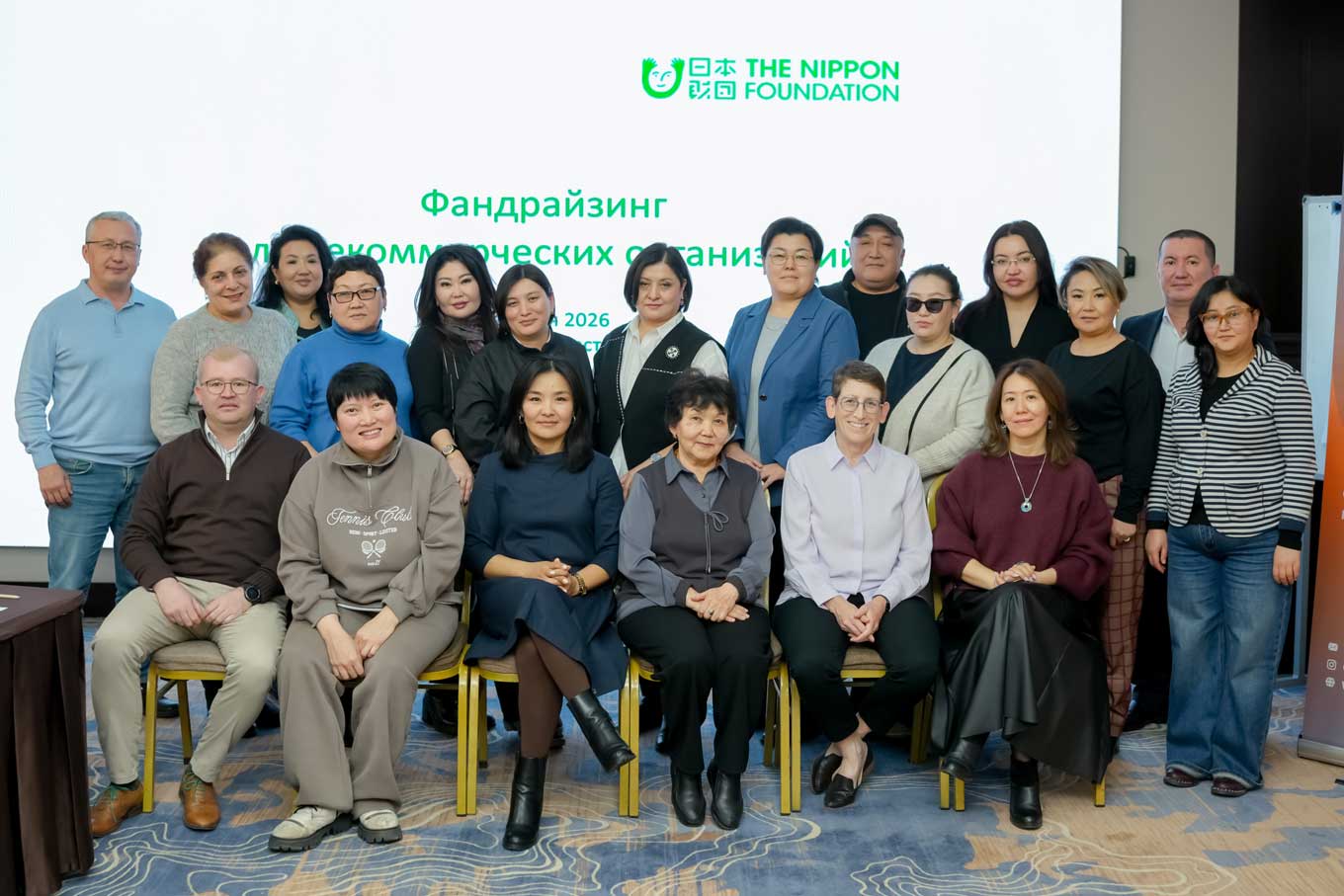
During the second year, a curriculum is being designed based on these teaching materials, and a 12-session training course is being planned in cooperation with Ala-Too International University. Participants will systematically learn about theories and practices for fund procurement, and will prepare specific plans for their own organization that can later be implemented. The participants will also have built a network among themselves, and there are plans for regional network events after the course is over. In addition to enhancing the capabilities of individual organizations, the program also aims to create a network of specialists who can share information across all of Central Asia.
Using this model created in Kyrgyzstan as a base, the project will look to roll out the program going forward to Kazakhstan and other Central Asian countries, and in Southeast Asia as well. After first implementing and verifying the program in Kyrgyzstan, the program will be refined to make it replicable in other countries, with the objective of creating a funding base to support the autonomous resolution of social issues in Asian countries.
Inquiries
- Please note that we can only accept inquiries in Japanese or English, and that it may take approximately one week to respond.