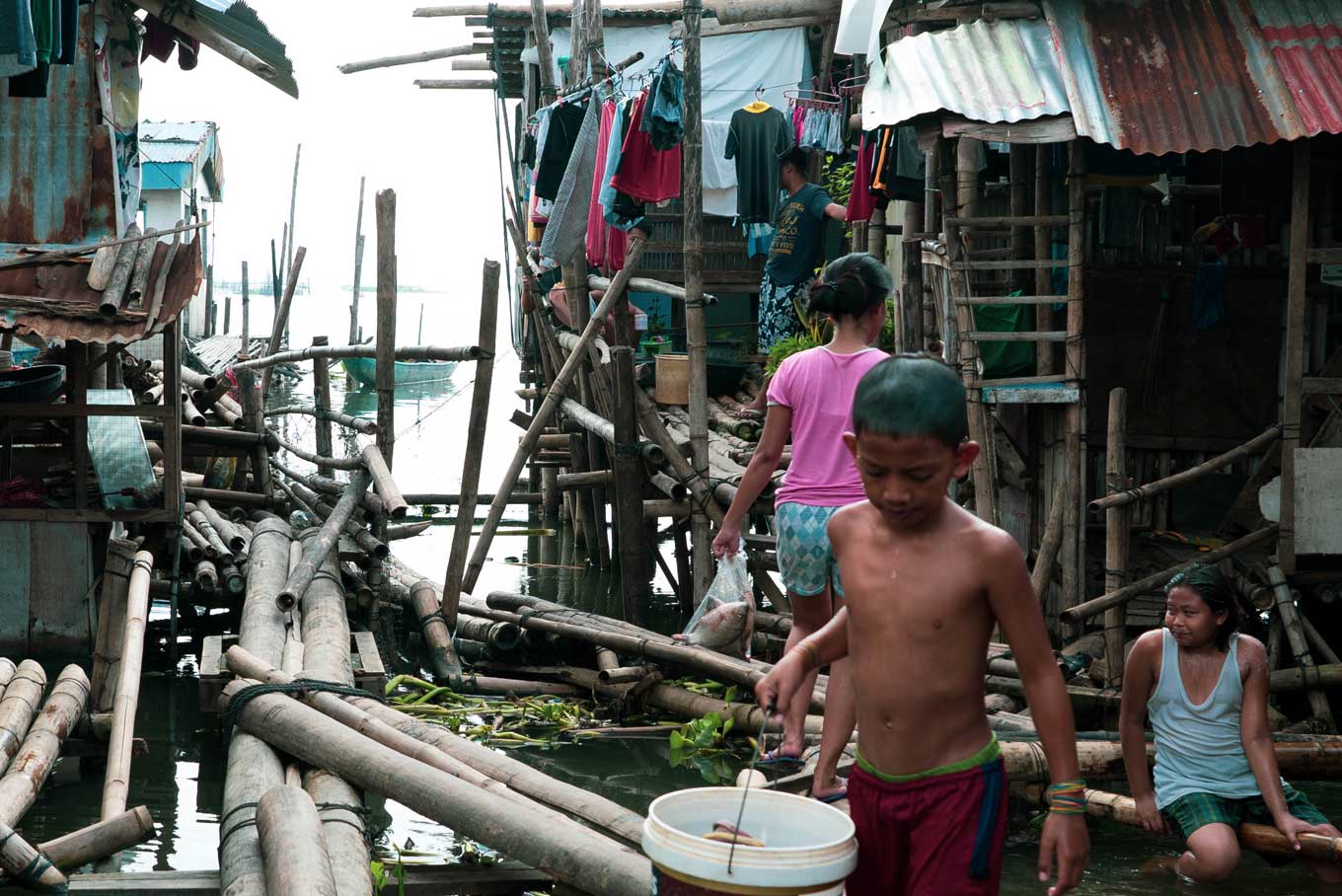
Supporting Mental Health Care for People Affected by Climate ChangeThe increasing risk of damage to coastal residential areas from climate change is becoming an issue
Support for mental health care for people affected by damage from climate change
As the impacts of climate change become more intense and frequent, The Nippon Foundation is working with the World Health Organization Regional Office for the Western Pacific to strengthen climate-resilient mental health systems across the region, including mental health and psychosocial support (MHPSS) for people affected by climate-related disasters.
Mental health issues arising from disasters caused by climate change
Damage from events including typhoons, flooding, storm surges, drought, rising sea levels, and heat waves is becoming increasingly intense and with increasing frequency. This is causing residents of affected areas to lose their homes and livelihoods and evacuate for extended periods of time, and is breaking up communities, which has a significant effect on these residents.
A survey of displaced people around the world conducted by the Internal Displacement Monitoring Centre found that in 2025, there were 17.53 million cases of people being internally displaced by natural disasters in the East Asia and Pacific region*, accounting for roughly 60% of the global total. Countries including the Philippines, Palau, and Vanuatu have particularly large numbers of cases of internal displacement caused by typhoons and rainstorms, showing the significant damage from natural disasters in the East Asia and Pacific region. Given the psychological burden placed on people from the uncertainty associated with protracted periods of evacuation and rebuilding their lives, support for mental health care, in addition to securing people’s physical safety immediately after disasters strike, is becoming increasingly important.
- Based on the regional classification of the Internal Displacement Monitoring Centre. This “East Asia and Pacific” region encompasses approximately 30 countries, including 5 East Asian nations, 11 Southeast Asian nations, and Pacific island nations.
Given this large number of refugees from natural disasters in the East Asia and Pacific region, responding to disasters caused by climate change within the Western Pacific region (the region for which the WHO Regional Office for the Western Pacific is responsible) is becoming an important issue. At the same time, while this region, which includes Palau and Vanuatu as well as Japan, is particularly susceptible to damage from climate change-related disasters, there are limited specialist human resources like psychiatrists and other mental health professionals to support mental health care. The need for support surges temporarily when a disaster strikes, making it difficult for specialists alone to respond to everyone. This has created the need for a structure in which non-specialists, including local healthcare providers, governmental officials, school staff, and local support providers, provide support for basic mental health care.
In addition, with support needs growing despite limited specialist human resources, coordination across climate change response policies, disaster prevention and mitigation measures, and initiatives in the healthcare field is essential. This also means that while making effective use of limited specialist human resources, a framework is needed to make support for mental health care a part of overall disaster response, with preparations being made before disasters strike and a focus being placed on mental health from the initial response to a disaster through the recovery and reconstruction stages.
Project’s objectives
To address these issues, this project is working with the WHO Regional Office for the Western Pacific to support mental health care for people affected by climate change-related disasters in five countries – Mongolia, Malaysia, the Philippines, Palau, and Vanuatu – as part of each country’s disaster prevention and mitigation programs, climate change response policies, and healthcare policies.
Specifically, surveys are being conducted on each country’s respective government policies and regulatory frameworks, support structures, and mental health needs in times of disasters, to create useful models for practical support that can be implemented locally with limited specialist human resources. Then, training curricula and tools that allow non-specialists to provide support will be created, and practical measures will be broadly implemented to assess people’s mental health when disasters strike and put them in touch with the care they need.
The mental health care support that this project is pursuing is not limited to medical treatment provided by a specialist. Using training curricula and tools, the project aims to have local healthcare providers, governmental officials, school staff, and local support providers quickly identify signs including uncertainty and stress, isolation, and a sense of loss, and provide basic mental health and psychosocial support (MHPSS).
The project is emphasizing support for people who are particularly vulnerable when disasters strike, including women, children and adolescents, older persons, persons with disabilities, immigrants, and internally displaced people. By sharing insights gained in each country across the region, we aim to create a sustainable and comprehensive support framework that reliably provides necessary mental health and psychosocial support (MHPSS) when disasters strike.
Related Link
Inquiries
- Please note that we can only accept inquiries in Japanese or English, and that it may take approximately one week to respond.