First Island State Ocean Summit to be Held in JuneBringing together 300 heads of state and senior officials from 30 countries around the world
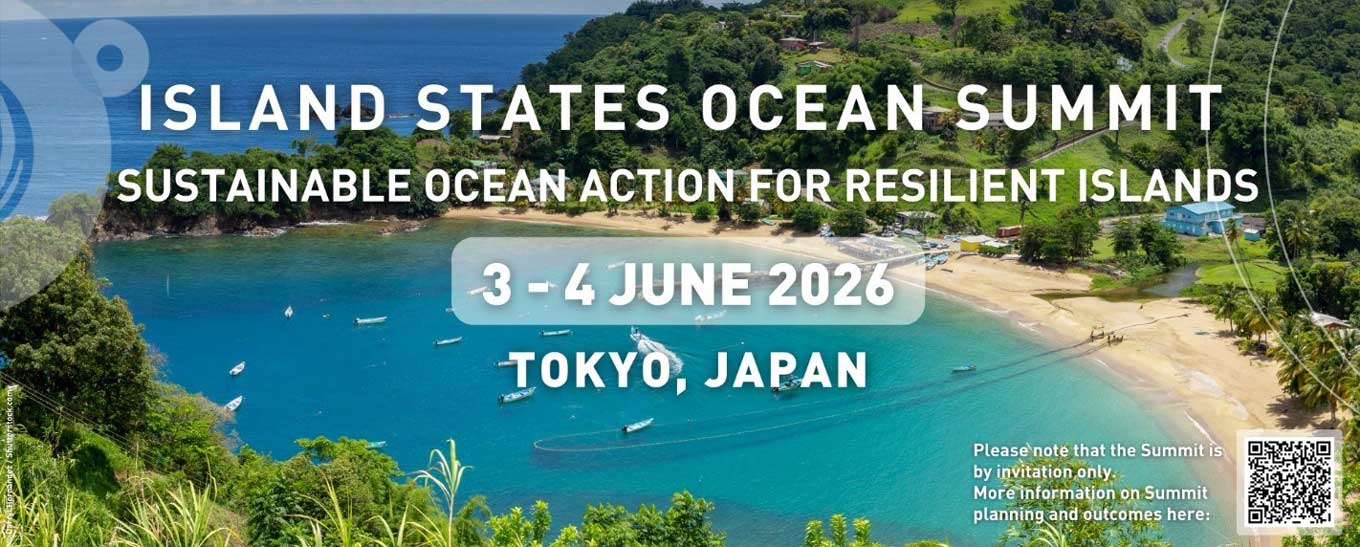
The Nippon Foundation, Japan’s Ministry of Foreign Affairs, and the Intergovernmental Oceanographic Commission (IOC) of UNESCO will jointly host an international conference, the Island States Ocean Summit, with roughly 300 people (as of May 13) including heads of state and cabinet ministers from roughly 30 countries including island states in the Pacific Ocean, Caribbean Sea, and Indian Ocean, as well as representatives of U.N. institutions, scheduled to attend. (Attendance is by invitation only.)
There is a growing need for a global forum focusing on island states to discuss issues including rising sea levels driven by climate change, ocean pollution, and the management of marine resources. It has also been pointed out that because forums like the U.N.’s International Conference on Small Island Developing States deal with a wide range of subjects, there are insufficient venues for discussion of ocean-related issues that will lead to concrete policy proposals. The Island States Ocean Summit is an international conference that will focus specifically on the ocean and island states, and will be the largest ever of its kind (according to IOC’s research).
The Summit will be co-chaired by Surangel S. Whipps, Jr., President of the Republic of Palau, and aims both to address urgent issues facing island states and formulate national government-level plans to preserve the ocean environment and use marine resources sustainably (sustainable ocean planning and management (SOPM)). The results of the summit will be reflected in deliberations at various international conferences to be held in the future.
Overview (background and objectives)
Among island states, Small Island Developing States (SIDS) are the most susceptible to the effects of global warming, and urgently need to gain the capabilities to address this unprecedented environmental change flexibly and effectively. The Summit will be the first international conference to deal with the subject of the ocean and island states, and will explore methods of support that will lead to SIDS’ self-reliance. Leaders from governments, academia, and the private sector involved with ocean issues around the world will work together with the aim of formulating new action plans to preserve their own country’s oceans while making maximum, sustainable use of those resources. Led by Co-Chairs President Whipps, IOC Executive Secretary Vidar Helgesen, and The Nippon Foundation Honorary Chair Yohei Sasakawa, new initiatives for the realization of transformation and innovation on a global scale will be announced on the Summitt’s final day. The outcomes will be reflected via IOC in deliberations at subsequent international conferences dealing with the global environment, including the UN Biodiversity Conference (CBD COP 17) to be held in October 2026 and the United Nations Climate Change Conference (COP31) to be held in November 2026. This initiative from Japan will therefore make a major contribution to support for island states.
The Nippon Foundation and island states
The Nippon Foundation has long supported island states, especially the Pacific island states that are important partners for Japan’s economic security. The Sasakawa Pacific Island Nations Fund was established in 1989, and in cooperation with partner organizations, the Foundation has provided Pacific island states with small boats and patrol vessels, while also working proactively to train human resources in a broad range of fields related to maritime affairs and ocean science, to support these countries’ governments and economies.
Co-hosting with IOC*
Policies based on scientific knowledge are indispensable for the resolution of various ocean-related issues, the building of sustainable ocean economies, and the management of marine resources. The Nippon Foundation places great emphasis on scientific knowledge, data, and information for the achievement of U.N. Sustainable Development Goal (SDG) 14: Conserve and sustainably use the oceans, seas and marine resources for sustainable development. By co-hosting this Summit with the IOC, which leads the UN. Decade of Ocean Science for Sustainable Development (2021-2030) as an international initiative that sets out a vision for the future of the oceans and identifies key challenges, the Foundation is promoting the formulation of highly effective plans for the world’s island states.
- IOC: The Intergovernmental Oceanographic Commission (IOC) of UNESCO is the UN’s lead body for ocean science, promoting international cooperation to strengthen the management, sustainable use, and resilience of the ocean. Bringing together 153 Member States, the IOC coordinates global efforts in ocean observations and services, tsunami warning systems, ocean science, capacity development, and ocean literacy, ensuring that science effectively informs policy, society, and sustainable ocean governance. Through its work, the IOC contributes to UNESCO’s mission to advance scientific knowledge and build capacity as foundations for peace, societal progress, and sustainable development. As the coordinator of the UN Ocean Decade of Ocean Science for Sustainable Development (2021-2030), the IOC leads global efforts to transform ocean knowledge into action for the benefit of people and the planet.
Sustainable Ocean Planning and Management
Sustainable Ocean Planning and Management (SOPM) is a comprehensive, strategic and future-oriented framework designed to guide decision-making about the overall sustainable use and conservation of a nation’s entire ocean resources. It is a whole-of-society, whole-of-government approach that serves as a unifying umbrella framework for ocean related governance at all scales.
In June 2025, the Intergovernmental Oceanographic Commission (IOC) of UNESCO’s Member States adopted a 5-year Strategy (2025-2030) on Sustainable Ocean Planning and Management with the mission to equip every nation with the capacity to develop sustainable ocean plans.
By developing integrated plans for fisheries, tourism, renewable energy, and other ocean-based industries, SOPM helps countries strengthen climate resilience while ensuring the long-term sustainability of marine ecosystems and coastal communities.
Japan adopted its Fourth Basic Plan on Ocean Policy in April 2023 and seeks to support other island nations in developing similar ocean planning frameworks.
Related Link
Inquiries
Public Relations Division
The Nippon Foundation
- Email: pr@ps.nippon-foundation.or.jp