Is It All Right To Sit While Dealing With Customers?Creating a new style of service with chairs for use at cash registers and other sales points

Key Points
- In principle, people in Japan’s service industry remain standing as they work. But these days, more and more people are questioning this tradition.
- In light of this situation, the Mynavi employment agency has initiated the “OK to Sit Project,” which provides chairs for use at cash registers.
- Repeated trial and error to keep up with changing times can lead to better working conditions.
In Japan’s service industry, employees traditionally stand while dealing with customers, so they end up standing all the time during their work.
These days, comments such as “Isn’t all right to sit?” are cropping up here and there, especially on social media.
In view of this situation, the part-time job search website Mynavi Baito, which is operated by the Mynavi online employment agency (external link, in Japanese), initiated the OK to Sit Project (external link, in Japanese) to promote the concept of sitting while serving customers. The goal is to promote a culture in which it is taken for granted that people will sit while they work.
For this article, we interviewed Risako Suzuki, who runs Mynavi’s OK to Sit Project, asking her about actual working conditions in the service industry and the Mynavi Baito Chair that was developed as part of this project.
Trying to promulgate service industry customs in Japan that are taken for granted in the West
The Nippon Foundation Journal Editing Department: What led you to start the OK to Sit Project?
Risako Suzuki: Some of the people who are now involved in the project came up with the idea while on overseas trips: they noticed clerks sitting at cash registers while they worked. Seeing that it was taken for granted in the West that clerks could operate cash registers while sitting, they started to wonder why clerks in Japan have to remain standing as they work.

Suzuki: Also, we had previously heard complaints from people in the service industry about the need to remain on their feet when they dealt with customers, so we started the OK to Sit Project as a small measure to improve their working conditions.
Journal: It is really tiring to have to be on your feet for hours while you work, isn’t it?
Suzuki: It certainly is! When our company conducted a survey about working conditions, a total of 65% of the part-time workers responded that they wanted to sit while serving customers, and 73.3% of the employers answered that they felt it would be all right for workers to sit while serving customers.
Journal: So why has not sitting while serving customers become common in Japan?
Suzuki: According to our survey, the biggest reason given, at 33.8%, is that standing “Helps prevent damage to our customer’s impression of us.” On the other hand, many gave answers such as “No particular reason,” “No reason to change,” “Because other businesses have not made moves to change”; such answers accounted for 45% of all responses. Yet in response to the question “How would you feel as a customer if you were served by a clerk who was sitting down?,” 79.7% answered that it would not bother them.
These results made us feel confident that we could improve working conditions for part-time workers if we could create a trigger for such a movement, so we developed the Mynavi Baito Chair to make things easier for clerks to work by enabling them to sit while dealing with customers.
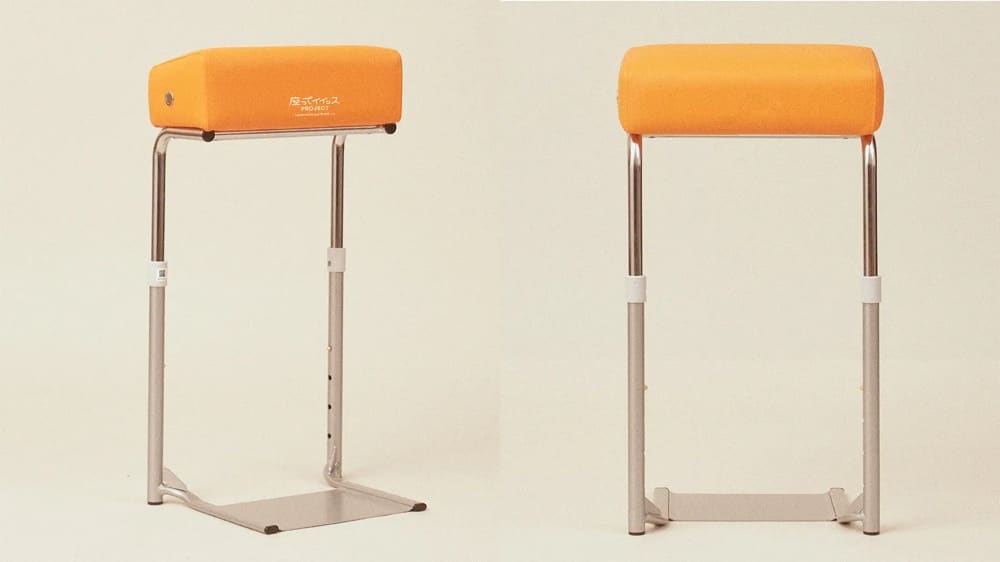
Mynavi Baito Chair: Hiding the fact that you are sitting
Journal: What features did you emphasize in designing the Mynavi Baito Chair?
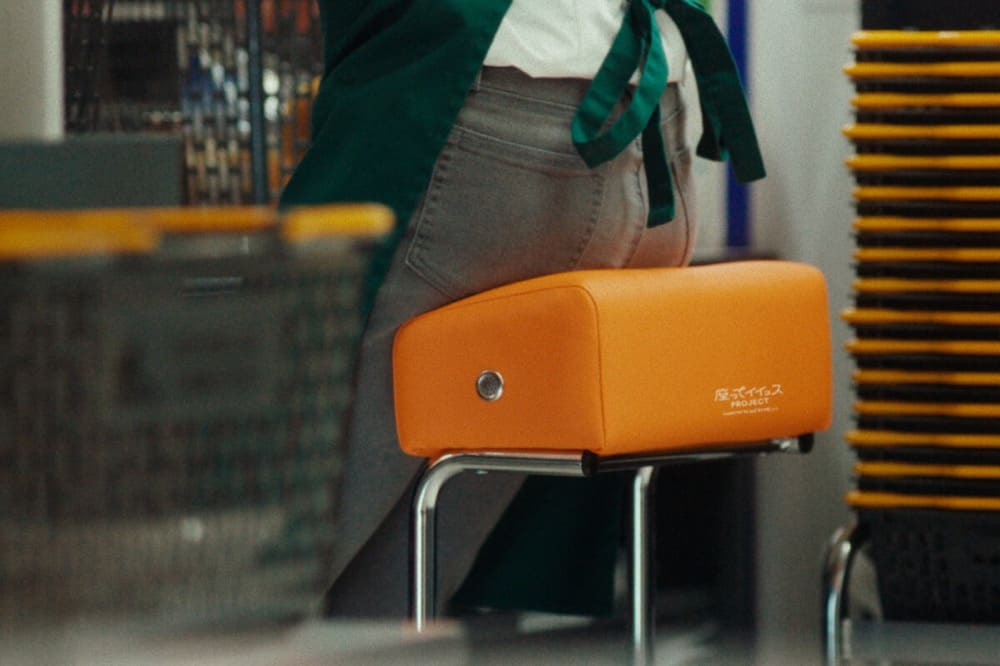
Suzuki: We prioritized making it easy for stores to adopt. We focused on the size, making it small enough to be used in all types of work spaces and still ensure stability when workers are sitting on it. We also insisted that, while it should be a chair, it should be designed in such a way that workers can use it to rest a bit but not appear to be sitting.
Since the custom of sitting while dealing with customers has not yet taken root in Japan, I believe many employees will worry about what customers will think. While I believe that eventually, it will be all right to shift to chairs that allow clerks to fully sit down, we settled on the current design because we got feedback that chairs that would allow for just a brief rest would be easier to use in workplaces where employees have to repeatedly stand up and sit down.
In addition, the height of the Mynavi Baito Chair can be set between 60 and 75 centimeters, allowing it to be adjusted to an individual worker’s height as well as the height of the cash registers.
Starting on March 28, 2024, Mynavi Baito Chairs have been introduced on a trial basis in six retail businesses, mainly at Don Quijote stores, and we are continuing to improve them based on the feedback we receive.
Journal: What do you think are the benefits in terms of hiring as well as employee workstyle and health that can be ensured by allowing employees to sit while they deal with customers?
Suzuki: Obviously, it would alleviate fatigue and create an environment in which it would be easy for anyone to work. We have not seen any major changes in hiring styles yet, but I imagine that introduction of the Mynavi Baito Chair will reduce the physical strain on employees. This could lower hurdles to employment for pregnant women and elderly people who, until now, even if they wanted to work, had to avoid jobs where they had to stand. It could also make it possible for them to work longer.
Journal: What kind of feedback have you received from the businesses that have participated in the trials?
Suzuki: We surveyed each of the companies that participated in the trial introduction of these chairs and some of the responses included comments from workers suffering from back pain or menstrual cramps saying that the chairs made it much easier for them to work. We also heard from healthy employees that it is hard to stay on their feet, so having a chair nearby that they can rest on briefly makes them feel less fatigue.
While at first, they worried about negative feedback from customers, they said that they didn’t receive any negative comments during the trial period. All the same, some still worried about customer perceptions.
One of the managers of a participating company told us, “My generation always took it for granted that we had to stand while working, so this project made me rethink work styles. Going forward, I’d like to keep making innovations to make it easier for employees to work.”
I would like to think that one of the achievements of this project is the impact it has had on people with discretionary power.
Journal: Have you done anything else to promote understanding of the concept of sitting while serving customers?
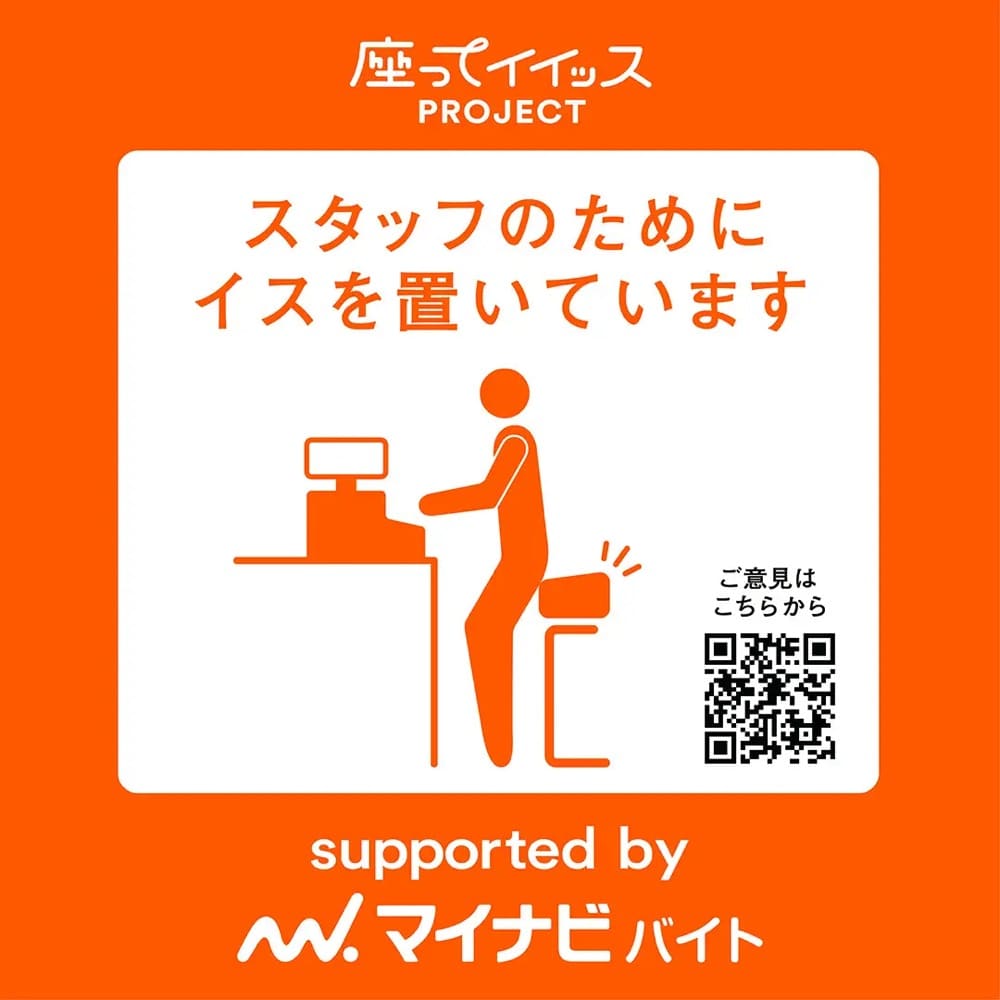
Suzuki: We have. We printed flyers and stickers explaining the aims of this project and have asked stores to put them up as part of our consciousness-raising campaign.
We have also posted consciousness-raising videos about the project on the company’s social media accounts and are increasingly adding “OK to sit while serving customers” to the remarks section of the job listings on our site as we continue to strive to promote this workstyle value.
In fact, I’ve heard that the number of applicants has increased as a result of our including “OK to sit while working” in our job listings. I expect that if we see more such concrete results, more and more companies will want to start using these chairs.
In order to further promote the use of Mynavi Baito Chairs, we are planning on increasing the range of sizes and types of chairs we offer, since the amount of space available to place chairs differs according to the store. We are therefore moving ahead, in consultation with the manufacturers involved in developing the chairs, in our efforts to make it possible for anyone to sit while serving customers.
Workstyles change with the times. It is important not to be afraid to adjust to them by trial and error
Journal: I feel that these days, the dress codes for employees are much freer than they were in the past. Why do you think that might be?
Suzuki: I think the biggest factor is the labor shortage. In the past, body piercings were forbidden, hair was supposed to be dark brown or darker, and there were various other strict rules about employee appearance. Yet even so, it seems they were able to fill positions in those days.
However, times have changed and there is a shortage of people looking for work. In addition, workplaces that have stricter dress codes tend to get fewer applicants for job openings. In fact, the looser the guidelines on hair style and color and so on for a job, the greater the number of applicants.
Today, people value being able to be themselves as much as possible at work. So, companies probably have had to change to adapt to this trend.
Journal: What can each of us do to help make this a society in which anyone finds it easy to work?
Suzuki: I think businesses should not be afraid of repeated trial and error.
In carrying out this project, I noticed that while many employers want to make it easier for their employees to work, many do not actually go so far as to implement policies to do so. This goes back to what I said before about sitting while working. I think everyone probably thinks that it should be all right for people to sit on the job, but many employers might stop short of allowing it because no one else is doing it. That’s why working conditions don’t improve.
There may be other complicating factors such as the cost of implementation that come into play, but I believe that improving working conditions leads to improved efficiency and better outcomes. I believe the place to start is to carefully listen to voices from the workplace.
I personally feel it is therefore important to actively create spaces for employers and employees to exchange opinions. New insights can be gained when people of different generations exchange opinions, and this can lead to deeper mutual understanding.
Journal: Do you plan to expand the OK to Sit Project beyond the realm of cash registers and other retail sites?
Suzuki: Actually, we have heard that workplaces like factories and hospitals where many workers have to remain standing are considering introducing Mynavi Baito Chairs.
We have also added an opinions section to the dedicated OK to Sit Project website so that employees as well as employers can give us feedback. We hope that this will help us pick up on workplace problems and use this to start projects that will create win-win situations for both employers and employees.
Editor’s Note
Although it used to be taken for granted that people working in the service industry would have black hair, today, no one raises an eyebrow at clerks with fashionable hair colors.
Likewise, we imagine that the day may come in the near future when we will not look askance at clerks sitting while serving customers and even come to wonder why they used to have to stand.
There are many social rules that we take for granted but that could be broken without causing trouble to anyone. This interview helped us notice the importance of questioning things we take for granted.
Text: The Nippon Foundation Journal Editing Department