Guide Dogs as Vital Partners in the Daily Lives of Persons with Vision ImpairmentVolunteer shortage demands an urgent solution
Key Points
- Guide dogs assist persons with vision impairment with their mobility, in turn encouraging them to enjoy independence and an active role in society.
- The guide dog program is made possible by the cooperation of various types of volunteers, but the program is still short of assistance.
- Reaching out to people in difficulty will help create a society that leaves no one behind.
For persons with vision impairment, going out on a quick errand may not be that simple.
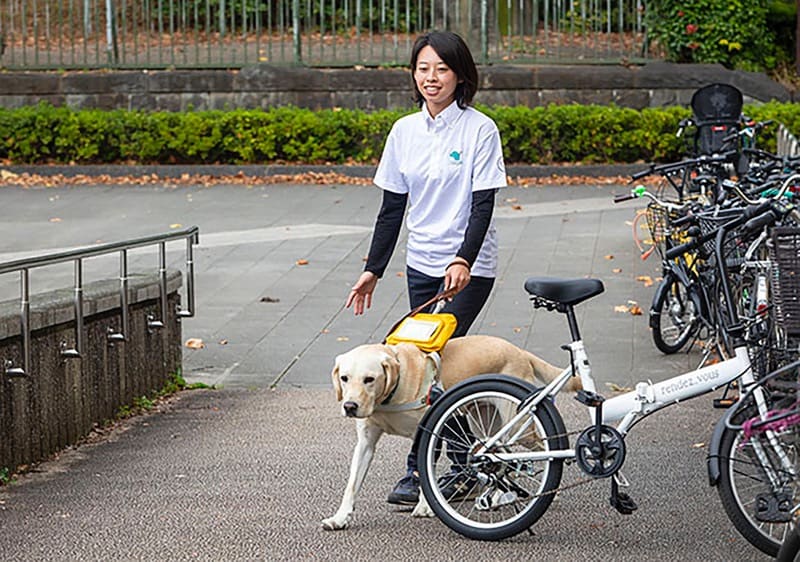
Guide dogs are crucial partners for persons with vision impairment. A guide dog not only ensures that their handler reaches their destination safely but also plays an important role in encouraging them to enjoy independence and play an active role in society.
And yet there are not generally a lot of opportunities to learn more about guide dogs. We spoke with Yuka Okuzawa, who works in public relations and communications for the Japan Guide Dog Association (JGDA) (external link), and found out more about guide dogs and recent developments and issues.
Guide dogs’ primary role in supporting persons with vision impairment
The Nippon Foundation Journal Editing Department: Most people are probably aware that guide dogs are there to support persons with vision impairment. But what does this specifically entail?
Yuka Okuzawa: There are 11 guide dog training organizations across Japan, and the specific support the dogs are trained to provide vary slightly from one organization to another. But the majority of guide dogs are trained to provide persons with vision impairment with the information they need to get around on foot — navigating, for instance, street corners, intersections, steps, or obstructions. There are also dogs that are able to guide their handlers up to ticket gates at train stations or the entrances to buildings.
A common misconception is that guide dogs are trained to learn routes and bring their handler to specific destinations, but that is not the case. Remembering the way is the handler’s job. The guide dogs’ main role is to provide their handler with information while they are en route.

Journal: There is another category of assistance dogs known as mobility service dogs, which help persons who have physical mobility issues. How do mobility service dogs differ from guide dogs?
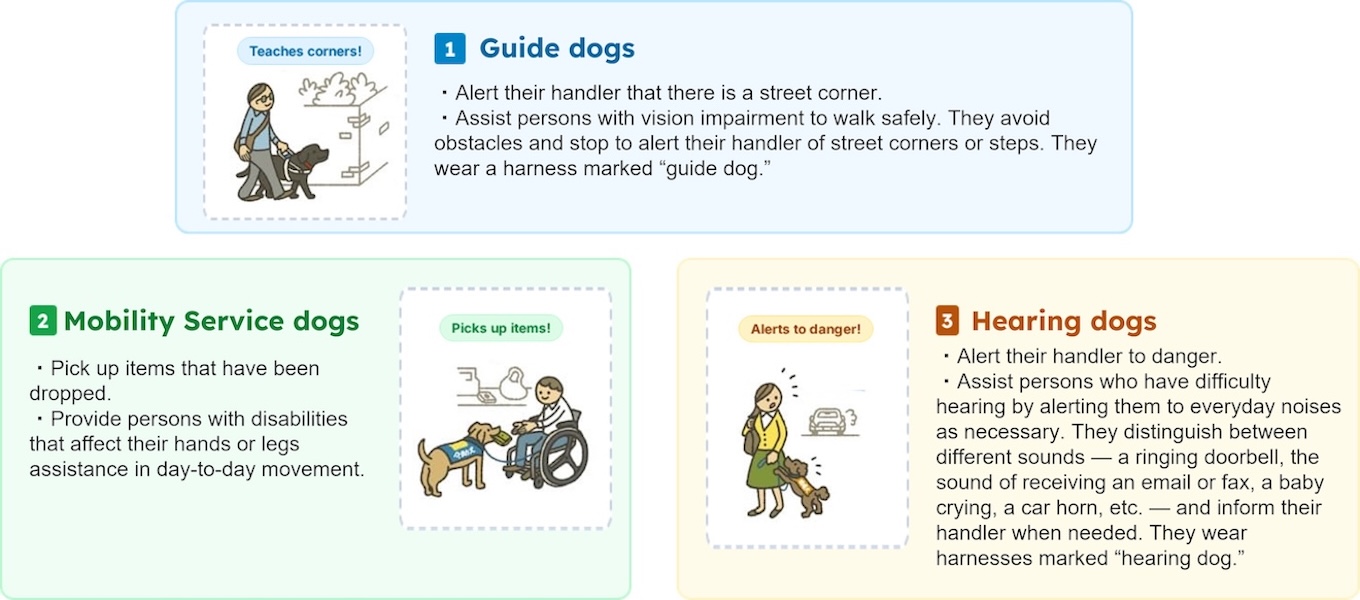
Okuzawa: Mobility service dogs and guide dogs are similar in the sense that they both support persons with disabilities. However, in Japan, while guide dogs (moudouken), mobility service dogs (kaijoken), and hearing dogs (chodoken) are collectively referred to as “assistance dogs for persons with disabilities” (“assistance dogs” for short), each of the three types has a different role.
The main task of mobility service dogs is to support persons who have difficulty moving their limbs by helping with everyday movement. This might include fetching a bottle or cell phone or picking up something that has been dropped.
Hearing dogs assist persons with difficulty hearing by distinguishing between different sounds — a ringing doorbell, a car horn, or emergency alarm, for example — and alerting their handler.
Journal: So, guide dogs are a type of assistance dog. Are there restrictions on which particular breeds are able to become guide dogs?
Okuzawa: There is no set breed of dog that can become a guide dog. At the same time, a small dog may not be physically strong enough to make the human handler recognize their movement when they want to stop or alert their handler to go around an obstacle. This is why it is typically preferred for large dog breeds to become guide dogs.
Given the need for the dog to communicate with humans, many guide dog breeds are former hunting dogs. The majority of guide dogs are Labrador retrievers. Golden retriever, shepherd, and collie are also common guide dog breeds.
Volunteers are essential for raising guide dogs
Journal: It must take various kinds of training for a dog to be able to assist as a guide dog. How are the dogs raised?
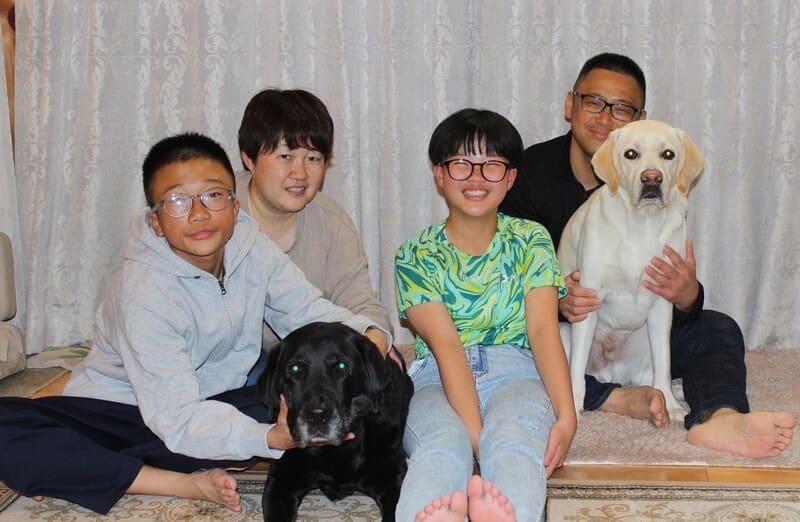
Okuzawa: Candidate guide dogs are the offspring of breeding dogs owned by JGDA and those from other organizations or overseas. From two months after birth to around one year of age, they are looked after by volunteers known as “puppy walkers,” where they build the relationships that they need to live in comfort alongside humans and learn the rules of the home.
This time spent building a close relationship with the puppy walkers is very important as it allows them to grow to love being with humans. The candidate dogs then part ways with the puppy walkers, and their training as a guide dog begins.
Journal: How long does it take to train a guide dog?
Okuzawa: It takes around a year on average. They make their debut as guide dogs when they are around two years old, but the length of training varies considerably from one dog to another. They each have their own individual personality, so some may be quick to learn, while others learn little by little, for instance.
The trainers follow a training plan that has been drawn up to suit each individual dog. At the same time, not all candidates become guide dogs. Dogs that have been determined unsuitable as guide dogs during their training due to temperament or health issues are known as “career change dogs” and are adopted by registered career change dog volunteer families. Around 30 to 40% of the candidates become guide dogs.
Journal: The percentage of candidates that actually become guide dogs is surprisingly low. Roughly how many volunteers are involved in raising them?
Okuzawa: In April 2024, there were around 3,000 volunteers involved in raising guide dogs. There are several different types of volunteers: volunteers who assist in the care of breeder dogs that will produce future guide dogs; puppy walkers who raise the guide dog candidate puppies; volunteers who take on the career change dogs once it has been decided they will not become guide dogs; and volunteers who look after retired guide dogs. However, like the guide dogs themselves, the volunteers are relatively limited in number, which has currently led to difficulty in stably maintaining efforts to raise guide dogs
Journal: There are probably many people who are interested in volunteering to raise guide dogs but are hesitant because they have never had a dog before. Would they also be able to volunteer?
Okuzawa: Provided they fulfil certain criteria — not being a single person household and not often away from home, among other requirements — anyone can volunteer. There are many cases of families working together to volunteer as puppy walkers.
The puppy walkers have the dogs for a short period of around one year, so it is really worth considering volunteering.
The issues: Guide dogs being refused entry to stores and lack of awareness of rehabilitation programs for persons with vision impairment
Journal: So, guide dogs are crucial partners for persons with vision impairment. But apparently there are stores or restaurants that refuse guide dogs entry.
Okuzawa: That’s true. In a survey we conducted here at JGDA in 2023, 44% of respondents said that their dog had been refused entry at some point. In the majority of cases it happened at a restaurant, followed by on public transport.
While the percentage of people who had experienced an access refusal decreased temporarily during the COVID-19 pandemic, the fact is that there are still many incidences of establishments refusing entry.
Journal: Why are guide dogs refused access to some stores or restaurants?
Okuzawa: We think it may be because many people aren’t aware of the Act on Assistance Dogs for Persons with Physical Disabilities,* or are concerned that allowing access will require them to provide special treatment.
Proprietors sometimes contact us here at JGDA with their queries and in most cases, they are understanding when we explain that there is no cause for concern, because the guide dogs wait quietly at the feet of their handlers inside the store. Guide dog handlers also tell us anecdotes of staff praising the guide dogs for their good behavior and welcoming them to come back, so understanding toward guide dogs does seem to be growing little by little.
- Under the Act on Assistance Dogs for Persons with Physical Disabilities, stores, hospitals, and other establishments open to the general public are obliged to allow assistance dogs access to accompany a person with disabilities. The person with disabilities accompanied by the assistance dog is obliged to control the dog’s behavior and ensure hygiene. The dog must be marked as an assistance dog in a way that is clear for those around to identify.
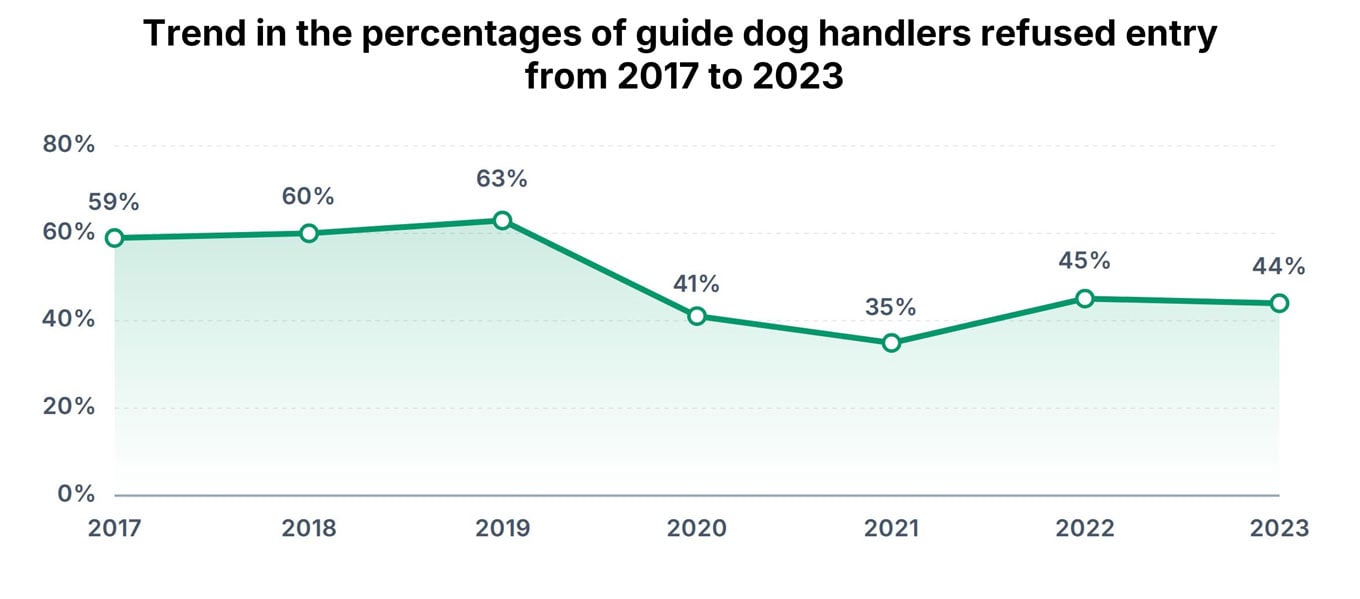
Source: Has Disability Discrimination Been Eradicated? Report of Current Trends in Refusal of Entry to Guide Dog Handlers; Press Release from Japan Guide Dog Association (external link, in Japanese)
Journal: What other issues does JGDA feel need to be addressed?
Okuzawa: There are also many persons with vision impairment who are unsure how to apply for a guide dog.
JGDA receives all kinds of queries, not only about applying for a guide dog, but also issues like not knowing how to apply for the identification booklet that is issued to persons with physical disabilities, persons who are losing their vision and want to find out what kinds of welfare services are available, and people who need information but don’t have a clue where to even direct their inquiries.
JGDA has a department that is exclusively focused on rehabilitation programs aimed at improving quality of life for persons with vision impairment (external link, in Japanese). The department’s job is to provide these people with information and work toward finding solutions to the issues they face. In addition to offering training for walking with a guide dog, it also provides rehabilitation training aimed at improving the quality of day-to-day life as a whole, and in some cases, it introduces those who need assistance to the relevant organizations in their local area.
Many of the people we provide information to tell us they wish they had known about it sooner, which made us acutely aware that information is still not reaching persons with low vision. We are happy to receive any kind of query, no matter how trivial it may seem.
Journal: We knew about the guide dog facilities but didn’t know that such an inquiry service existed. Are there any initiatives that JGDA as a whole is pursuing to solve the issues of refusal of access of guide dogs, lack of volunteers, or information failing to reach persons with vision impairment?
Okuzawa: We currently hold seminars and lectures for businesses, government bodies, and schools. Guide dogs have recently been included as subject matter for school textbooks, so there are more opportunities for us to visit schools and actually give classes. In 2023 we held classes for over 300 schools, or 450 schools in total when including online classes.
On the weekends, we also hold events at large commercial facilities, where we conduct demonstrations and distribute materials that introduce the role of guide dogs, with the aim of making guide dogs and persons with vision impairment a more familiar presence.
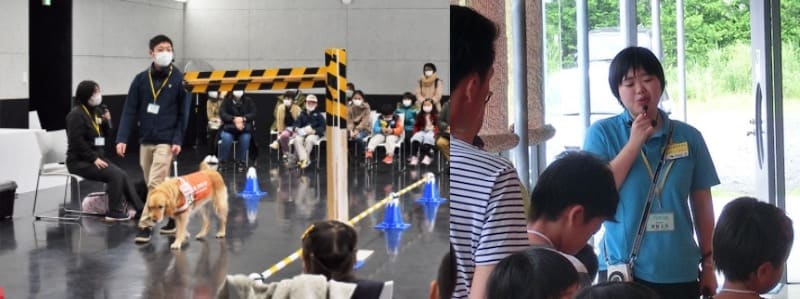
“Can I help?”: The simple question that contributes to a society that leaves no one behind
Journal: There are also people who say they don’t know how to interact with guide dogs. Please explain the best way to act around a guide dog.
Okuzawa: There is no need to interact with a guide dog. Some people may try to touch, whistle to, or feed a guide dog when they see one, but it is best to avoid distracting a guide dog. Guide dogs love people, so they will be friendly to people even if they are meeting them for the first time. If that were to happen near a step or intersection, it could inadvertently develop into a dangerous situation. Please just observe them quietly from afar so as not to distract them from doing their job.
Journal: What must we do as individuals in order to help create a society that is more comfortable for guide dogs and persons with vision impairment?
Okuzawa: When people who rarely come into contact with persons with vision impairment or guide dogs suddenly have such an opportunity, it is understandable that they don’t know what to do. But it is a shame if — like those who refuse guide dogs access — they reject them out of insecurity.
If you see a person accompanied by a guide dog or with a long cane at a busy intersection, the best thing you can do is take the initiative to approach them and perhaps ask if everything is ok or if they need help.
Reaching out like this and initiating communication will help toward creating a society that takes the needs of persons with vision impairment into consideration.
Editor’s Note
We were touched by Ms. Okuzawa’s encouraging words: “if you know very little about persons with vision impairment, then all the more reason to show interest and take the initiative to interact with them.”
It is not covered here, but another topic that occurred to us during the interview is the issue of touch screens. Since the COVID-19 pandemic, it is more common to order and pay via touch screens, and yet some screens are apparently not designed to be accessible for persons with vision impairment.
What is convenient for one person may be a source of inconvenience for another. This interview has also prompted us to consider what it means to create a society that is convenient for everyone. We are acutely aware that creating a society that leaves no one behind will require an open ear to feedback from all kinds of different people.
Text: The Nippon Foundation Journal Editing Department