Sasakawa Ryoichi: A Life
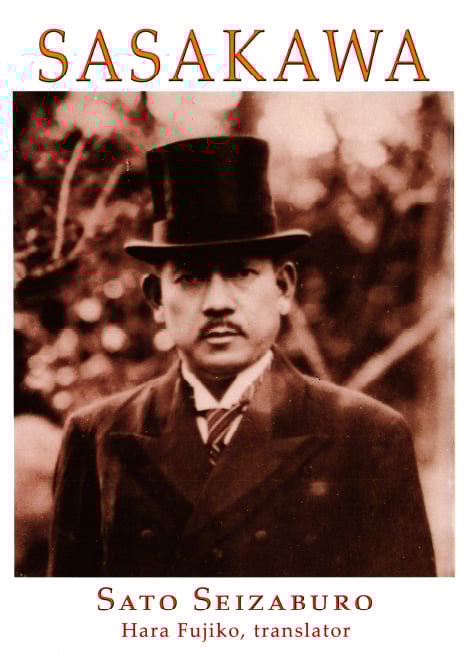
Sato Seizaburo
Translated by Hara Fujiko
Originally published in 2006
Access the Full Text
- Book Cover (PDF / 434KB)
- Entire Book (PDF / 15MB)
- Chapter 1: From Childhood in Meiji Japan … To Patriotism in the 1930s … To Wartime Membership in Parliament (PDF / 873KB)
- Chapter 2: The Hero of Sugamo Prison (PDF / 1MB)
- Chapter 3: A new role as a god of wealth: From motorboat racing to philanthropy (PDF / 929KB)
Introduction: The Man Who Overcame the Modern Japanese Dilemma
Sato Kenji
SASAKAWA RYOICHI: A LIFE is a critical biography of the man who established The Nippon Foundation, along with numerous other organizations including the Sasakawa Peace Foundation, Museum of Maritime Science, United States-Japan Foundation and Sasakawa Health Foundation. His name is held in high esteem as a world-class philanthropist overseas, although this fact is little known in his home country.
Sato Seizaburo, my late father, wrote the book from the summer of 1997 to the spring of 1998. More exactly, he spoke it; ever since word processors (the forerunner of PCs) became available in the mid-1980s, Dad—allow me to call him this way—had me hit the keyboard and type down the words. Dad was a slow writer, and he always had a pretty busy schedule.
By 1997, I was an author of four books and an award-winning play myself. I had my own prose style, which naturally seeped in. Furthermore, Dad asked for my opinions regarding the content of the book. Suggestions were welcomed, and a number of them got incorporated into the work.
This is not a claim of co-authorship. SASAKAWA, for all intents and purposes, remains a Sato Seizaburo book. However, the voice within these pages is a hybrid. Reading it, for me, is a unique and eerie experience—I hear Dad talking, but he sounds like me.
Like son, like father, or so to speak.
Personal impressions and recollections aside, SASAKAWA RYOICHI: A LIFE contains certain features that are absent in Dad’s other works. Being a serious scholar, Dad preferred an “academic” approach in whatever he chose to discuss. He always adopted an objective perspective and remained cool and composed in his analysis. But the tone of this book is quite different.
While giving fairness of argument its due respect, Dad simply couldn’t contain his passion for conveying Sasakawa’s greatness to the reader. In the book’s Postscript, Dad himself admits to how he warmed to Sasakawa as his research progressed.
This book is a tribute, or even a valentine, to the man. What resulted is an engrossing biography that draws the reader inexorably into the world of its subject. This then begs the question: What was it in Sasakawa that Dad found so enthralling?
The key to unraveling this mystery lies in the book’s subtitle. The English edition that appears on this website takes a very simple subtitle: A LIFE. But the phrase Sato, my father, chose for the original Japanese edition was more radical, even off the wall. Namely: EMISSARY FROM ANOTHER DIMENSION.
SASAKAWA RYOICHI: A LIFE is a legitimate critical biography and does not contain anything that would place it in the category of the occult or science fiction. Nevertheless, Dad felt compelled to append this unusual subtitle. One must presume that for Dad, the greatness of Sasakawa lay in his otherworldliness.
But then, what was so outré about this man?
Moral Slogans from the Outer Limits
Dad was not the first to notice something otherworldly in Sasakawa. In fact, the phrase “another dimension” was taken from an essay by Hoshi Shinichi, renowned author of over a thousand imaginative short stories.
During the 1970s and 1980s, the Japan Shipbuilding Industry Foundation (predecessor of The Nippon Foundation) ran a series of TV spots showing Sasakawa marching with children singing nursery rhyme-style songs that highlighted a variety of moral slogans. Each spot would end with a thunderous proclamation, “Ichi-nichi ichi-zen (One good deed a day)!”
This may sound perfectly fine, even commendable. What could be wrong about advocating moral behavior on television anyway? And yet Hoshi wrote he was flabbergasted when he saw these TV spots (known back then as “Sasakawa commercials”) for the first time, feeling as if he had landed in another dimension. He explains why.
TV ads, Hoshi argued, are for selling something and earning a profit. Not for nothing are they called commercials. However, the TV spots of the Japan Shipbuilding Industry Foundation did not try to sell anything and were only repeating moral slogans. The contradiction they harbor was downright oxymoronic—commercials without any commercial intent.
But, or perhaps for that very reason, the “Sasakawa commercials” were unforgettable. They were the most indelible spots to be aired in Japanese television history, and thus qualify as the greatest masterpiece of public relations. But this further compounds their contradiction: the commercials that were not at all commercial stood as the greatest masterpiece of public relations, or advertisement.
By now it should be clear why Hoshi felt he had landed in another dimension when confronted with the Sasakawa TV spots. They indicated an alternate world in which moral rectitude was more marketable than goods or services. This concept, needless to say, is poles apart from the socially accepted idea of what sells and what doesn’t; seen this way, Sasakawa’s moral slogans did come from the outer limits.
For the record, it was me who knew the Hoshi essay and told Dad about it, although little did I imagine he would pick the phrase “another dimension” and use it as the subtitle of his book. In other words, Dad also caught a glimpse of an alternate world, a better one than the world we live in, through Sasakawa. Here’s a translated quote from the Preface he wrote for the original Japanese edition of the book (p.vii).
“The subject of this book is Sasakawa Ryoichi, the man – his way of life and his thoughts… It is my contention that understanding his life and thoughts can shed valuable light on unraveling a series of major problems that trouble our nation. That is: Why is it so difficult for Japan to produce creative leaders capable of pioneering paths in new directions? What are the difficulties that such leaders face? What are the issues that beset Japan’s intellectuals and mass media?”
Contrary to what we see abroad, Sasakawa’s reputation in Japan is not particularly a good one. But what if this assessment could be changed? Wouldn’t that facilitate the emergence of a second and third Sasakawa, which in turn would help make Japan a better country?
These were the thoughts that enthralled Dad. He saw Sasakawa Ryoichi as a messenger from an alternate and better Japan, arriving on the scene to preach the gospel of social reform. And what better way to describe such a man than as an emissary from another dimension?
Modern Japan and Its Existential Crisis
The alternate Japan that Dad glimpsed through Sasakawa is more than a land where moral rectitude is highly marketable. It is a Japan that overcame the existential crisis caused by the defeat of World War II in 1945.
The national identity of modern Japan was a shaky one to begin with. During the final years of the Edo Period, the country was forced by the United States to open itself up to the world; consequently, many felt the urge to fight against and expel the Western powers bent on colonizing Asia. However, given the gap in technology that existed between Japan and the West, it was apparent that such uprising was doomed to fail.
Thus a new strategy was devised. Japan was to strengthen itself through modernization and westernization. And when it became powerful enough, the expulsion of the West would be carried out.
It was a highly pragmatic solution to the situation Japan found itself in, and became the driving force of the Meiji Restoration. Nevertheless, for all its practical merits, this strategy was deeply self-contradictory. The road to self-affirmation was now paved with self-denial.
World War II, for Japan, was a means for resolving this contradiction. By becoming the regional hegemon, it would establish its own sphere of influence, then known as “The Greater East Asia Co-Prosperity Sphere.” The days of Western colonial rule would come to an end, and Japan would finally establish a fully integrated national identity. In fact, when the attack on Pearl Harbor took place, quite a few intellectuals lauded it as the consummation of a long-held goal that went back to the Meiji Restoration.
Unfortunately, the war ended in utter defeat. Reconstruction was impossible without American aid, making dependency and subordination inevitable. But the United States was Japan’s principal adversary in war; moreover, it was the very country that had forced Japan to end its seclusion! Japan had to lower itself further to the depths of self-denial and self-abnegation.
This existential crisis rendered Japan’s postwar national identity even shakier than before. In order to survive, and hopefully thrive, under Pax Americana, Japan had to repudiate its past, especially the years it had spent challenging the United States and other Western nations. However, since the expulsion of the West was the tacit goal of modernization, this meant that Japan now had to completely deny all its history that came after the Meiji Restoration.
At the same time, modernity itself could not be rejected. Affirming a national identity based on the realities of the Edo Period or even earlier periods of Japanese history was out of the question. Incidentally, General Douglas MacArthur, Supreme Commander for the Allied Powers, declared at the ceremonies of surrender that he stood reminiscent of Matthew Perry. Perry was the naval officer who forced Japan to open its ports in the 1850s.
In a nutshell, Japan was compelled to completely deny the nation that existed before 1945. Such historical amnesia can’t help but make the Japanese national identity shallow and superficial. It was inevitable that a conservative backlash—usually labeled as the “right-wing shift”—would occur.
The problem with this backlash was that it offered no solution to the existential crisis of 1945. Because postwar Japan had been founded upon a denial of the past, such conservatism could only result in a denial of the present: an empty celebration of illusive national glory that had nothing to do with the current state of the country. Such emptiness, in turn, reinforced the notion that there was no alternative but to deny the past.
This, then, is the modern Japanese dilemma: the fundamental incapability of establishing a stable national identity. No wonder novelist Oe Kenzaburo, in 1994, titled his Nobel Prize lecture “Japan, the Ambiguous, and Myself”.
Sasakawa, however, was an exception. He managed to overcome this dilemma. That was, for Dad, the essence of his otherworldliness; that was what enthralled him so much.
The Integrity of Patriotic Philanthropy
Before World War II Sasakawa was the leader of an organization called the Patriotic People’s Party, and was known as a right-wing nationalist. After the war, he rose up under the banner of “The World Is One Family. Human Beings Are All Brothers and Sisters” to dedicate himself to various forms of social contribution supported by the revenues of the motorboat racing business. Since the late 1960s, when Japan had completed its recovery from the ravages of war and was on its way to become an economic superpower, these activities took on the form of global philanthropy.
Right-wing nationalism is often associated with jingoistic chauvinism and xenophobia, and rightly so. It would be reasonable then to assume that Sasakawa emerged from the cauldron of Japan’s military defeat to betray his former self, or to have at least experienced some form of conversion. But Dad denies this, saying “He went against the stream and was consistent in this regard, both before and after the war.” (p. 24) This claim is repeated several times in the book.
Sasakawa’s patriotism rested squarely on an egalitarian tenet that loving one’s country meant bringing happiness to the masses. This tenet would gradually evolve into the belief that Japan should take the initiative in the emancipation and the salvation of the people of Asia suffering under the yoke of Western colonial rule. Such a notion, of course, was not original in itself; “liberation of Asia” was the advocated cause of establishing the Greater East Asia Co-Prosperity Sphere.
What was unique about Sasakawa was that he expanded this notion even more after the surrender of Japan. I quote from SASAKAWA RYOICHI: A LIFE.
“He had been concerned from prewar days for the whole world, and not just for the Japanese people. Before the war he believed that if necessary Japan should use military force to undermine Western colonial domination of Asia and thereby bring about the liberation and independence of non-white peoples in the region. After the total defeat of Japan in World War Two his thinking underwent a complete change. He dreamed of renouncing the world’s arms to save humankind forever from the scourges of war.” (p. 128-129)
It should be noted that this type of cosmopolitan sentiment was also common among left-wing intellectuals in postwar Japan. But in their case, the sentiment was directly linked to the denial of the past, and in particular to the rejection of patriotism. Sasakawa’s global philanthropy was perfectly compatible with his patriotism. Throughout his life, he admired the Emperor, remained critical against anti-nationalistic sentiments, and insisted the Japanese constitution, especially Article 9 (which declared renunciation of war), should be changed.
In other words, Sasakawa managed to maintain his integrity over the existential crisis of 1945. I find it telling that the longest chapter of the book (Chapter 2, in the English edition) covers the immediate postwar years, a period in which Sasakawa voluntarily became a Class A war criminal (in his zeal to defend Japan in court) and was incarcerated in a prison located in Sugamo, Tokyo. It was during the Sugamo Prison years that Sasakawa developed his patriotic philanthropy and fully became the man we know: emissary from another dimension.
Here I would like to point out something not mentioned in the book: the striking similarity between Sasakawa’s Sugamo experience and “the Hero’s Journey.” This concept, popularized by American author Joseph Campbell, refers to a story pattern universally observed in myths.
During the journey, the hero must enter a realm beyond everyday life. In this realm exists the fundamental source of all life force, known as the “World Navel.” The task of the hero is to unlock this source and release its flow into the rest of the world. Through accomplishing this task, the hero is himself transformed; he becomes the master of life.
Patriotic philanthropy was not the only thing Sugamo Prison awakened in Sasakawa. He referred to the prison as “Sugamo University of Supreme Life Mastery” (translated as “Sugamo Best University of Life” in the book), of which he named himself president. In other words, he claimed that this was the very place where ultimate truths of life could be learned. Some cellmates asked for a diploma when they were about to be released; Sasakawa happily granted their requests.
Even the idea for developing a motorboat racing business came to him from a magazine article he read while being incarcerated. Sugamo Prison was indeed his World Navel.
Principles, Privileges and Social Innovation
The reason why Sasakawa was able to overcome the modern Japanese dilemma is actually quite clear. From a young age, he had a very strong sense of mission – a deeply rooted belief that he had been born to clean up the world and make it a better place, and that it was his sacred duty to constantly make the greatest effort toward fulfilling this mission.
Such a person is immune to existential crisis even when his country suffers a crushing defeat. Granted, Japan failed to become a regional hegemon; but that does not mean the necessity to create a better society was also gone. The loss of millions of lives and the impoverishment of the entire country only called for an even greater effort to be made. Doubling down was the natural response.
It could be argued then that Sasakawa didn’t have to struggle with the modern Japanese dilemma in the first place. His personal identity existed on a higher plane—if not in another dimension. This also explains why Sasakawa was disliked in his own country, especially by intellectuals and the media; his very existence made them feel unstable, and hence, uneasy.
The sense of mission, i.e. his principles, led Sasakawa to a very austere lifestyle, despite the immense wealth he managed to accumulate. Never did he enjoy the privileges that came along with worldly success. And he was actually happy living such a life, finding it fulfilling.
Near the end of SASAKAWA, Dad empathizes this last point by comparing it to a short story by Hoshi Shinichi about a man who lives under almost identical conditions (the reader should have no trouble figuring out who knew this story and told him about it). Hoshi portrays it as pure hell, a fine example of truth being stranger than fiction.
Postwar Japan, on the other hand, chose to deny the dilemma itself. It had abandoned the fundamental principle of building a stable national identity in its pursuit of the privilege of prosperity. No doubt this was the more convenient path to take if Japan were going to cooperate with the United States–or, more frankly, become its dependent. Had the nation instead opted to overcome the modern Japanese dilemma, its economic recovery and growth quite likely would have been delayed.
But one must heed the warning of Dwight Eisenhower: “A people that values its privileges above its principles soon loses both.” By the 1990s, Japan had lost sight of where it was going and would wander aimlessly before finally entering its current trajectory of decline. This, in my opinion, was the inevitable consequence of its earlier choice.
It is fitting that SASAKAWA RYOICHI: A LIFE has become available again on The Nippon Foundation website. Not only because Sasakawa established the organization back in 1962, but also because his kind of spirit is what we need as the foundation of social innovation, the building of a better world to live in. Given the current situation of the world, the necessity of such innovation is surely not limited to Japan.
So here it is. How the man lived, what he dreamed. Share the hope and share the future. After all, Sasakawa was a staunch optimist.
- Note: The Postscript of SASAKAWA RYOICHI: A LIFE erroneously credits the author of this article as “(Sato) Takeshi ” (p.217). The correct name is Kenji. Furthermore, it compounded the error by describing him as the eldest son of Sato Seizaburo. Not quite; Kenji was the only child.
Ⓒ2026 Sato Kenji. All rights reserved.
Access the Full Text (As listed above)
- Book Cover (PDF / 434KB)
- Entire Book (PDF / 15MB)
- Chapter 1: From Childhood in Meiji Japan … To Patriotism in the 1930s … To Wartime Membership in Parliament (PDF / 873KB)
- Chapter 2: The Hero of Sugamo Prison (PDF / 1MB)
- Chapter 3: A new role as a god of wealth: From motorboat racing to philanthropy (PDF / 929KB)