What Does an ‘All-Inclusive Society’ Look Like?How SOLIT’s Misaki Tanaka is using fashion to make this dream a reality
Key Points
- There are people around the world who face restrictions on the clothes they can wear due to disabilities, gender, religious beliefs, and other factors.
- SOLIT designs and produces semi-customized clothing that “anyone can wear freely, comfortably, and to their individual preferences.”
- SOLIT aims to realize an all-inclusive society where no one and nothing is left behind, taking into account both diverse individuals and the global environment.
Are you familiar with the term “inclusive design”? Inclusive design is a design approach that ensures diverse individuals — who are often overlooked when considering conventional products and services due to factors such as age, gender, disability status, background, or beliefs — can lead fulfilling lives. Starting from the earliest stages of the design process (planning, market analysis, requirements definition, and design), this approach ensures that the needs of diverse users are incorporated throughout the development phase.
Fashion brand SOLIT (external link, in Japanese), featured in this article, takes this a step further through what it calls “all-inclusive design,” incorporating users even earlier in the process. Guided by the slogan “creating an all-inclusive society where no one and nothing is left behind,” SOLIT is committed to creating sustainable fashion that takes into account the needs of not only diverse individuals but also the global environment.
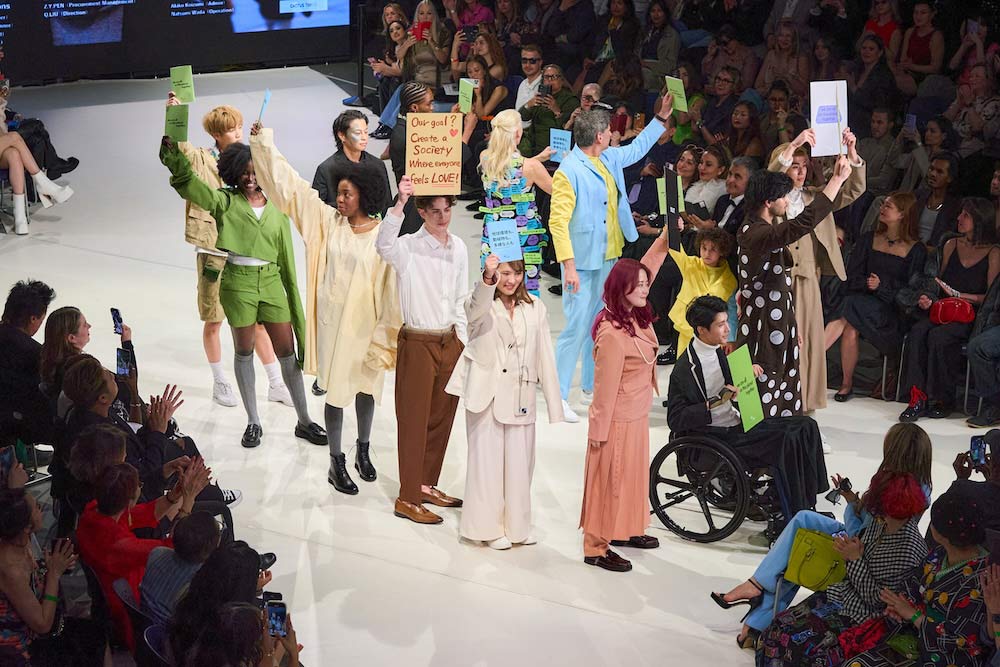
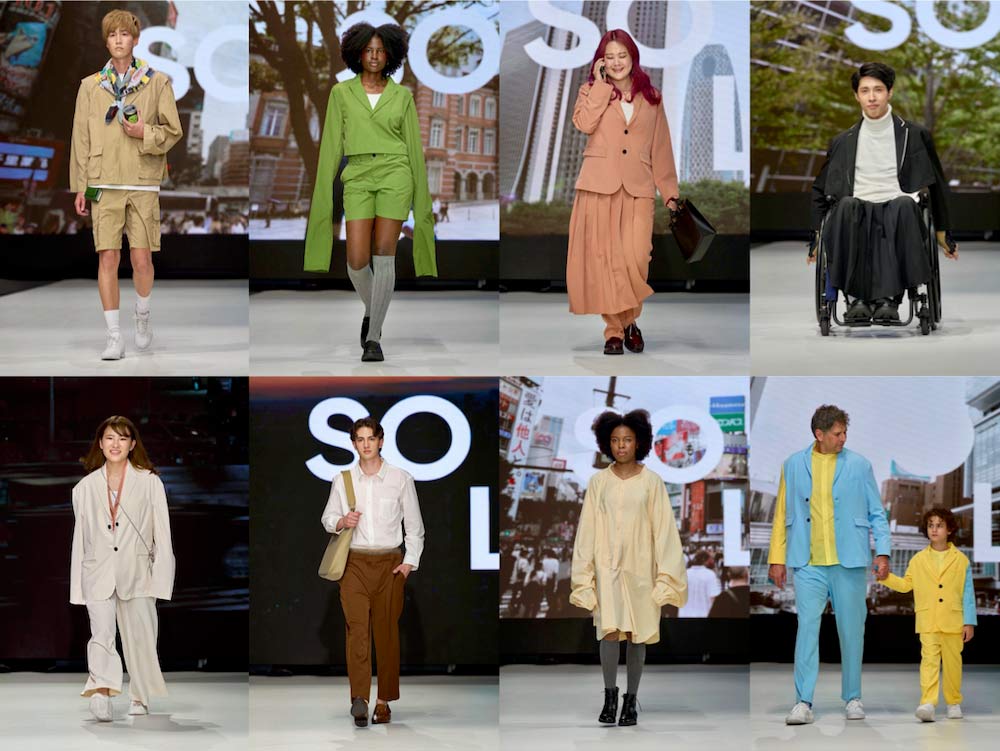
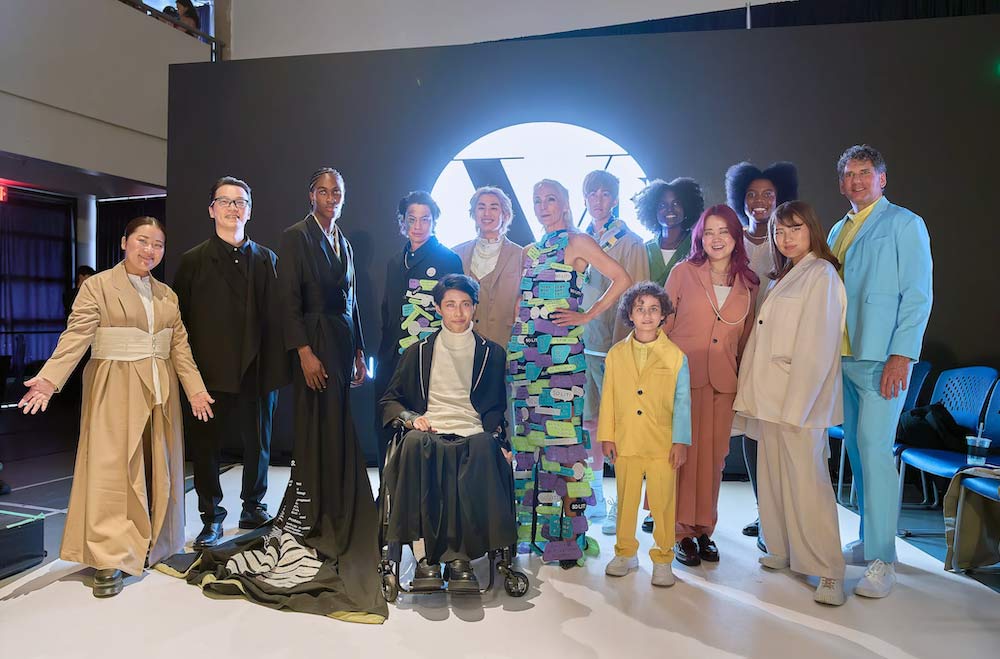
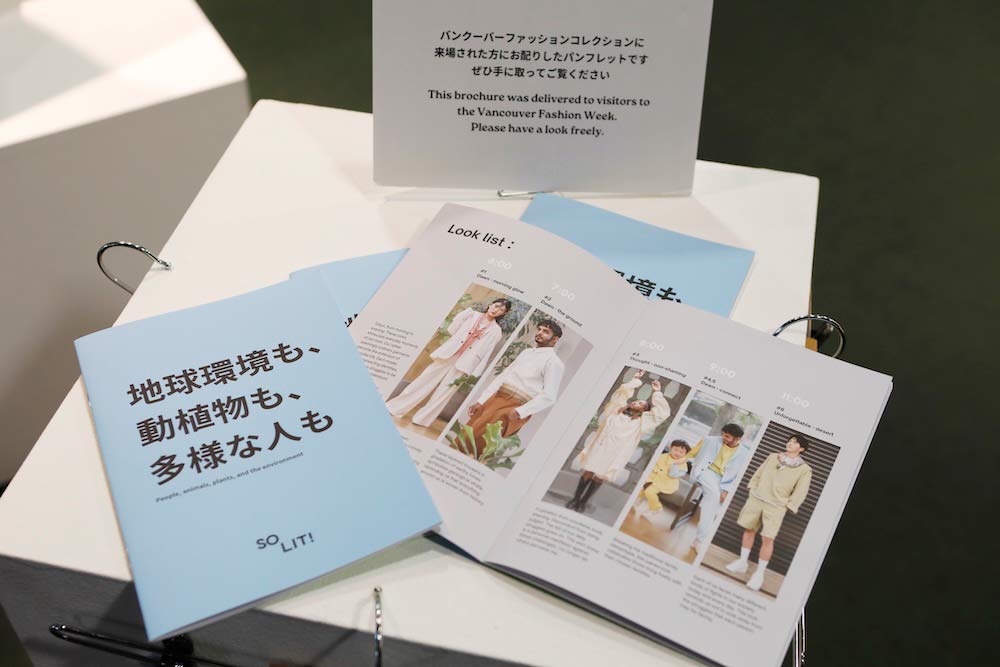
On April 23, 2024, SOLIT debuted on the runway at Vancouver Fashion Week (VFW) (external link, in Japanese), held in Vancouver, Canada — a city known for its diversity. The brand’s runway performance, featuring models from a range of backgrounds, attracted widespread attention.
We spoke with SOLIT founder Misaki Tanaka about the company’s vision of creating an all-inclusive society, as well as her thoughts on the future of the fashion industry and business.
Ms. Tanaka has led several ventures as a social entrepreneur. Following her experience of the Great East Japan Earthquake that struck northeastern Japan in March 2011, she founded Bosai Girl, a collective of young women with the shared vision of making disaster preparedness a natural part of everyday life, where she led disaster awareness initiatives through to 2020. In 2018, she also established morning after cutting my hair, Inc. (external link, in Japanese), a PR firm focused on solving societal challenges, through which she has continued to address a wide range of societal challenges.
Custom designs born from dialogue with diverse individuals
The Nippon Foundation Journal Editing Department: You have led several initiatives, starting with Bosai Girl. When did you first desire to contribute to society through your work?
Misaki Tanaka: When I was in elementary school, the first occupation I wanted was to be a child welfare officer*.
It wasn’t that I was a beneficiary of welfare myself, nor did I have friends from particularly difficult family environments. But watching a television drama, I realized that there were children growing up in completely different circumstances from mine, even though we were living in the same era.
From there I learned that there was a profession of child welfare officer that exists to support children in difficult circumstances, and I thought, “I want to help, too.” This was what first drew me to social issues, and my interest grew from there.
- A child welfare officer provides consultation services to parents and guardians regarding child protection and welfare, and assists in resolving the challenges they face.
Journal: So, you were drawn to societal challenges at a young age. What led you to found SOLIT?
Tanaka: It started with an assignment I received in graduate school, which I had enrolled in out of a desire to reexamine how societal challenges could be addressed within a capitalist society. The assignment was to think about something you are deeply passionate about.
This was right after I dissolved Bosai Girl, so I was starting from zero. As I clipped and gathered photos of things I liked, contemplating what I wanted to do next, I noticed images of clothing and of a grandmother hugging a child. Looking at them, I realized I wanted to help people find greater happiness from wearing clothes.
When I discussed the idea with my classmates, I learned that there were people who faced limits in their choice of clothing due to factors such as paralysis in their hands, or religious restrictions. Reflecting on my own experience, I realized that growing up I, too, had been unable to wear the clothes I liked due to my plus-size figure.
As a child, I assumed that I had no choice but to choose from the available options. But as I grew older, I came to understand that there were underlying issues behind this, such as structural issues in the fashion industry and corporate systems focused solely on producing whatever clothes could be sold in large quantities. I was convinced that these issues needed to be addressed.
Journal: SOLIT’s products stand out for the wide range of sizes available and the ability to customize features such as buttons and the length or width of sleeves. How did these designs come about?
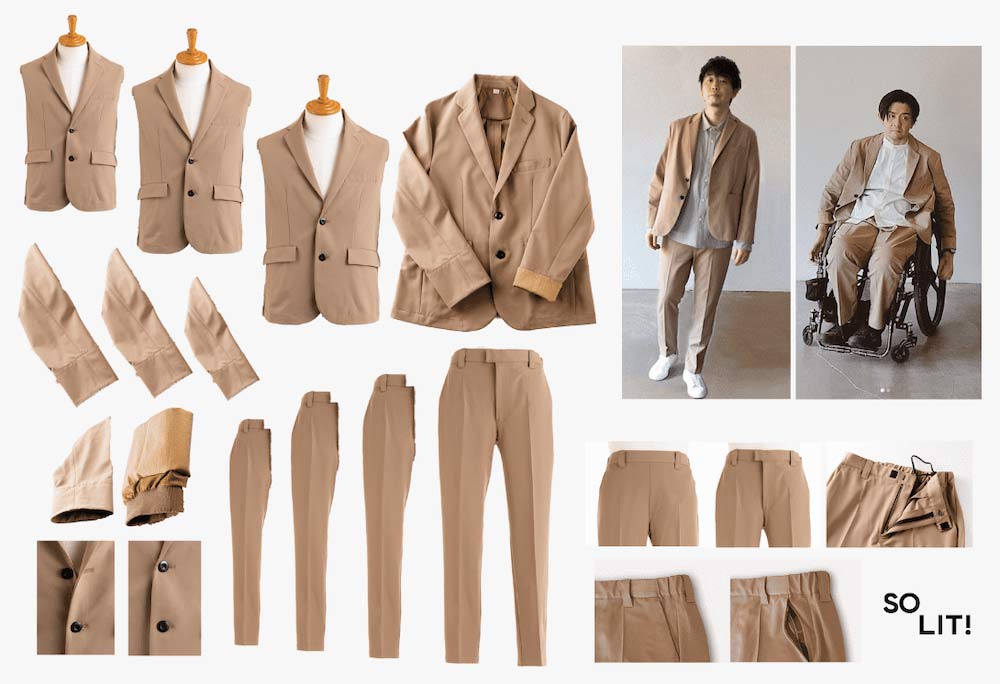
Tanaka: We apply inclusive design principles to everything we do, from our management to product development. We bring together diverse members from the planning stage, exchanging ideas as we develop products.
When project members who found fashion a challenge said, “I can’t wear clothes that are only available in standard small, medium, and large sizes,” this led to the idea of offering 14 sizes. Then we heard, “Simply making the size larger or smaller doesn’t mean it will fit well,” which led to the idea, “What if people could customize each part themselves?” This is how we arrived at the concept of designs that allow for high levels of customization, such as selecting different sizes and lengths for the right and left sleeves, or choosing buttons.
However, fully custom-made clothing would be too expensive. So, we worked closely with our factory team to achieve prices that people would feel were within reach and worth paying for an item of clothing they could wear and cherish for a long time.
Journal: What type of “diverse members” are involved in SOLIT, and what do you focus on in your manufacturing process?
Tanaka: Our members include people with visible disabilities, such as wheelchair users, as well as those with unseen disabilities such as mental health challenges. There is also incredible diversity in attributes such as age, skills, body types, living environments, cultural backgrounds, communication styles, religious beliefs, and sexuality. We bring together the strength of each member to create new concepts.
However, I don’t think it is possible to create something that resonates with people 100% of the time. So, there is a constant dilemma — are we creating something that might end up as waste? I believe it is important to always keep this perspective in mind, and to incorporate it into our decision-making process at every step.
Delivering what is needed, to those who need it, in the amount needed
Journal: So, this approach also takes into account the global environment and human rights.
Tanaka: I feel that the ability to buy whatever you want, whenever you want, will only accelerate current trends toward mass production, mass consumption, and mass disposal.
This is why we made a conscious decision not to operate physical stores. Instead, we are entirely made-to-order, and ask our customers to wait about 45 days from order to delivery. This also allows us to reduce costs without compromising quality.
However, I recently discovered SOLIT clothing being resold on a major flea market site. This made me uneasy. Even if our clothes are reaching diverse users and helping solve their challenges, if they are no longer wanted after a short time, what impact does this have on the global environment?
Even if we help solve human challenges, neglecting the environment felt wrong.
So going forward, we plan to shift to irregular, limited-time sales. We want to create items that people feel they truly need and want, while also fostering an environment to ensure the items we make are used and cherished for a long time.
Journal: Could you explain again what SOLIT’s “all-inclusive” vision involves?
Tanaka: When people talk about diversity, there is a focus on the diversity of humans, but the diversity of other living things and the global environment is often overlooked. In Japan, issues such as the societal inclusion of people with disabilities, older people, and women receive attention, but things like racial discrimination, religion, immigration, and refugees are rarely discussed.
On the other hand, discussion about sustainability tends to focus almost exclusively on the environment, without questioning whether this makes life easier for diverse people.
Sometimes, solving one problem creates other, separate problems. We shouldn’t overlook this.
For us at SOLIT, an all-inclusive society is one that considers diverse people, animals and plants, and the global environment — a society where no one and nothing is left behind. Our goal is not to make money — we want to highlight ethically questionable practices and play a role in building ways for people to collaborate beyond conventional boundaries.
We also hope to apply the knowledge and experience we have gained through our initiatives to help other companies promote diversity and inclusion, and to assist in developing new businesses and services.
Journal: What response have you received from the people who have worn SOLIT’s clothing?
Tanaka: One customer I will never forget was a man who told us, with tears in his eyes, “This is the first time in my life I’ve been able to wear a jacket.” He had always wanted to dress up smartly to meet his daughter, but until then had only ever worn loose, pajama-like clothes.
Clothing is sometimes referred to as a “second skin,” and I believe that wearing a particular outfit can give people courage or lift their spirits. For people who have carried a negative image of themselves or endured feelings of sadness, clothing can nurture their souls and enrich their lives. To me, this is the true power of fashion.
Expanding the network of diverse members through Vancouver Fashion Week
Journal: Tell us about VFW. I hear you were invited by the organizers — why did you decide to participate?
Tanaka: To be honest, at the time I wasn’t very enthusiastic about joining as I had a negative image of fashion shows as events designed to promote mass consumption. But VFW is the only fashion show themed around diversity, and the organizers allowed us to participate as a one-off appearance. So, we decided to take part just once — not to sell clothes, but to showcase the society we hope to realize via a 10-minute runway appearance.
Journal: You chose to raise funds for VFW through crowdfunding.
Tanaka: While we needed funds for travel and preparation, at the same time we wanted to increase the number of “allies” who resonated with our vision and to convey the message: “To realize an all-inclusive society, your support is essential.” This is why we decided to conduct a crowdfunding campaign (external link, in Japanese). We were very fortunate to reach our initial goal of 500,000 yen in just three days. In the end, 104 people extended their support, allowing us to reach our next goal of 2 million yen.
Journal: What did your VFW performance feature?
Tanaka: Our concept was “It’s wonderful! — I know!”(IT’S SOLIT! — Duh!). The show was set against the backdrop of Tokyo’s Shibuya district, depicting the flow of a day from 6 a.m. to midnight.
We could have hired all our models locally in Vancouver, but this wouldn’t have allowed us to truly express the fashion we had created, which allows diverse individuals to customize designs to match their personal preferences and body types.
So, of the 14 models in the show, seven, whom we selected through open auditions and other means, joined us from the planning stage and helped build the show together.
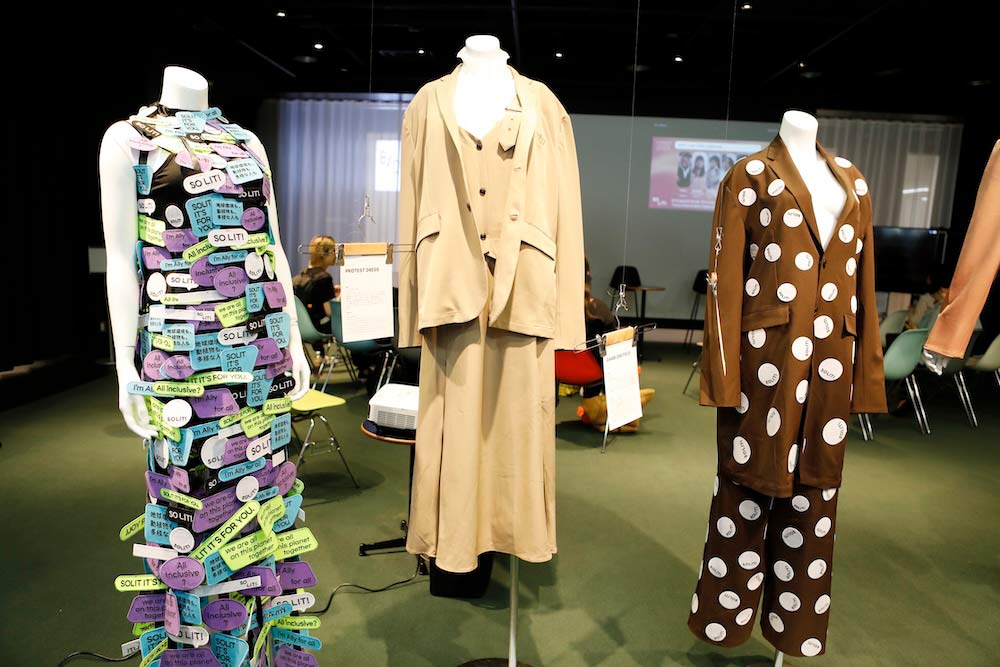
Each collection had its own story, such as dresses covered with miniature protest placards, or white dotted patches representing overflowing feelings. The show conveyed the image of a protest unfolding from morning to night, expressing what each member involved felt about fashion.
Journal: During the finale, everyone held up placards ― almost like a protest march.
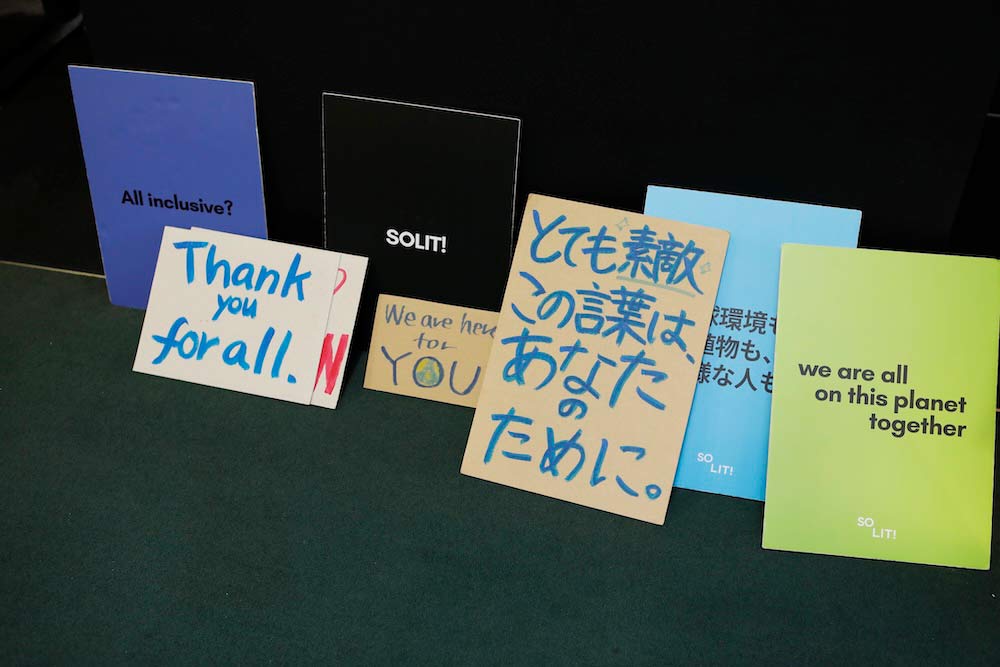
Tanaka: Our placards only used gentle language. Protest signs often feature combative phrases like “Stop this!” or “No more such-and-such!”
While it is important to express your stance, those on the other side may have circumstances that prevent them from changing. That is why we used our placards to convey messages like, “Why don’t you come and join our world?” and “We’re doing this for you.”
Journal: That is a wonderful message. What kind of initiatives do you think society needs to achieve the all-inclusive society SOLIT advocates in its mission?
Tanaka: Our society tends to place high value on people who are highly productive or can generate money effectively. However, I truly believe we need evaluation criteria that extends beyond this.
I have a grandmother who is always there to listen to me or offer me snacks. She might not be efficient or generate profits, but to me, she is irreplaceable — more valuable than money or anything else.
I hope we can create ways to properly value and recognize these types of contributions to people’s happiness and well-being.
Journal: Finally, what can we as individuals do to help build an all-inclusive society?
Tanaka: I would say to start by “not turning a blind eye” to the issues in society.
You might worry that speaking up could offend or hurt someone, or that you might fail. I think this fear leads many people to turn a blind eye even when they feel something is wrong. But if we keep turning away from problems, we can’t have a meaningful discussion and our society won’t change.
Rather than attacking others one-sidedly, we should engage in dialogue. If we fail, we apologize, and if we succeed, we praise each other — it feels as though building this type of basic relationship has become more difficult in recent times. So perhaps start with something simple, like complimenting someone once a day.
Editor’s Note
Ms. Tanaka’s commitment to engaging in dialogue between individuals in order to “leave no one and nothing behind” and her comment that “Although there might be friction, speaking up is better than doing nothing” left a lasting impression.
Through this interview, I learned that many people face limited fashion choices for a variety of reasons, and how issues that myself, my friends, and my family may have simply accepted as “inconvenient but unavoidable” might actually be changeable. This realization gave me hope.
Why not start by listening closely to the challenges faced by those close to you, and thinking together about how we could make lives even a little more comfortable? Speaking with Ms. Tanaka, I felt that a kinder, more inclusive society lies beyond.
Text: The Nippon Foundation Journal Editing Department
Photo: Emi Enishi
Profile
Misaki Tanaka
Born in 1988. After graduating from Ritsumeikan University, she led an information support service for evacuees displaced from Fukushima Prefecture following the Great East Japan Earthquake. In August 2013, she founded Bosai Girl, a women-led disaster preparedness awareness initiative working under the slogan “updating disaster preparedness.” This initiative earned her the Minister of Economy, Trade and Industry Encouragement Award at the 32nd Human Power Awards (now JCI JAPAN TOYP).
In February 2018, she founded morning after cutting my hair, Inc., a PR firm focused on solving societal challenges, where she serves as CEO. In September 2020, she founded SOLIT Corporation, where she also serves as CEO, with the aim of realizing an “all-inclusive economic zone”.