Students Learn the Realities of Today’s Fisheries and Serve Their Food at a RestaurantIntroducing the Blue Camp
Key Points
- Over the past 40 years, Japan’s fisheries production has fallen to less than one-third of what it was. A crisis in fishery resources is becoming a serious issue.
- The Blue Camp is a project in which students of the next generation learn about, reflect on, and put into practice ideas for the future of the ocean, guided by four top chefs from Tokyo and Kyoto.
- By eating fish dishes while learning about the current state of the ocean and the fisheries industry, people have an opportunity to see it as something that concerns them personally.
The Blue Camp (external link, in Japanese) is a project where students learn, think, and take action, together with top chefs, about the future of the ocean and food.
Chefs for the Blue (external link), an NGO that promotes awareness initiatives in pursuit of a sustainable ocean, launched this project with grant support from The Nippon Foundation’s Umi-to-Nippon Project (The Ocean and Japan Project) (open in a new tab, in Japanese) with the aim of developing the next generation of people involved in the ocean and fisheries.
Students selected from across Japan spend three months learning directly from stakeholders about the realities surrounding the ocean, fisheries, and distribution. In the final program, as a forum for sharing what they’ve learned, they open a limited-time pop-up restaurant with support from top chefs.
In the second year of the program (FY2024), a total of 15 students participated, eight on the Tokyo team and seven on the Kyoto team.
This article highlights the Tokyo pop-up restaurant held in August 2024. We also spoke with Hiroko Sasaki, Executive Director of Chefs for the Blue and a food journalist.
“How do we keep eating fish 100 years from now?” Members wrestle with the question, without an easy answer
In August 2024, the Blue Camp opened its pop-up restaurant for a limited six-day run.
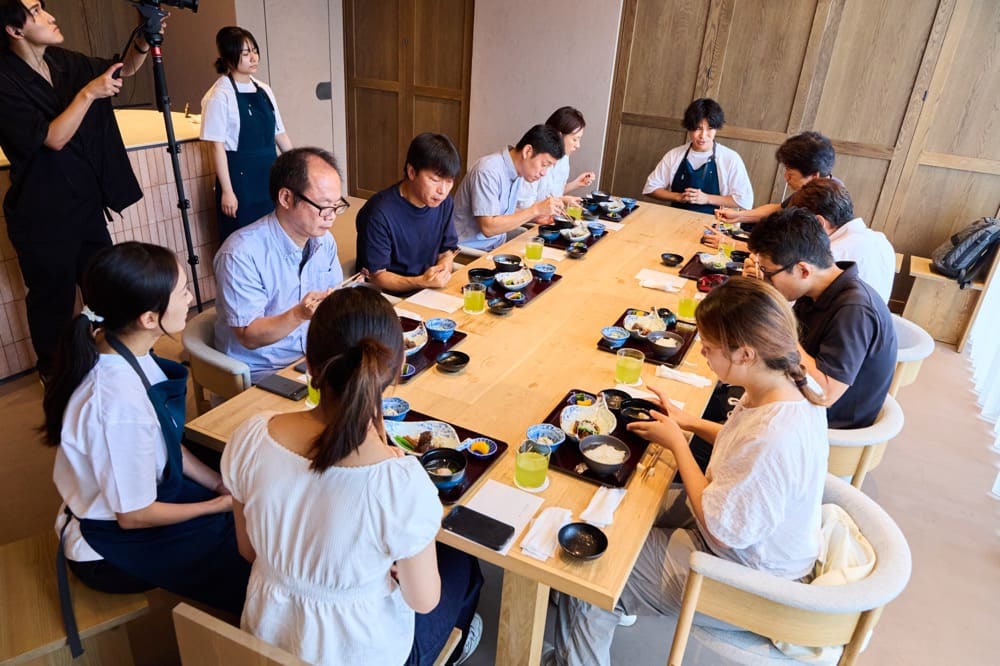
At the venue run by the Tokyo team, guests were served a menu created around the theme “ao-no-ima (the blue now),” focusing on the ocean today, fisheries today, and distribution today.
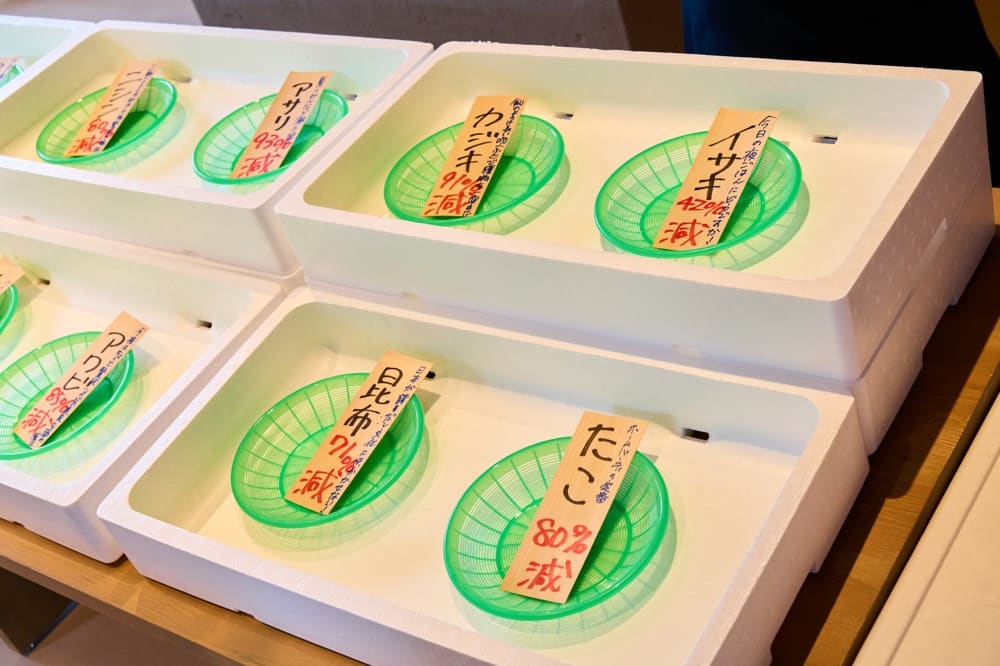
The venue also featured displays on the history of fish consumption, as well as materials illustrating the current state of the ocean and the fisheries industry.
Through a range of programs, including touring fishing ports and fish auctions, meeting with set-net fishers, and more, many members encountered the workings of the fisheries distribution system firsthand. They say they were stunned to learn that Japan’s fisheries production has fallen to less than one-third of what it was over the past 40 years.
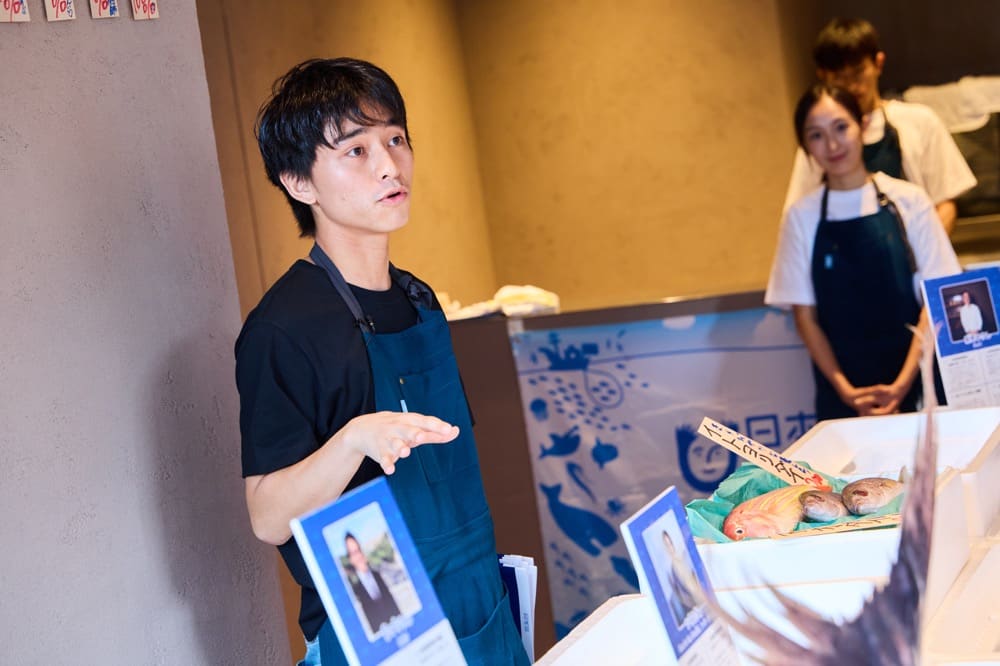
After the meal ended, one member, Waku Yasunaga, began speaking to guests about the importance of fisheries resource management,* emphasizing that “fish are not an infinite resource.”
- Fisheries resource management: Managing and rebuilding fish stocks to support more stable fisheries operations. It also includes maintaining and rebuilding stocks in surrounding waters through international negotiations.
Reference: [Explainer] How Should We View Amendment of the Fisheries Act for the First Time in 70 Years? | WWF Japan (external link, in Japanese)
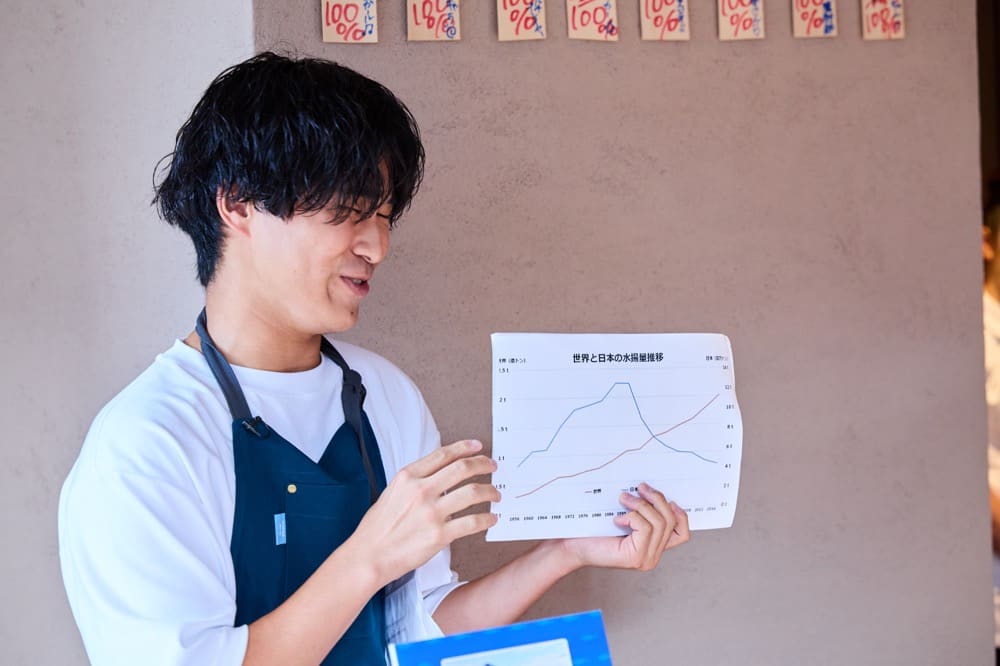
“Major causes of declining catches include global warming, marine pollution, and overfishing. Yet global fisheries production is increasing. In Norway, known as a major fisheries nation, they’ve worked on resource management by setting catch quotas per fishing vessel based on scientific evidence.”
“If Japan is to continue fishing sustainably, we need resource management. There are those who ask whether restricting catches would cost fishers their income. But if we keep taking fish as we are now, a future where we can’t catch any at all is entirely possible. Resource management is essential to keep fisheries viable.”
Daisuke Tanaka added that the team also wrestled, through repeated discussions, with what they should communicate through the pop-up restaurant.
“We shared ideas around the theme of how we can keep eating fish 100 years from now. To do that, we first need to pass on Japan’s fish-eating culture. And to sustain that culture, as I mentioned earlier, we need resource management. That led us to ask how everyday consumers can become more mindful of resource management.”
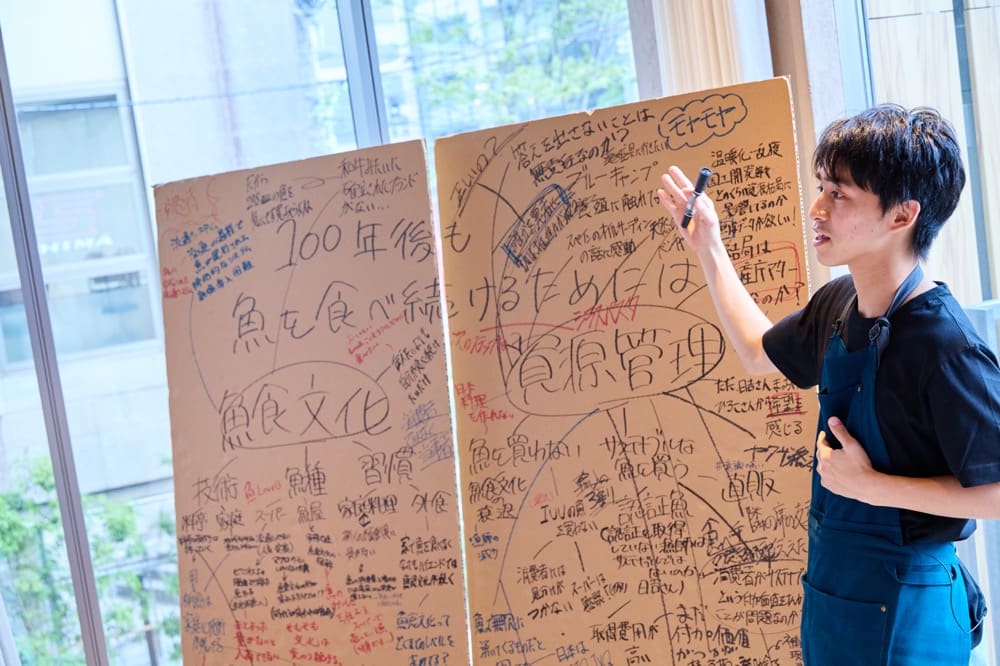
“Based on the Fisheries Act, which was revised for the first time in 70 years in 2018, efforts are underway to strengthen resource management. But deciding which fish to manage and coordinating with producers is entirely the Fisheries Agency’s role.”
“When we thought about what consumers can do, we discussed whether people should choose seafood caught by eco-certified fishers. But certification is costly for fishers, and in the first place, few consumers currently see enough added value in eco-labels.”
“Another idea was to avoid buying illegally caught fish. But it’s estimated that 30% of seafood caught globally comes from illegal, unreported, and unregulated (IUU) fishing, so it’s possible you’re buying illegally caught seafood without even realizing it.”
“In the end, we couldn’t come up with a clear answer to the question of what we should do to keep eating fish 100 years from now.”
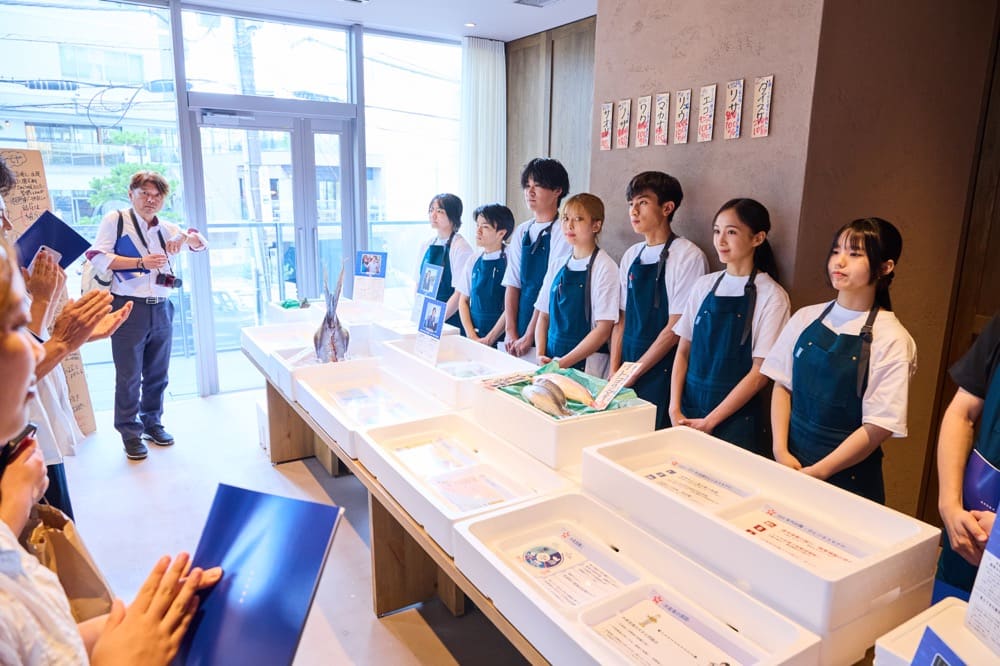
They closed by appealing to guests: “If we can share what we struggled with and couldn’t find an answer to, we hope it helps you understand what’s happening in the ocean today and sparks even a little interest.”
“We’re cheering for you” makes it feel like someone else’s problem. We want you to act with us, facing the same direction
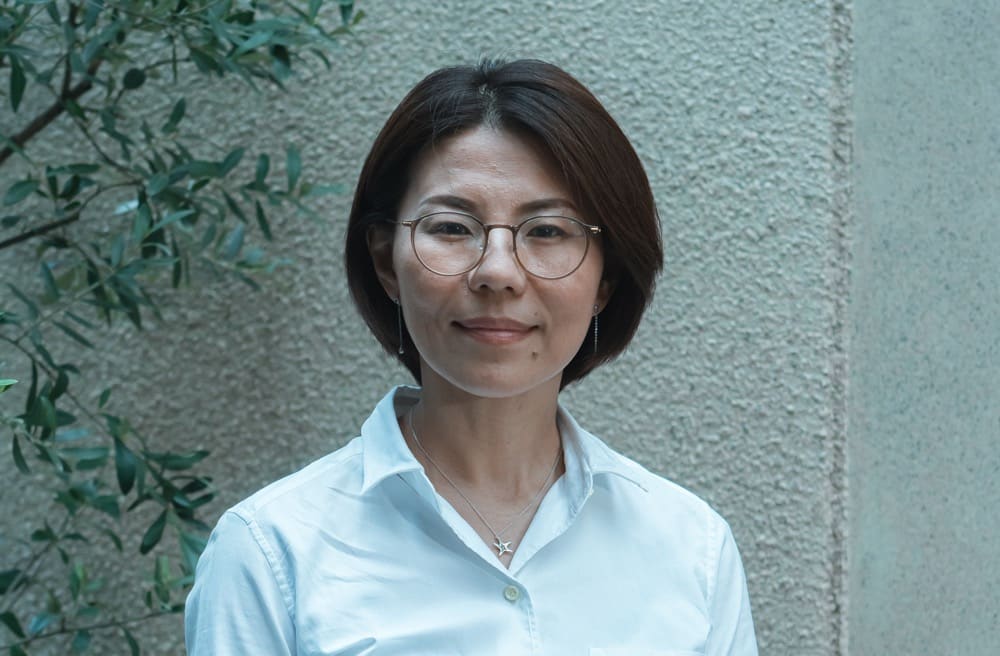
The Nippon Foundation Journal Editing Department: Now we’ll speak with Hiroko Sasaki, Executive Director of Chefs for the Blue. To start, what led you to found Chefs for the Blue?
Hiroko Sasaki: A few years ago, I learned for the first time through on-site reporting in fishing communities that fish stocks were continuing to decline, and I was shocked. I felt we were headed in a bad direction and had to do something. I reached out to chefs I already knew, and in 2017 we started a study group. That was the beginning of Chefs for the Blue.
Since then, we’ve run awareness initiatives for a wide range of audiences, including producers, distribution, restaurants, consumers, and others, to protect Japan’s fishery resources and carry food culture into the future. Out of a desire to work with the next generation who will live alongside the oceans of tomorrow, we created the Blue Camp.
Journal: In the Blue Camp, students board fishing boats to observe set-net fishing up close, visit fish markets, speak with officials from the Fisheries Agency, and experience many other parts of the fisheries industry. After restaurant training, they handle everything at the pop-up restaurant themselves, from designing the menu to cooking and serving. How did this concept come about?
Sasaki: Through conducting various activities, one of the challenges that I began to feel was that the seafood supply chain was so complex that few people could see the whole picture.
If we want to leave fishery resources for the future, fishers, distributors, retailers, and consumers need to understand one another and take action in the same direction.
So, in this project, we built the program around having participants see each part of the seafood supply chain firsthand, experience it, and engage in dialogue with the people involved.
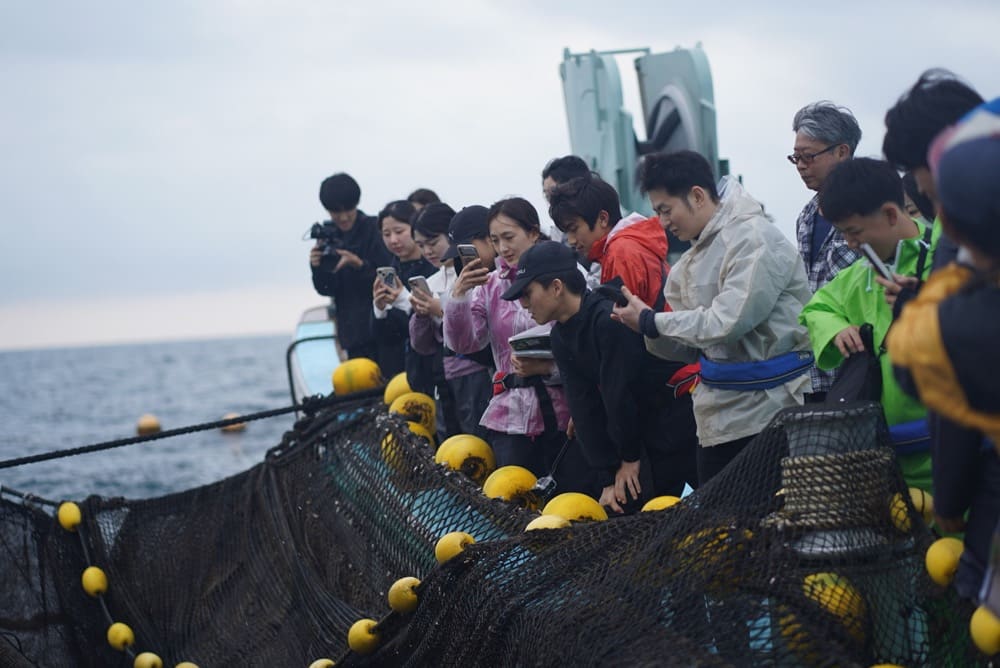
Sasaki: I also believe restaurants are a form of media, places that can connect producers and consumers. Because they hold so much potential, we chose a restaurant as the program’s final destination, hoping to share the many stories surrounding the fisheries industry.
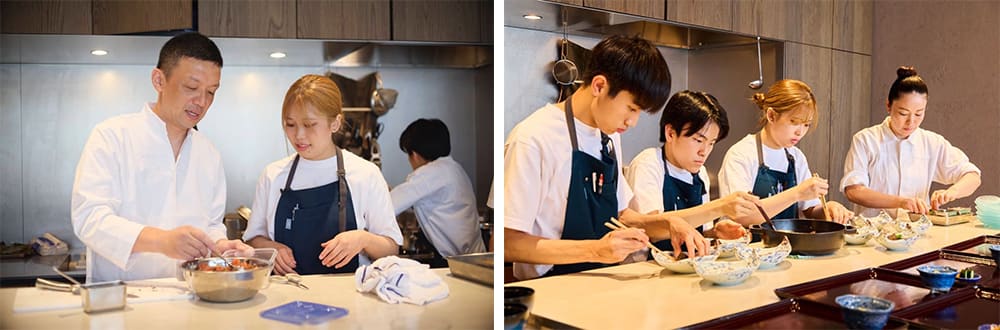
Journal: What kinds of students applied? And are there any stories that have stayed with you?
Sasaki: We accept high school students, vocational school students, and university students, and their fields of study vary widely. Some love fish as living creatures, others love fish as food. Some are interested in food culture and feel a sense of urgency about the problems facing the ocean, and others, like students in agriculture, simply want to learn more about the sea. They’re truly diverse.
In both 2023 and 2024, one thing the students often said was: “I really hate being told, ‘We are cheering for you.’” We hear comments like, “We’re sending a message that we want you to face the ocean as a stakeholder and change as well, so when someone says ‘We are cheering for you,’ it feels like they’re treating it as someone else’s problem, and it’s frustrating.”
Journal: How did you respond when you heard that?
Sasaki: For people to change their awareness and habits, the first step is knowing, then empathizing, and then, for some, supporting. Only after that, two steps later, in a sense, do you finally get to changing your own behavior. We’ve continued our awareness work through Chefs for the Blue, but if you asked how many people we’ve truly changed, I can’t say confidently.
With that in mind, I told them, “With just a two-hour restaurant experience, you managed to move people all at once through three steps: know, empathize, and support. That’s incredible, and you should be proud.” Feeling frustrated that it’s being treated as someone else’s problem is something we feel too, and I think it’s a very weighty statement.
Journal: What was the response from guests?
Sasaki: Some people were moved to tears by the students’ heartfelt presentation. One person who works in the fisheries sector told us, “In Japan, resource issues haven’t gotten much attention. We’ve been desperately trying to do something about it on our own, but I’m deeply moved to see there are people in the next generation thinking about it this much.”
Others seem to be taking action too, saying things like, “I was inspired by the words ‘The most important thing is getting people to know,’ so I told people close to me and posted on social media,” and “I want as many people as possible to learn about the current state of ocean resources, so I’ve been showing the booklet distributed at the event to everyone I meet.”
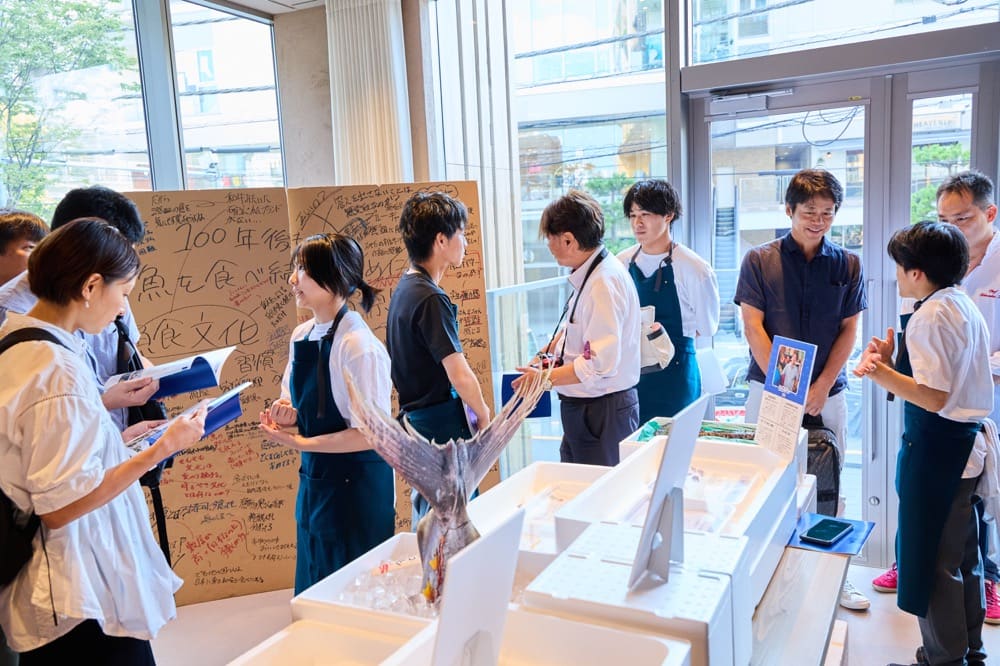
The first step toward a solution is knowing. And eating delicious fish, too
Journal: Every year, the news reports that certain fish are scarce while others are abundant. Through Chefs for the Blue’s work, have you felt the ocean crisis more acutely in any way?
Sasaki: It’s been seven years since we started, and I can feel the warming intensifying year by year. Fish are moving farther and farther north, so you hear stories everywhere, species that used to be caught in Hokkaido no longer showing up at all, or ocean sunfish, considered a warm-water species, being caught in Hokkaido. Pacific saury, long said to be in poor supply, is being talked about as a bumper catch this year, but it’s not a situation where we can simply celebrate just because it’s cheap.
Journal: The trend of Japanese people eating less fish is also seen as a problem. To increase the number of people who take interest in the issues surrounding the ocean and fisheries, and who act, what can each of us do?
Sasaki: I think the best thing is for people to eat delicious fish. In fact, two of the members who participated this time didn’t like fish, but through the project, they visited production areas and ate fish cooked beautifully, and both said they came to love it.
When you try to communicate the issues facing the ocean and fisheries with the environment as the keyword, there’s a real barrier. But if you use food as the entry point and ask what we should do to keep eating this delicious fish far into the future, it may be easier for many people to see it as an issue that affects them too.
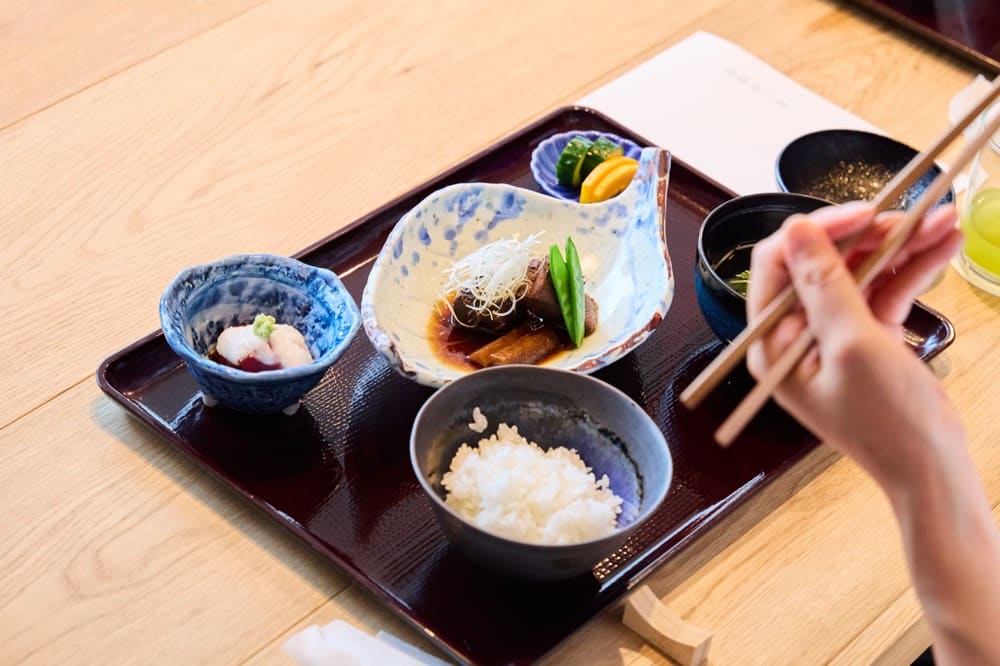
Journal: That also ties into food education. Will the Blue Camp continue in the future?
Sasaki: Yes, that’s the plan. If we continue for 10 years, we’ll have about 160 alumni. Centered around those 160 people, I hope a broader community connecting the fisheries industry will grow: chefs, the fishers who have supported us, people working in logistics, and others, and that it will become a catalyst for changing society.
Editor’s Note
The students’ words, “It’s frustrating to be told, ‘We are cheering for you,’” stopped us in our tracks. As they said at the pop-up restaurant, fish are not an infinite resource. Catches of species such as tuna and Japanese eel, as well as familiar, everyday fish like bonito, mackerel, and Japanese flying squid, have also been declining year by year. To carry Japan’s fish-eating culture, now enjoyed around the world, 100 years into the future, I hope we can all begin by knowing.
Text: The Nippon Foundation Journal Editing Department
Photo: Eizaburo Sogo
Profile
Hiroko Sasaki
Executive Director, Chefs for the Blue. A journalist who continues to report and write in Japan and abroad on food and sustainability. Studied international relations in Japan, journalism and culinary arts in the United States, and cultural anthropology in Hong Kong. Since 2017, she has worked with top chefs in Tokyo and Kyoto on awareness initiatives aimed at a sustainable ocean, advancing projects with the mission of maintaining fishery resources and carrying food culture into the future. Special Member, Fisheries Policy Council, Ministry of Agriculture, Forestry and Fisheries (Planning Subcommittee / Resource Management Subcommittee).
Related Themes
Related Link
Related Articles
From Streets to the Sea: How The Nippon Foundation Turns Cleanup into a National Movement
Field Notes