‘Social Model of Disability’ Concept Raises Awareness of Unconscious Discrimination, Leading to a Better Society
Key Points
- The “social model of disability” is the idea that the difficulties faced by persons with disabilities are caused by society, not by those individuals.
- A “Barrierful Restaurant” program was organized to let people experience the social model of disability.
- Because anyone can become an interested party at some point, it is important to view the difficulties faced by persons with disabilities as one’s own concern as well.
On April 1, 2024, the amended Act for Eliminating Discrimination Against Persons With Disabilities* was enacted, making it legally mandatory for private businesses to provide reasonable accommodation for persons with disabilities.
Reasonable accommodation refers to measures to eliminate differences in opportunities and treatment between persons with and without disabilities, and to improve and adjust the circumstances that are creating obstacles. This is an essential measure for the realization of an inclusive society in which no one is left behind.
However, when persons with disabilities complain about social inequities, they often receive negative responses, with some people telling them that “they aren’t making enough effort” or “they shouldn’t be selfish.” Why is it so difficult to understand one other?
One clue to solving such problems is the concept of a “social model of disability.” What does that concept entail? And what is needed to achieve an equal society?
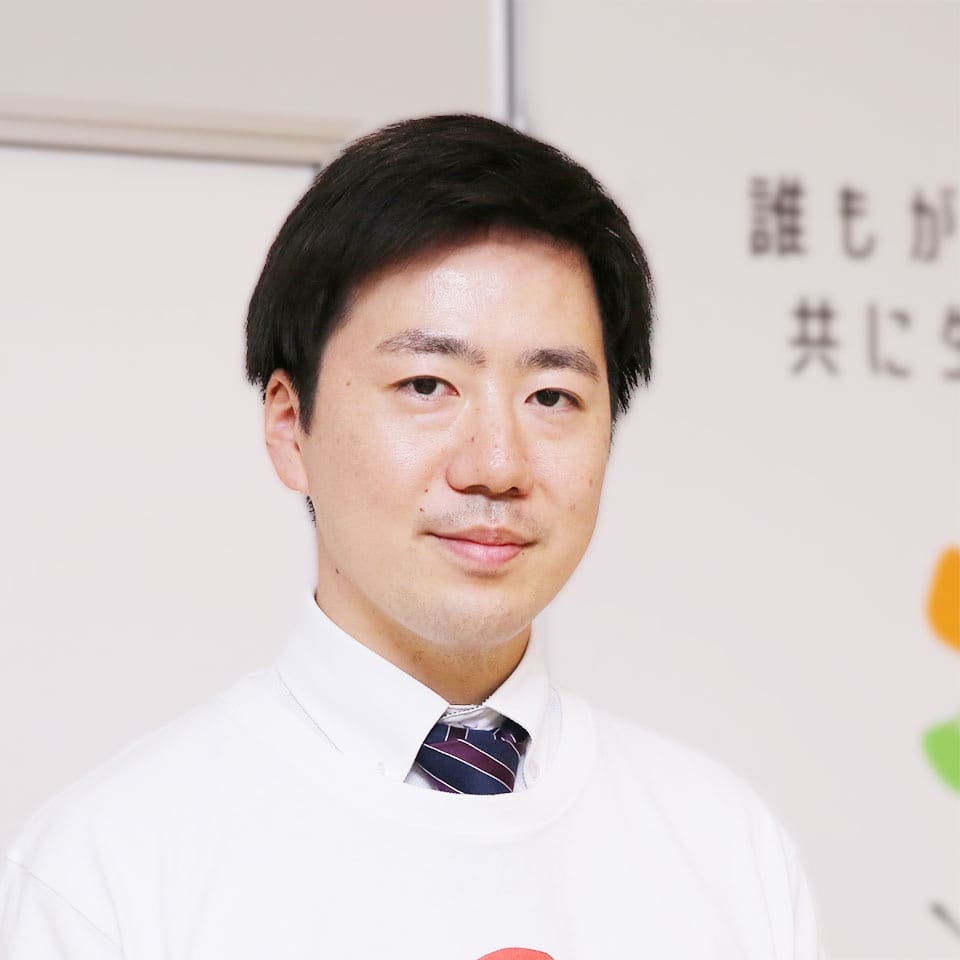
We spoke with Yuichiro Sato, head of the Corporate Planning Office at the Nippon Care-Fit Education Institute (external link).
Is a disability the responsibility of the individual or of society?
The Nippon Foundation Journal Editing Department: To begin, can you please tell us about the efforts of the Nippon Care-Fit Education Institute?
Yuichiro Sato: Our vision is to create a society where “everyone lives together for someone.” Put simply, our goal is to create an inclusive society.
We carry out various initiatives to achieve that. For example, in 2000, we launched a new qualification called “service caregiver” (external link, in Japanese), or what we refer to as a “care-fitter” in English, and we are focusing on training people who will be responsible for achieving an inclusive society. A care-fitter refers to a person who has learned the mindset and skills needed to appropriately assist elderly people and persons with disabilities. Currently, about 1,000 companies have adopted this qualification, and there are about 220,000 people who are certified care-fitters.
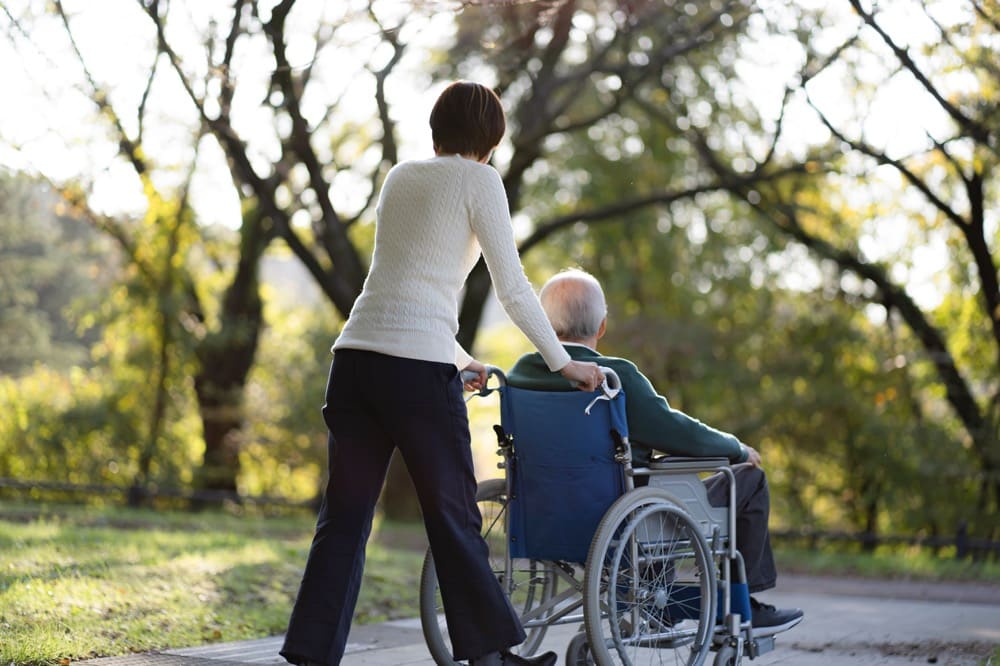
Sato: In Yamanashi Prefecture, we also provide employment support for persons with disabilities, so we are aiming to realize an inclusive society through diverse projects.
Journal: As part of that, I heard that you are also working to raise awareness of the concept of a social model of impairment.
Sato: That’s correct. The social model of disability refers to the idea that the problems faced by persons with disabilities are caused by society and the environment. The opposite would be the individual model of disability (also called the “medical model”), which is the idea that the problems faced by persons with disabilities are caused by the individual’s physical and mental functions.
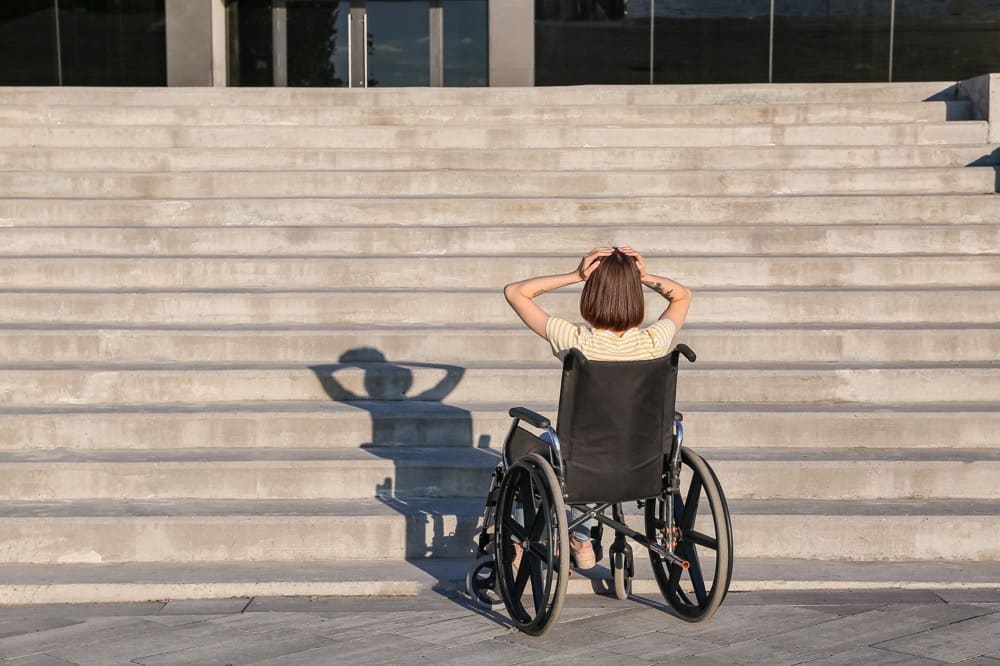
For example, let’s say there is a building that does not have an elevator. If that’s the case, wheelchair users can’t go up to the second floor. In such a case, if you say, “That person is in a wheelchair, so they can’t go up to the second floor,” that thinking reflects the individual model of disability because it views the cause of the disability and difficulty as lying with the individual. On the other hand, if you say, “The building manager has not provided a way for wheelchair users to go up to the second floor,” that is the social model of disability since the obstacle is seen as being caused by society or the environment.
From the perspective of persons without disabilities, when a person with a disability has some kind of problem, they tend to think that the cause is that person’s impairment. That is why wheelchair users are sometimes subjected to people ranting that “it’s your own responsibility” or “you just need to go to rehab.” But don’t you think that the real cause is on the side of a society that assumes everyone can stand and walk?
Journal: I would imagine that there are a lot of people who unconsciously fall into the individual model way of thinking.
Sato: I also think that’s a danger. If you start thinking that the cause of the issue is on the part of the individual, you stop seeing the problems that lie on society’s side. This may put an excessive burden not only on persons with disabilities but also on various other minority group members, and we won’t be able to get rid of discriminatory treatment.
In addition, if consideration is given according to the concept of the individual model, there is a risk that misconceptions such as “disabled = pitiable” or “disabled = unable to do anything” will spread. That’s why we want the idea of the social model of disability to take root throughout society.
Using a role-reversal experiment with disabled and nondisabled persons
Journal: In the past, there was a wheelchair user who visited a train station without contacting the station in advance, and the staff refused to let her ride, so she published her story on her blog and the news became a hot topic, mainly on social media. There were very noticeable comments to the wheelchair user such as, “Don’t bother the station staff” and “Don’t be selfish.”
Sato: I feel that the theory of self-responsibility is very deeply rooted in Japan. For example, if someone is not very good at studying, they tend to be seen as not putting in enough effort. But maybe they were placed in an environment that was not conducive to studying. Sometimes, whether you can study or not can be greatly influenced by your family environment.
However, this may be difficult for those people who can study and are successful to understand. Rather, a lot of people really think that although they happened to be in an environment where it’s easy to study, they are actually successful thanks to their own efforts, or they think that others are naïve not to more of make an effort.
Similarly, people who can use a station without any inconvenience find it difficult to realize that they are being given preferential treatment.
I wonder if such people would shout “selfish” at persons with disabilities who seek assistance.
Journal: The underlying cause of the trouble someone is facing may be related to the distortions in the social structure, but that is not taken into account.
Sato: That’s right. We started an experiential program called the Barrierful Restaurant (external link, in Japanese), which lets people experience social barriers directly in a “restaurant” setting. This offers a reversed social environment where wheelchair users make up the social majority, and all the staff are wheelchair users.
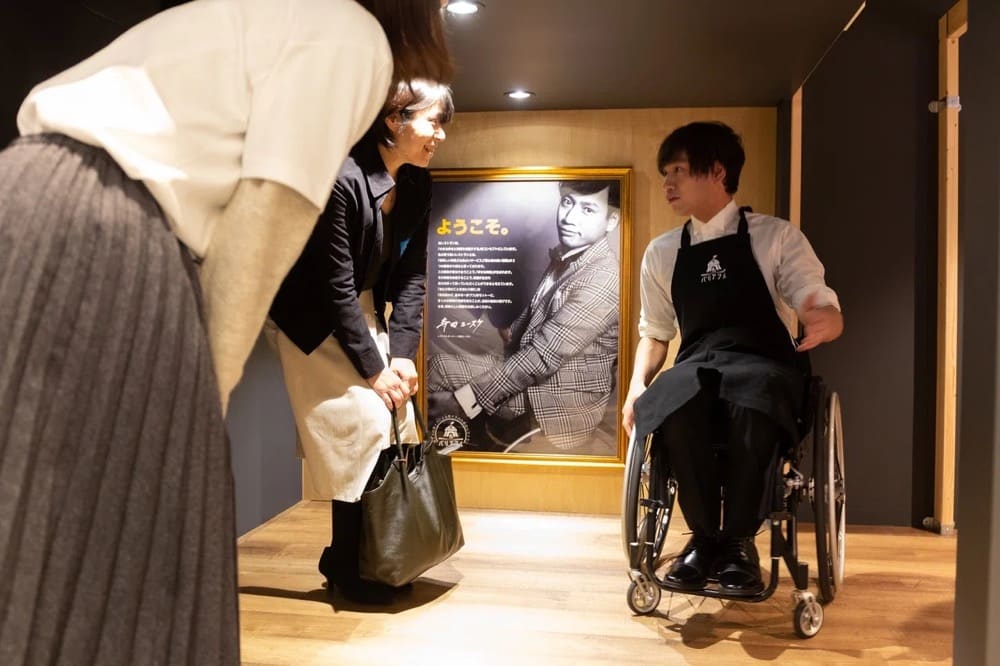
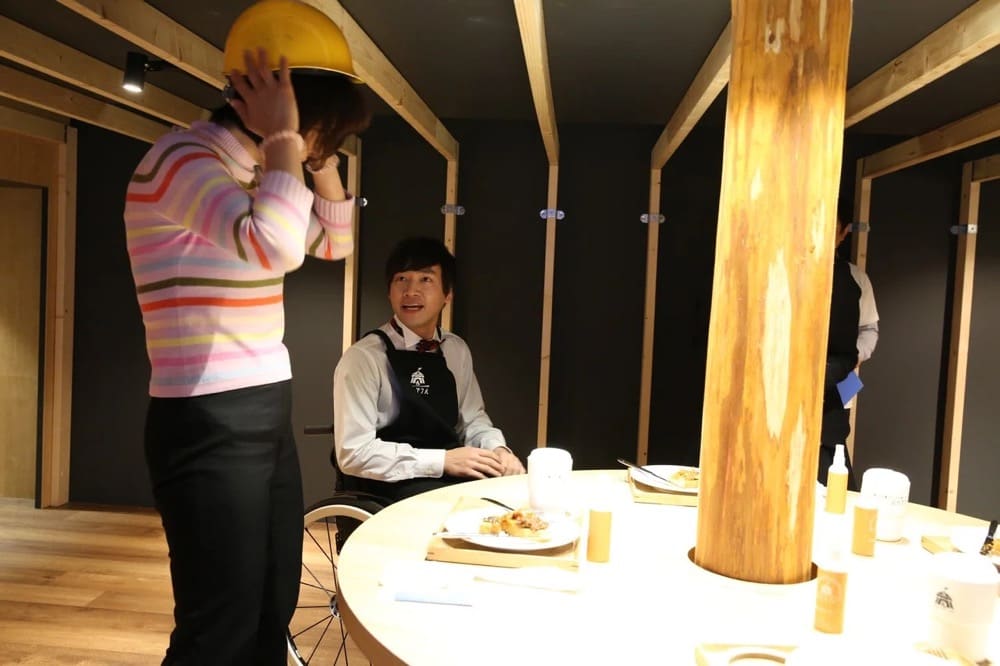
Sato: Bipedal walkers who visit here are in the minority, and guests who are standing and walking are seen as “persons with a bipedal walking impairment.” The facilities in the restaurant are also designed for wheelchair users, so for example, the ceiling is low and there are no chairs.

Journal: That truly does reverse the majority and minority.
Sato: That’s right. In the program, helmets are provided as a reasonable accommodation for persons with bipedal walking impairment, and donations are requested to be made for the purchase of wheelchairs. But from the perspective of those who actually participated, they are not happy about such considerations at all. Even if you borrow a helmet, it doesn’t change the fact that you are in an environment where wheelchair users are the majority…
Sato: In other words, this is the same as in the real world. In a society where people who can walk on two legs are the majority, even if you say, “Let’s create one barrier-free road” or “Let’s set up several wheelchair-accessible seats,” that’s not equal.
Journal: It is meaningless if we do not review the way in which society itself is designed for the majority, rather than just introducing a makeshift fix.
Sato: Exactly. We wanted people to be aware of the “unconscious bias of the majority,” so we came up with the plan for the Barrierful Restaurant.
In fact, participants tell us that they came to realize through the experience that disability issues are created by society. It seems that there are things that can be best understood by experiencing them.
However, it’s hard to understand everything just by participating in one Barrierful Restaurant, and I feel that ongoing efforts need to be carried out to have people become aware of social biases.
A society that is easy for persons with disabilities to live in is easy for everyone to live in
Journal: What do you think is needed to get more people to think about the difficulties faced by persons with disabilities as being a matter that concerns them as well?
Sato: In the first place, I think everyone has an element of being both the majority and minority at the same time. It’s not just about whether you have a disability, but also whether you are right-handed or left-handed, what your gender is, whether you have overseas roots…
And those majorities and minorities are not fixed. What is a minority in one situation may become the majority in another. Therefore, everyone has the potential to become a minority and feel some type of difficulty and inconvenience.
For that reason, I think it’s necessary to understand that the difficulties faced by minorities are not those individuals’ problems but are issues that can arise when the balance in the relationship with society is disrupted.
It’s something that can befall you as well; some small thing can upend things completely. If that way of thinking spreads and becomes commonplace, I think that a truly inclusive society will be realized.
Journal: If you imagine what would happen if your current situation were upended, it may be easier to understand it as something that concerns you as well.
Sato: I think it’s good to try a thought experiment and imagine what it would look like if a place you usually use were designed for persons with disabilities, just like the Barrierful Restaurant.
You may realize that you yourself have been given preferential treatment, your pride may be hurt, and you may be shocked to learn that you have been involved in discrimination. However, it’s one thing to find the cause of the difficulty and quite another to figure out how to then take action against it. Even if your pride is hurt, I think you should be able to take action to change society.
In addition, I think that a society that is easy for minorities to live in has great benefits for the majority as well. One easy-to-understand example is the tools for online meetings that became popular during the COVID-19 pandemic.
In fact, even before the pandemic, wheelchair users who had difficulty getting around had been asking for such technology to be introduced as soon as possible. However, many people objected, saying, “There’s no way we can communicate without meeting face-to-face.”
But as soon as it was introduced during the pandemic, everyone realized how convenient it is, and now it is used as a matter of course.

Sato: If you think about reasonable accommodation for persons with disabilities in this way, that consideration may have a shared benefit. Therefore, it is important to be aware of assumptions and review what we consider to be “the norm.” There are various “norms” in groups and societies, but there are many people who suffer because of them. I hope we can think about it that way and can change society little by little.
Editor’s Note
To be able to stand and walk, to be able to use a telephone, to be able to read written words… In this society there are various norms, and things are designed based on them. And those who don’t fit the norm have managed to devise ways to adapt to society.
However, when I learned about the concept of the social model of disability, I felt that we need to make a change. Even if you can’t stand and walk, make a phone call, or read written text, you can live a happy life without being forced to face difficulties. Isn’t that precisely what an inclusive society is all about?
To that end, I hope each of us can review what kind of inequities there are in society and apply the social model to rethink them one by one.
Text: The Nippon Foundation Journal Editing Department
Profile
Yuichiro Sato
Director of the Corporate Planning Office at the Nippon Care-Fit Education Institute. Mr. Sato joined the Institute in 2014. While being involved in the management of the care-fitter course, which is attended by nearly 10,000 people each year, he has expanded his network with companies related to diversity and inclusion and persons with disabilities and is serving as a bridge to promote inter-company collaboration and connections between businesses and persons with disabilities.