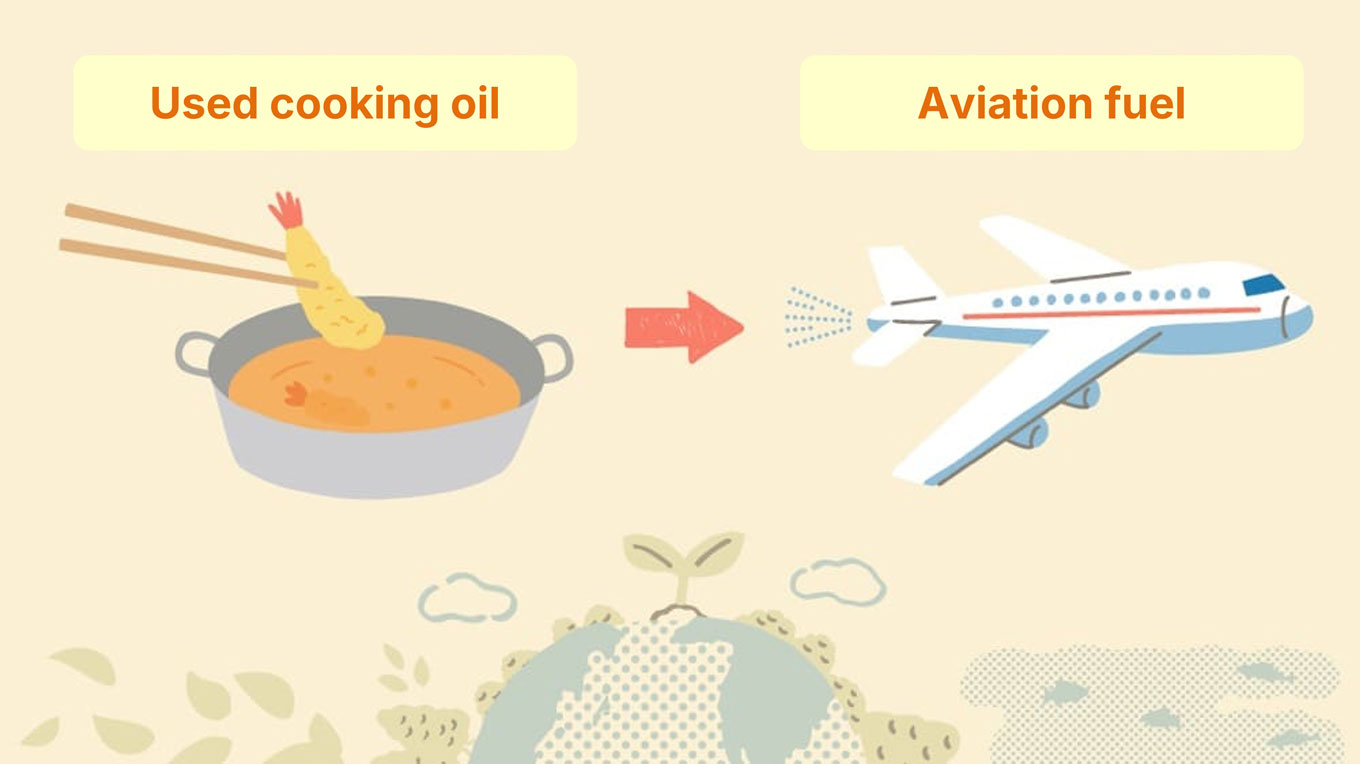
Used Cooking Oil as Airplane Fuel?Growing adoption of CO2 emission-reducing sustainable aviation fuel
Key Points
- The amount of carbon dioxide (CO2) emissions from the aviation sector is increasing. Measures to address this are being rapidly pursued around the world.
- Sustainable aviation fuel (SAF) made from raw materials like used cooking oil (UCO) is drawing interest as a key to decarbonization.
- The domestic production and wider use of SAF within Japan are essential for achieving the global target of net-zero greenhouse gas (GHG) emissions by 2050.
Creating the fuel used by planes and other aircraft essentially entails refining crude oil by heating it to extreme temperatures. The amount of carbon dioxide (CO2) in the atmosphere is therefore increasing along with growing demand for air transport.
Given this concerning increase, sustainable aviation fuel (SAF) — made from alternatives to fossil fuels like used cooking oil (UCO), animal and vegetable fat and oil, waste plastic, and unused woody biomass — is drawing interest as the next generation of aviation fuel. As SAF can significantly reduce CO2 emissions while also achieving the same efficiency as conventional aviation fuel, the UCO needed to make it is currently rising in value and becoming a hotly sought-after resource around the world.
In Japan, on the other hand, the use of SAF is relatively uncommon, and the UCO from restaurants that make tempura and other fried foods is used in livestock feed mixtures or exported overseas. A trailblazer amid such limited interest, REVO International Inc. (external link, in Japanese) sources UCO from around Japan to produce a biodiesel fuel[1] called C-FUEL.[2] On top of pursuing research and development to produce biofuels from UCO and a variety of other materials, REVO International came together with JGC Holdings Corporation (external link) and Cosmo Oil Co., Ltd. (external link) to establish Saffaire Sky Energy LLC in 2022 as a joint project to construct a production plant for Japan’s first domestic mass production of SAF.
- 1. Biofuels like biodiesel are energy resources created from living organisms like animals and plants, as alternatives to petroleum and other fossil fuels. Diesel is engine fuel widely used for ships, planes, and cars.↩︎
- 2. C-FUEL is a biodiesel produced from UCO using technology developed by REVO International. C-FUEL is a registered trademark of REVO International.↩︎
We spoke to Shinsuke Tatsuta, a specialist in carbon recycling at REVO International, to find out more about the company’s initiatives and the possibilities that SAF opens up.
CO2 emissions from the aviation sector on the rise since the COVID-19 pandemic
The Nippon Foundation Journal Editing Department: Please first tell us about what led to REVO International’s establishment and the areas the company is involved in.
Shinsuke Tatsuta: REVO International was established in 1999, but it had started out before that as a volunteer organization involved in gathering empty cans from rivers and activities like that.
Our CEO, Tetsuya Koshikawa, was at the time studying the technology to produce biodiesel using UCO under the late Kyoto University Professor Emeritus Takeo Shimizu while also conducting his own research and development.
REVO International was established to launch this technology as a full-scale business. Apparently, back then the company had just one pickup truck with which they travelled around approaching restaurants in Kyoto and collecting their UCO.
Until then, the restaurant proprietors typically had to have a contractor pick up the UCO for an industrial waste disposal fee of around 500 to 1,000 yen per can. REVO International purchased the used oil for 5 yen per pick up, regardless of the volume, which was an extremely good deal for restaurant proprietors.
This began to catch on, and the company developed a system for collecting a stable supply of UCO to serve as raw material, while at the same time continuing to develop the technology. This allowed REVO International to both produce the high-quality biodiesel C-FUEL and engage in production and research development of fuels like SAF and HVO* using new materials and technology.
- Hydrotreated vegetable oil, a biofuel produced from vegetable oil and animal fat.
Journal: Statistics from the Ministry of Land, Infrastructure, Transport and Tourism (external link, in Japanese) suggest that of Japan’s total CO2 emissions (fiscal year 2022), emissions from the transportation sector account for 18.5%, and domestic aviation alone accounts for 5.1%. Air travel is known as a form of transportation with a particularly high environmental impact. Is demand for air travel on the rise?
Tatsuta: Yes, it is. Before the pandemic, there were 4.5 billion air travelers in 2019. This number is predicted to rise to 4.7 billion people in 2024 and looks set to continue to increase further in the future. CO2 emissions in the international aviation sector are said to account for 1.8% of total global emissions. The adoption of SAF is progressing across the world.
Journal: So, what kind of fuel is SAF exactly?
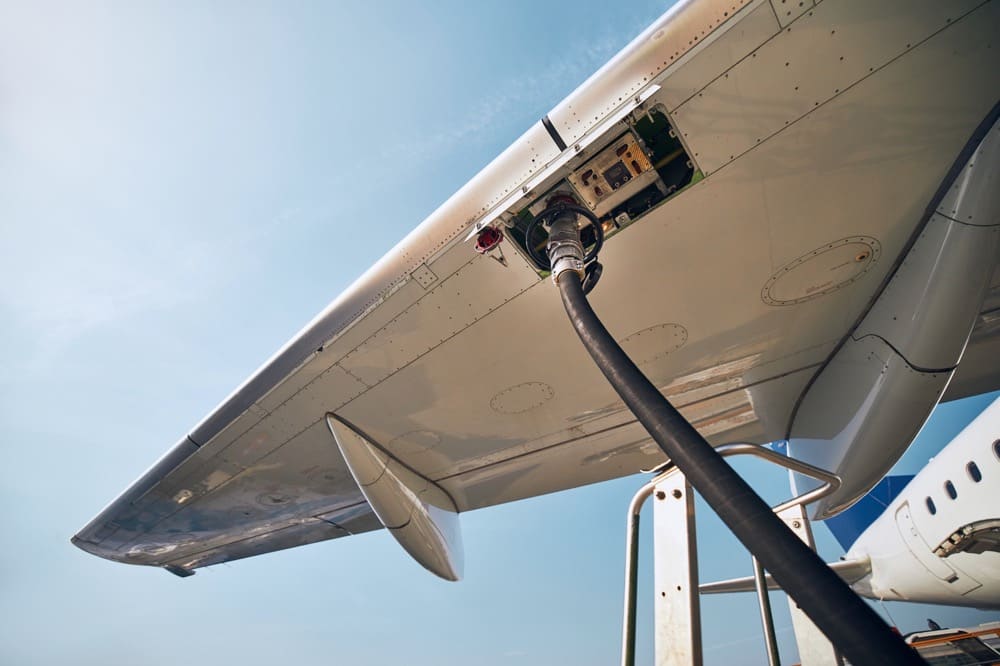
Tatsuta: SAF is the collective term for aviation fuels produced from materials other than fossil fuels like oil, coal, and natural gas. A key feature of SAF is that its use reduces CO2 emissions by around 80% compared with conventional fuels, while providing the same performance as conventional fuels, allowing existing infrastructure to be used as is.
The International Civil Aviation Organization, a specialist agency of the United Nations, has set the target of net-zero greenhouse gas emissions from the aviation sector by 2050 and member nations are pursuing various initiatives to achieve it. In Japan, the goal is to ensure that SAF accounts for 10% of the aviation fuel used domestically by 2030.
One liter of UCO produces around 800 milliliters of SAF, while the remaining 200 milliliters become fuels like diesel or naphtha* (according to production figures from Saffaire Sky Energy’s plant in Sakai City, Osaka Prefecture).
There are alternatives to UCO that can also be used to produce SAF — including alcohol, seaweed, and municipal waste — but in terms of cost efficiency and the amount of energy consumed in fuel production, liquids are of course better than solids, so UCO is considered the optimum material for producing SAF.
- Naphtha is one of the petroleum products obtained when refining crude oil. With further thermal decomposition various basic chemicals can be extracted.
Reference: “What is naphtha, a key raw material for plastic? Plastic types, challenges, and analysis of the future of plastics” (external link, in Japanese)
Construction underway to create Japan’s first mass production plant for the manufacture and greater adoption of domestically produced SAF
Journal: You mentioned that Japan’s domestic goal is to replace 10% of aviation fuels with SAF. To what extent is SAF being used now?
Tatsuta: Unfortunately, use of domestically produced SAF is close to 0% of aviation fuels used. There are some companies that have adopted the use of SAF on a provisional basis, but many use SAF imported from overseas.
Journal: Why is the use of SAF not catching on in Japan?
Tatsuta: On top of the fact that Japan has no domestic facilities for the mass production of SAF in any case, securing stable quantities of UCO is also a challenge.
Around 2.5 million tons of cooking oil circulate within Japan on the whole annually. Of those 2.5 million tons, around 380,000 tons are said to be reusable UCO, but approximately half of the UCO is reused for chicken and pig livestock feed. Using UCO for livestock feed is completely banned in European and American countries due to food safety concerns, so it seems that such information needs to be shared and greater emphasis placed on the importance of supplying UCO for the production of SAF.
The greatest problem is that over 30% of Japan’s UCO is being exported to other countries. If this continues, Japanese airline companies will find themselves in the nonsensical trap of forking out high prices to import SAF produced from UCO that was exported out of Japan. Going a step further, large amounts of CO2 will surely also be emitted in the process of this importing and exporting.
In collaboration with JGC Holdings and Cosmo Oil, we established Saffaire Sky Energy to address this need for domestically produced SAF. Currently, Japan’s first plant for the mass production of SAF is being constructed within Cosmo Oil’s Sakai Refinery, with the aim of it being up and running in 2025.
Meanwhile, at REVO International we are currently constructing facilities for producing C-FUEL and other SAF and HVO in Tahara City, Aichi Prefecture, which are due to be completed in early 2025.
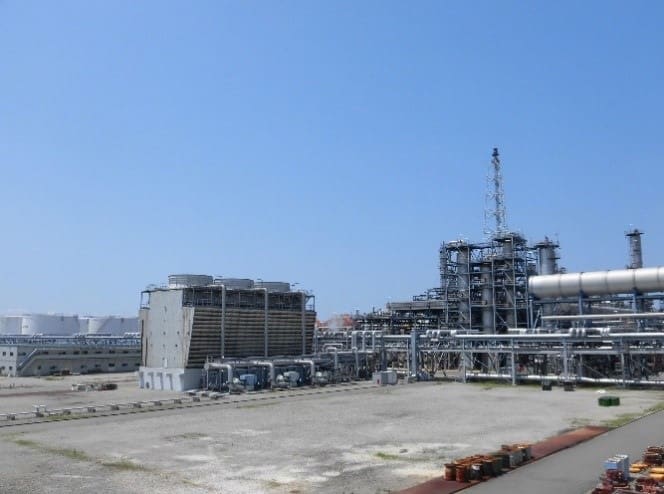
Journal: What kinds of places does REVO International currently collect UCO from?
Tatsuta: As many as around 29,000 restaurants — from well-known major restaurant chains like the conveyor belt sushi chain Sushiro and yakitori chain Torikizoku to small privately-owned restaurants. Our staff collect from each individual restaurant as suits the amount of waste oil they produce and the space they have to store it
Production of SAF from oil used for home cooking or alternative raw materials
Journal: Would it not be possible to produce SAF from oil that has been used for cooking in a typical family home?
Tatsuta: Yes of course, UCO from the home could be used to produce biodiesel like C-FUEL or other SAF. However, currently most households dispose of their UCO by adding a solidifier and throwing it in the combustible trash. So, we are working with government bodies and local authorities to develop approaches for collecting the oil, like setting up local collecting stations. The ideal goal would be to eventually set up collection boxes at convenience stores or other places close to home.
Journal: What is the toughest challenge to address when working toward the greater use of SAF?
Tatsuta: As I mentioned before, securing a stable supply of UCO is a challenge. Even combining the oil that is currently reused for livestock feed, the waste oil that is exported, or the UCO from family homes, it is not nearly enough to cover the amount of SAF required in Japan.
We have therefore been working since 2008 to use abandoned Vietnamese farmland to cultivate non-food plant material so that it can be used as raw material for SAF and other biodiesel. We have also succeeded in developing the technology to create SAF and HVO from waste plastic, waste wood, and other alternative types of waste other than UCO.
Journal: In relation to the efforts to produce SAF and increase its adoption in Japan, what can we each do to play our part toward ensuring a carbon-neutral society?
Tatsuta: At REVO International we really are grateful for each and every individual who learns more about SAF, C-FUEL, and other biodiesels and the importance of circulating resources and appreciates and supports our initiatives. We hope that businesses, local government entities, and organizations that support our work will participate in the project. It would also be great if individuals could voice their interest in collection points for UCO in their local areas.
While it might be just one small step, the more people who take an interest and become supporters of the use of SAF, the more it will contribute to spreading the use of SAF within Japan and even to curbing the global warming that is principally caused by CO2 emissions.

Editor’s Note
Although some local authorities and stores already have systems in place for collecting UCO, the majority of local authorities still incinerate UCO as waste. The Tokyo Metropolitan Government has announced plans to pursue the Tokyo Fry to Fly Project — a campaign to collect UCO for producing SAF — among other initiatives aimed at realizing “zero emission Tokyo” that will contribute to achieving the global target of net-zero CO2 emissions by 2050.
Mr. Tatsuta concluded by saying how great it would be for people to voice interest. Many local authorities have contact forms on their websites so that anyone can share their opinions easily. Let’s start the work toward a sustainable society in our own towns and communities.
Text: The Nippon Foundation Journal Editing Department
- Note: Information is accurate as of the date of the original publication.
Related Themes
Related Links
Related Articles
From Streets to the Sea: How The Nippon Foundation Turns Cleanup into a National Movement
Field Notes