Toward a Society Where Everyone Can Enjoy Being Out and ActiveHow the companion support system supports leisure activities for people with visual impairments
Key Points
- The Companion Support System is a welfare program in which guide helpers* assist visually impaired individuals when they travel outside their home for leisure activities.
- Due to challenges such as low awareness of the system and high barriers to application and use, the utilization rate remains below 10 percent of eligible individuals.
- Registering as a guide helper and promoting awareness of the system can help create a society where all people can enjoy excursions more freely, regardless of disability.
- A supporter who accompanies and assists people with visual impairments during leisure excursions. Also known as a companion support provider.
Enjoying an outing is a common way to spend a day off. For people with visual impairments, however, such an outing involves many challenges. For instance, even if a person with a visual impairment visits a supermarket to shop, they encounter difficulties obtaining information such as where items are located or what products are being sold.
To address these challenges, Japan introduced the Companion Support System in 2011. This system aims to help people with visual impairments enjoy outings by having guide helpers accompany them when they go out. However, the utilization rate of this system is estimated to be below 10 percent of eligible users.
To learn more about how the Companion Support System works and the challenges in expanding its adoption by visually impaired individuals, we spoke with Takamichi Suzuki, Director of otomo inc., which operates a companion support service office in Adachi Ward, Tokyo, as well as a store selling items to support the livelihoods of persons with visual impairments.

Even a trip to cheer on a favorite performer or team is possible — helping people with visual impairments enjoy leisure activities
The Nippon Foundation Journal Editing Department: First all, what kinds of challenges do people with visual impairments face on outings?
Takamichi Suzuki: Although the situation has been changing recently thanks to the “reasonable accommodation”[1] of persons with disabilities becoming mandatory, increased understanding of people with disabilities, and advances in technology, there are still many situations in which people with visual impairments encounter difficulties.

Suzuki: For example, imagine that a person with a visual impairment wants to take a train to a shopping center and do some shopping. If they are familiar with the route from their home to the nearest station, they might be able to walk there by themselves, although some people require support from a helper. Others may undergo orientation and mobility training[2].
Once they reach the station, if they tell a staff member their destination, the staff can contact the destination station and ensure that someone is waiting to assist them from the platform to the ticket gate.
However, at stations in rural areas with staff shortages, passengers might be asked to contact the station in advance or may need to wait some time until staff are available to assist them.
After exiting the ticket gate, there is, of course, no longer any assistance from station staff. Recently, more people with visual impairments have begun using navigation apps designed to guide them to their destination. Even so, people often tell me they have trouble finding the entrance to buildings.
Journal: Once reaching the destination, do staff members at the facility generally guide them?
Suzuki: It depends on the facility. In the case of shopping, store staff will often provide assistance, but if there is a shortage of staff, users requiring support may be asked to contact the store in advance. We have also heard that some facilities, which could be considered potentially dangerous such as gyms, ask users with visual impairments to bring a companion.
Journal: In that case, using the Companion Support System would help solve these challenges. Could you explain about the system in more detail?
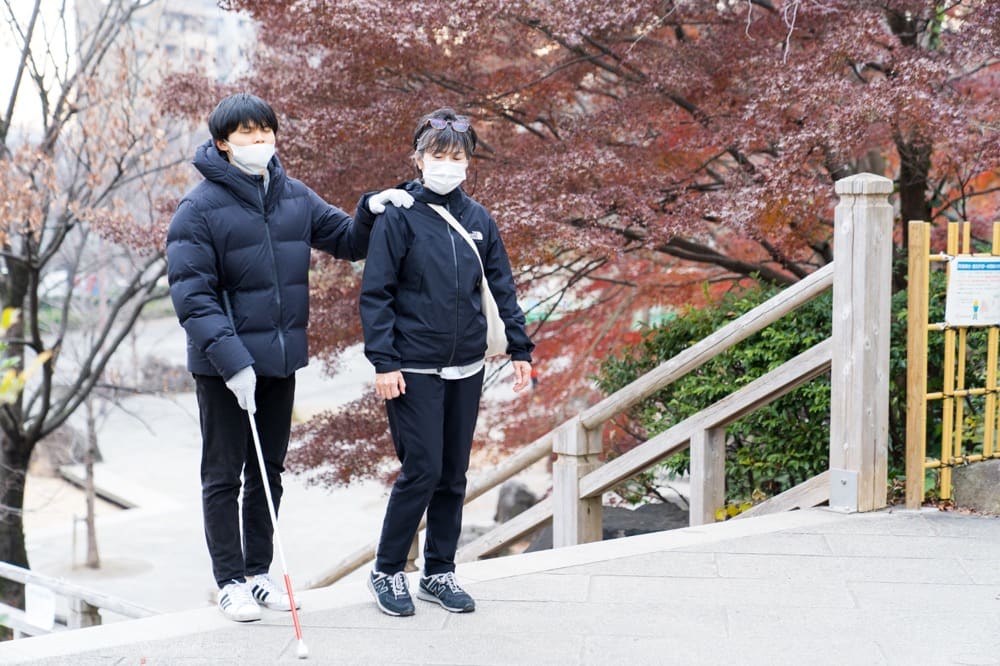
Suzuki: The Companion Support System is a welfare service for persons with disabilities in which a support worker accompanies a person with a visual impairment on excursions that are difficult to navigate alone, providing necessary information and helping ensure safety while traveling to the destination. The service is limited to short-term, leisure-related activities — it cannot be used for commuting to work or school, or for long-term use or economic activities. Barring these restrictions, however, it can be used for quite a wide range of activities. In addition to accompanying the individual to their destination, guide helpers also provide support as needed, such as reading written materials aloud or writing on the user’s behalf.
Staff who provide this service are known as “guide helpers.” They obtain the required qualifications by completing specialized training for companion support workers.
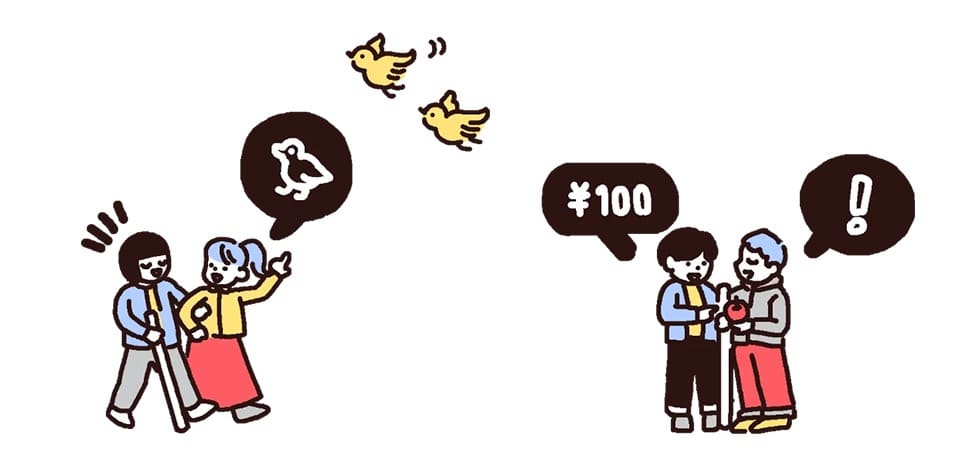
Suzuki: Although it depends on household income, users generally pay 10 percent of the actual cost. In this case, the hourly fee is around 200 to 300 yen. There is also an income-based monthly cap on out-of-pocket costs, so once this monthly limit is reached, no additional fees are charged beyond this.
However, costs for the guide helper such as admission fees to facilities or concert tickets must be paid by the user.
Journal: So costs for the guide helper are also borne by the user. What steps do people with visual impairments need to take in order to use the system?
Suzuki: They first need to receive approval for benefits from their local government. This involves visiting the municipal welfare office and stating that they would like to use the Companion Support System. Then, they create a usage plan and submit an application. If the application is approved, the number of hours they can use the service per month and their out-of-pocket costs are determined.
After this, the user contacts a private welfare service provider, such as our organization, that offers companion support services and makes a request to use the services of a guide helper.
Journal: What type of purposes do people use the service for?
Suzuki: Usage purposes vary widely, from shopping, training at the gym, to hospital visits, travel, and more. In one case, one of our staff accompanied a client to an idol concert. The guide helper memorized the faces of the group members, and when one of them looked in the direction of the client, the helper would tell them “She’s looking this way now,” and the client would wave. Since an outing is a special occasion for our clients, we try to do everything we can to support them so they can have an enjoyable and memorable day.
- 1: If a person with a disability expresses an intent or need to remove a societal barrier, necessary and reasonable measures must be taken to remove that barrier, as long as the burden of doing so is not excessive.↩︎
- 2: A type of functional training for people with visual impairments that provides instruction on how to use a white cane and safe and efficient indoor and outdoor mobility. Reference: “Do You Know About Orientation and Mobility Trainers? — Saitama Prefecture” (external link, in Japanese)↩︎
Systematic challenges: Barriers to usage and difficulty ensuring economic viability of service providers
Journal: What led you to found otomo?
Suzuki: My mother herself has a visual impairment, having been diagnosed with low vision.* However, she had never used a guide helper, so I knew nothing about the system.
Then one day at a networking event, I exchanged business cards with someone who was a service provider. This was the first time I learned about guide helpers and the Companion Support System. I thought that at the very least, perhaps I should take the training course to become a guide helper for my mother’s sake. But when I attended the training, I heard quite a lot of negative comments. I learned that awareness of the system is very low, and that even many people with visual impairments do not know about it. In addition, even when people want to use the service, there is a chronic shortage of guide helpers. I felt that the system would eventually be necessary for my mother, and that it would be a shame if it dwindled away. This was what motivated me to launch otomo as a service provider.
- A condition in which individuals experience visual impairment such as difficulty seeing clearly, sensitivity to light, or a narrowed field of vision due to a range of causes, resulting in challenges in daily life.
Journal: Why had your mother never used the system before?
Suzuki: I think there were psychological barriers. She didn’t know what kind of person would come as a helper. In addition, I think the fact that she had been able to manage her daily life on her own by putting up with some inconveniences was a big factor.
However, when I talked with her again after launching otomo, I realized she had actually faced many difficulties when venturing outside the house. She still has a small amount of vision, so she can handle shopping to a certain extent, but she can’t read the text on products. For example, she said she buys rice balls at the convenience store without knowing what filling is inside — it’s like Russian roulette. Although she said it jokingly, I was quite shocked to realize she couldn’t even select the food she wanted to eat.

Journal: Are there many people with visual impairments like your mother who have never used the system?
Suzuki: Yes, the utilization rate is very low. Although there are around 320,000 people with visual impairments in Japan, as of April 2023, only 26,584 people used guide services under the Companion Support System — less than 10 percent of the total.
Journal: Why are there so few users?
Suzuki: There are several factors. Some people are able to go out on their own and therefore do not need to use the system. Others simply do not know about it. Quite a few people contacted us after learning about our service through the media, saying it was the first time they had heard about guide services and the Companion Support System. Another factor is that there are high barriers before people can actually begin using the service. They need to go to a local government office and apply, and if they are approved, many service providers are not accepting new clients. Some clients told us they had searched fruitlessly for a provider for four to five years before finally finding otomo.
Journal: Four to five years? Why are so many service providers not accepting new clients?
Suzuki: First of all, there are very few welfare providers that offer guide support services. Second, many that do offer guide support services are primarily providers of home-visit care services, and companion guide support is only a small part of their operations, so they have limited capacity. According to statistics from about 10 years ago, providers like otomo that specialize exclusively in companion guide support account for only around 0.2 percent of all welfare service providers. One reason for this is that it is difficult to maintain economic viability operating solely under this system. Because the service supports clients’ leisure activities, usage volume can vary widely — for example, two hours one month and 50 hours the next. These fluctuations in volume make it difficult to increase staff in preparation for reservations.
Becoming a guide helper and spreading information —what can individuals do to help?
Journal: From what you have shared, it sounds like the system itself faces many challenges.
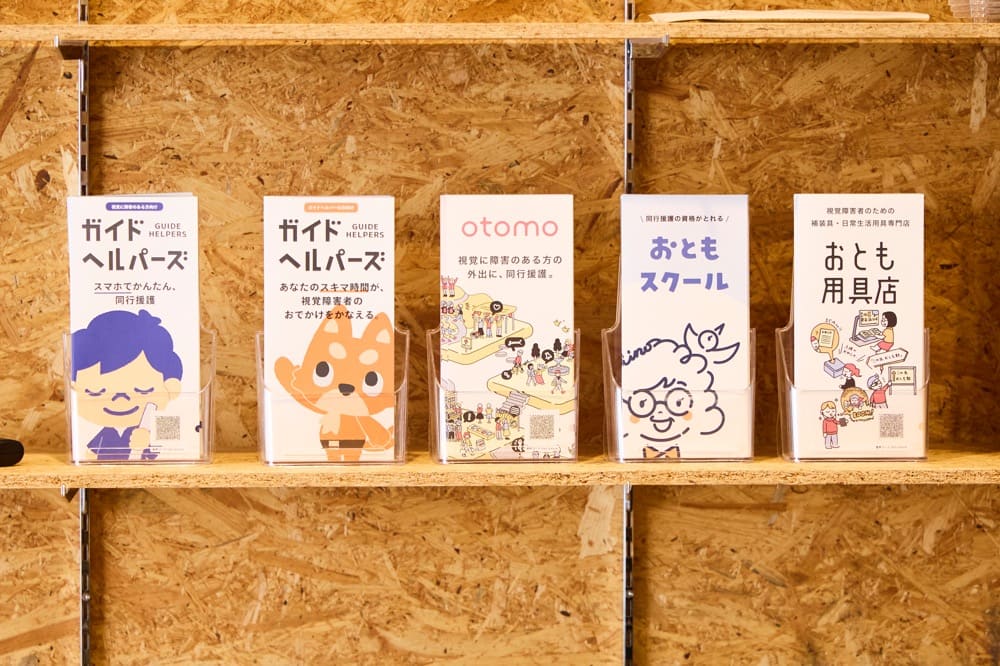
Suzuki: That’s right. One issue I feel is particularly concerning is that the number of hours people can use the service varies depending on the municipality in which they apply. In Tokyo, clients can use the service for around 50 hours per month on average, but some municipalities allow only 12 hours per month. Furthermore, all providers face a chronic shortage of guide helpers. We are taking a range of actions to address these issues. For example, we run a school where people can take a training course to become a guide helper, and we have also increased hourly wages for helpers.
Journal: What can we as individuals do to help expand the Companion Support System and build a society where everyone can enjoy outings freely, regardless of disability?
Suzuki: First of all, I hope people who read this article will learn that becoming a guide helper is one way they can help support the daily lives of those with visual impairments. In addition, people living with visual impairments can have difficulty accessing the information they need, including support systems. Simply sharing information about the Companion Support System with visually impaired acquaintances or their families — or even bringing up the topic in conversation — is one way to help.
Editor’s Note
Through this interview, we learned that there are major challenges to expanding utilization of the Companion Support System, including low public awareness — even among persons with disabilities themselves—as well as a shortage of supporters. otomo has developed an online app called Guide Helpers (external link, in Japanese) that facilitates smooth matching between users and guide helpers. The system allows helpers to take on guide work when they have time in their schedule, similar to food delivery platforms such as Uber Eats.
With the introduction of services such as this that make support more accessible, I hope that awareness of the Companion Support System will spread, helping to build a society where everyone can enjoy leisure activities, regardless of disability.
Text: The Nippon Foundation Journal Editing Department
Photo: Eizaburo Sogo