‘AI Suitcase’ Robot Guides People With Visual Impairments While Avoiding Obstacles and Pedestrians
Key Points
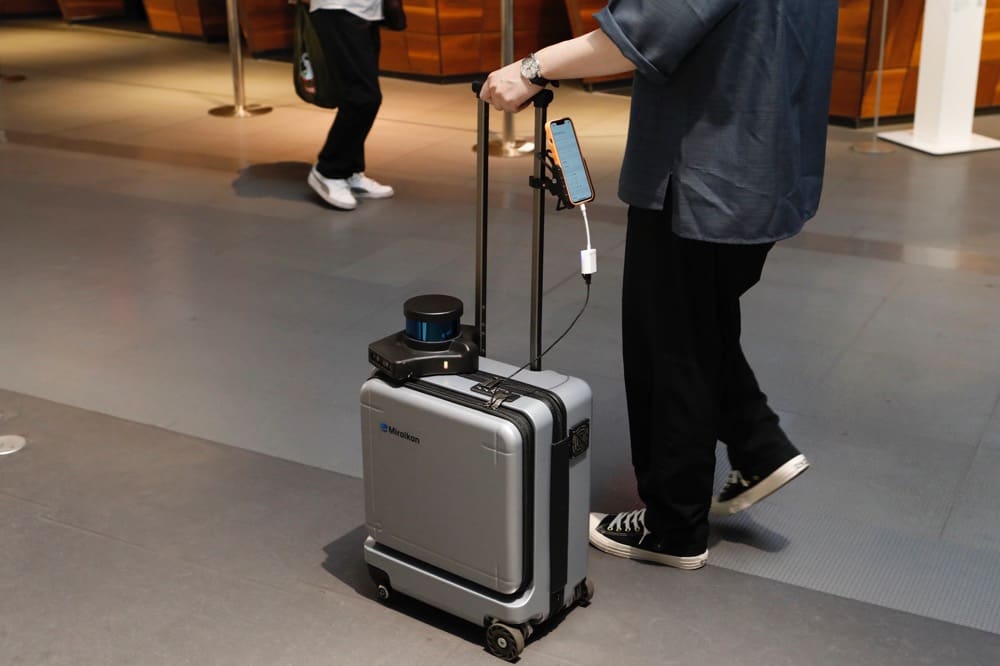
- The AI Suitcase is an autonomous guide robot designed to support the mobility of people with visual impairments.
- Using sensors to perceive its surroundings, it guides users safely to their destination along an appropriate route.
- By embracing rather than fearing new technologies, our society can build a future in which all people have freedom of movement regardless of disability.
Whether it is visiting a newly-opened shopping complex or taking a walk down a different street than usual, most of us enjoy freedom of movement in our daily lives — deciding where we want to go and how to get there.
But for some members of our society, such as those who are blind or have impaired vision, mobility presents a major challenge.
People with visual impairments navigate through sensory cues other than sight. However, as they are unable to confirm their surroundings visually, they face the constant unease of wondering whether they are on the correct route. If they become lost, getting back on track can be difficult. As a result, individuals with visual impairments face significant challenges in their day-to-day life.
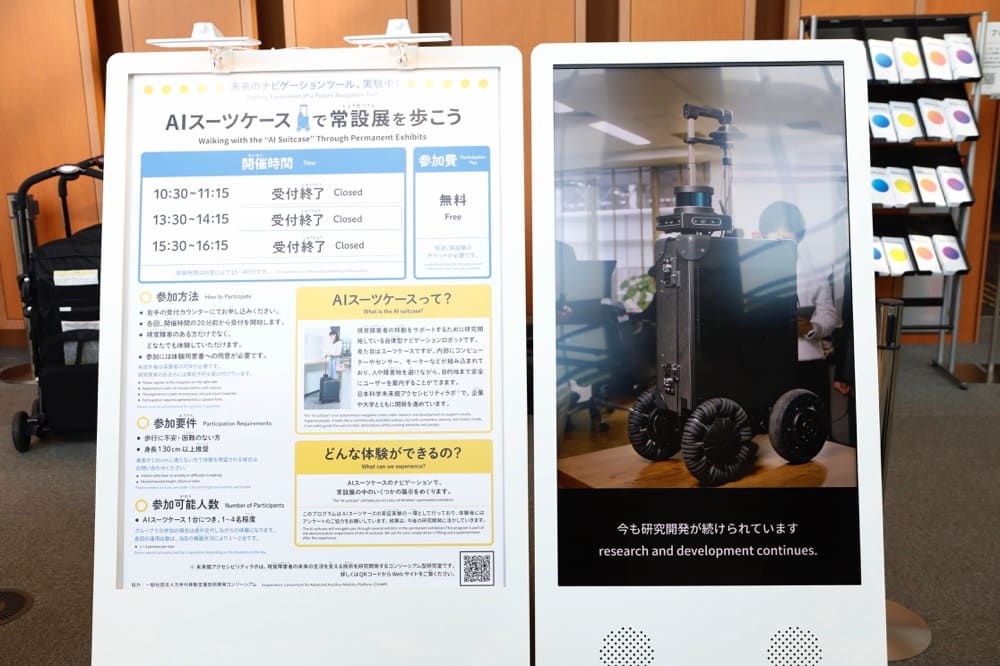
One innovation being developed to address these difficulties is the “AI Suitcase (external link).” This autonomous navigation robot is being developed by a research team led by Chieko Asakawa, Chief Executive Director of Miraikan — The National Museum of Emerging Science and Innovation (external link), who is also an IBM Fellow and herself totally blind. Development of the robot is being carried out by the Miraikan Accessibility Lab (external link) in collaboration with external partners.
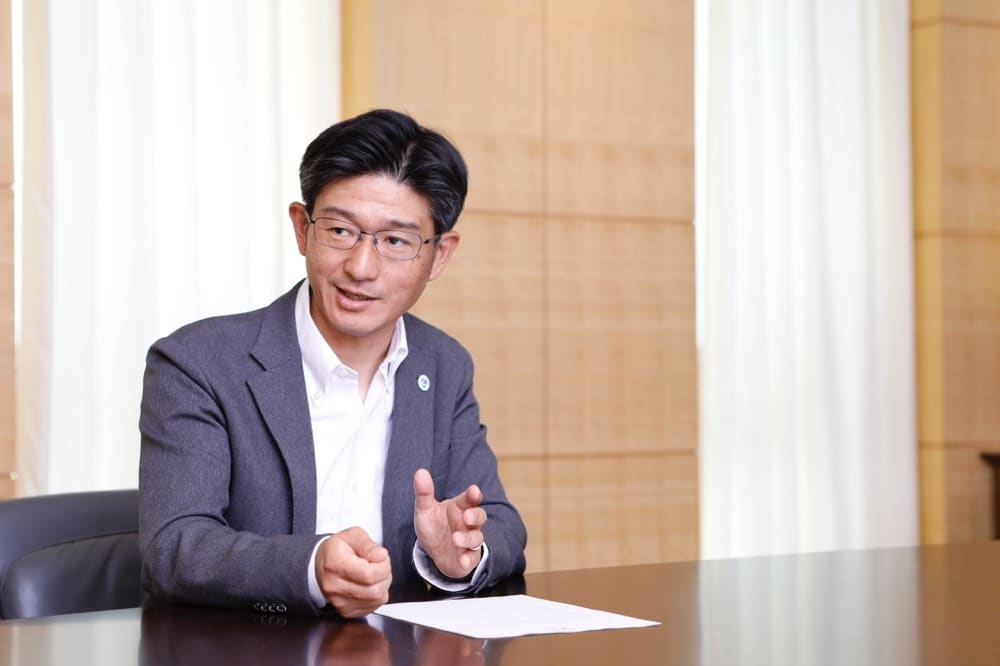
How might the AI Suitcase transform the lives of people with visual impairments? We spoke with Dr. Hironobu Takagi, Executive Director of Miraikan and Director of the Accessibility Lab (Research Promotion Office).
Mobility challenges faced by people with visual impairment have changed little with time
The Nippon Foundation Journal Editing Department: What kinds of difficulties do individuals with visual impairments currently face?
Hironobu Takagi: People with visual impairments encounter a range of challenges. One example is access to information, such as being unable to read printed text or words displayed on screens, nor images and graphs. This makes it difficult to work or study.
However, in 1997 a team at IBM Japan led by Chieko Asakawa developed and commercialized a browser called Home Page Reader, which reads web pages aloud to the user. Since then, a wide range of technologies enabling visually impaired individuals to access information have been developed, dramatically improving the availability of information.
Today, smartphones allow visually impaired users to conduct everyday activities such as listening to the news, checking their bank accounts, or shopping online.
Mobility is another major challenge affecting daily life for those with visual impairments. The primary tool used to navigate when walking is still a white cane[1]. While sighted[2] individuals perceive their surroundings visually, those with visual impairments navigate by identifying landmarks through senses other than sight, including feeling out their surroundings using a cane.
For example, they might memorize the route to their school or workplace and think, “There’s a wall here, so I need to turn left,” or “The atmosphere (environmental sounds, etc.) has changed, so I must have entered an open space.” By combining multiple nonvisual landmarks such as these, they navigate toward their destination. Accordingly, traveling alone to an unfamiliar place can be very difficult.
The same is true when traveling with a guide dog. Although guide dogs can indicate corners, warn of steps, and help avoid danger, they do not take users to the destination. Whether to go straight through an intersection or turn is ultimately the decision of the individual.
This means that unlike sighted persons, enjoying a stroll through an unfamiliar part of town on their own is currently extremely difficult for those with visual impairments.
Journal: Is the AI Suitcase being developed to help address these challenges?
Takagi: That’s right. The AI Suitcase is a navigation robot designed for persons with visual impairments. It perceives its surroundings and guides users to their destination while avoiding people and obstacles.
When used inside Miraikan, it also provides voice announcements along the way, such as explaining details about the exhibition at the destination or warning the user that the corridor ahead is narrow. To avoid startling users by suddenly changing direction, the suitcase emits a vibration immediately before it turns. In addition, if the user lets go of the handle, the device automatically stops for safety.
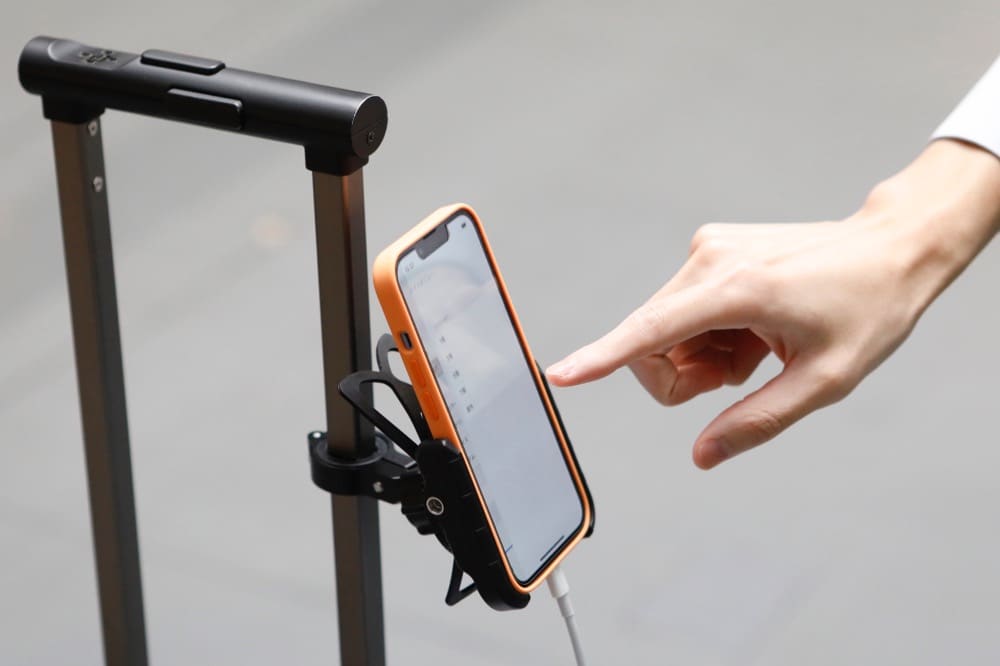
Journal: So, the robot guides users to their destination using non-visual cues, such as sound and vibration.
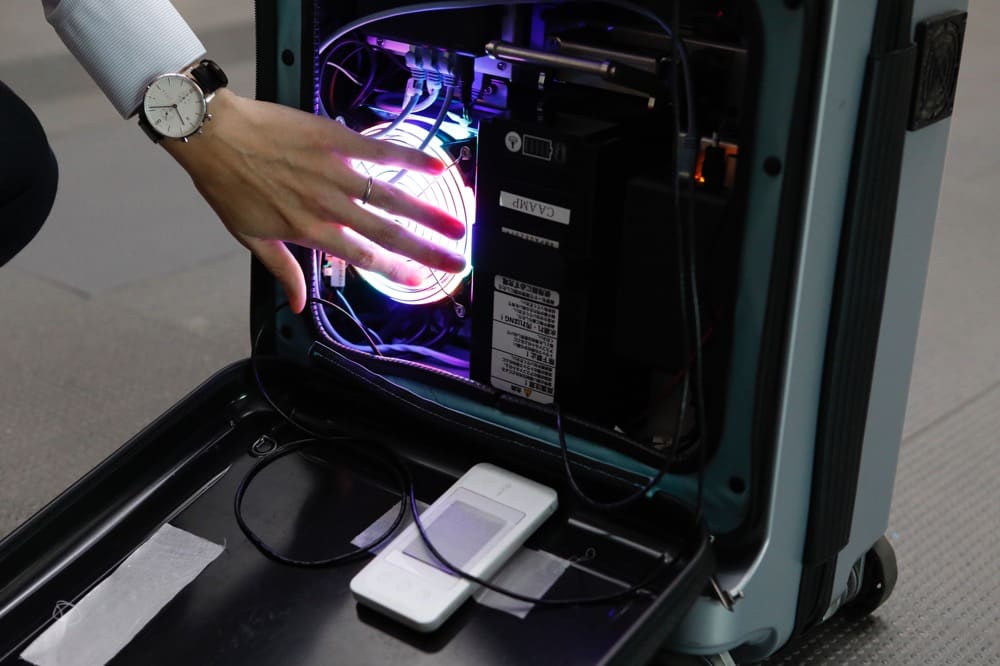
Takagi: That’s right. To ensure safe navigation, the device is equipped with multiple sensors. The most important of these is LiDAR, a sensor developed to allow autonomous vehicles and robots to perceive their surrounding environment. This sensor enables the robot to estimate its position based on the shapes of nearby walls.
The suitcase is also fitted with depth cameras, which measure the distance between the unit and objects in view. Three of these sensors are mounted in different directions, enabling the system to determine where people nearby are heading and how fast they are moving. This helps prevent collisions.
- 1: A white cane is commonly used by visually impaired individuals in Japan to navigate while walking↩︎
- 2: The antonym of “visually impaired individual,” referring to a person with unimpaired vision↩︎
Expanding options for visually impaired individuals by developing a support tool that blends into society
Journal: What led you to develop the AI Suitcase?
Takagi: I was previously part of a project to develop a smartphone-based navigation system for users with visual impairments. Although we achieved a very high level of accuracy, this technology did not solve the fundamental problem – that users with visual impairments still needed to walk carefully with a cane while constantly checking their surroundings.
As we were discussing ways to make it easier for people with visual impairments to navigate their way around town, Ms. Asakawa brought up an interesting point. She said that when she goes out alone, she finds it helpful to push a suitcase while she walks. If there is a wall, the suitcase bumps into it; if there is a step, the wheel drops, letting her know features of the surrounding environment. This made us think: wouldn’t a suitcase that had a motor and sensors be even more useful?
When we thought about the idea further, we realized that a suitcase would actually have several advantages. It already has a practical, portable design. It also has space to hold many sensors and components. And finally, it looks natural when people push it around.
This last point is actually the subject of some debate. Unlike a white cane or guide dog, a suitcase alone does not immediately signal that the holder has a visual impairment. In other words, it allows the user to blend into society.
Journal: Does this mean some people with visual impairments prefer not to attract attention to themselves?
Takagi: Our studies showed that both perspectives exist. Some prefer not to stand out, while others want the people around them to recognize that they have a visual impairment.
In Japan, there has long been a common understanding that people with visual impairments make their condition easily identifiable in order to receive support from those around them. For example, if someone with a white cane is trying to cross a busy road, people nearby will instinctively step in to help. In dangerous situations like this, some people prefer others to recognize that they are visually impaired. In line with this philosophy, Japan’s Road Traffic Act requires people with visual impairments to carry a white cane or travel with a guide dog so that others can identify their condition.
At the same time, however, there are others who would prefer not to stand out. They want to be able to walk freely through the city without worrying about how others perceive them. That is why we believe our role is to increase the number of options available by providing a choice for those who prefer to navigate their way without attracting attention.
Journal: Can the AI Suitcase be used in places the user is visiting for the first time?
Takagi: Unfortunately, this is not yet possible. At present, the AI Suitcase cannot operate in environments it has not previously learned. In order to use the suitcase effectively, it must first measure the three-dimensional layout of the surrounding environment.
That said, once this has been done, the system works well. For example, a single floor of Miraikan can be mapped out in only a few hours, making basic navigation possible. However, this is only “basic” navigation. To improve accuracy further, additional information is required. One example is route data — appropriate paths for the suitcase to travel must be registered. Another is information about nearby locations. By registering landmarks such as restrooms, users can search by voice for destinations like “the nearest restroom.” When using the system in Miraikan, we also register detailed information about exhibitions so that the system can provide voice explanations to users.
Only once all this information is prepared can the system guide users properly. Accordingly, navigating an entirely new location remains difficult. However, our research is ongoing.
Journal: Do you think it will eventually be possible to use the system anywhere?
Takagi: Yes, that is our goal. Ultimately, we want to create a system that can even allow people with visual impairments to travel overseas on their own. Imagine arriving at an overseas airport, navigating your way to the taxi stand, and then reaching your hotel — all on your own. This is the future we hope to achieve.
I hope people will understand the role of AI Suitcase when they see it in real-life situations
Journal: Hearing more about the AI Suitcase, I wondered whether it might eventually replace guide dogs.
Takagi: There are clear differences between the two. Guide dogs have excellent mobility — for example, they can easily climb steps. In this regard, the AI Suitcase has limitations. From a technological perspective, it might be possible to design a mechanism that allowed it to climb steps, but this would require a complex structure that would delay practical application. So, for now, we have decided not to factor steps into the design.
In addition, guide dogs are already a well-established presence in society. Their role is clearly recognized, and as animals they possess intuitive abilities that AI may not be able replicate, including strong danger-awareness and aversion.
On the other hand, one advantage unique to the AI Suitcase is that it can understand spoken instructions. If you tell it your destination, it can recognize the request, guide you there, and let you know when you have arrived. This is one major advantage of the technology.
So rather than replacing guide dogs, we believe that guide dogs will continue to serve a key role, and hope that the AI Suitcase will complement this by performing roles that guide dogs cannot. In a sense, we see the AI Suitcase as a technology that further expands the path guide dogs have pioneered.
Journal: I believe that the AI Suitcase could greatly expand the choices and possibilities available to people with visual impairments. At the same time, I wonder what we as individuals can do to help address this issue.
Takagi: I first learned about the day-to-day challenges facing people with visual impairments when I met Ms. Asakawa and began working with her on research.
Individuals with visual impairments live and work in much the same way sighted persons do, but they also face unique challenges — for example, traveling to unfamiliar places or reading restaurant menus. Meeting Ms. Asakawa made me aware of the challenges these individuals encounter. For those who have never interacted with a person with a visual impairment, these types of experiences might be difficult to imagine. But if you see someone who appears to be struggling, please do not hesitate to talk to them and offer assistance.
I also hope people will not be afraid of new technologies. Tools like the AI Suitcase may become more common in the future, and you might encounter them in your day-to-day life. In these situations, I hope people will accept and watch over these technologies with an understanding of the role they play.
Safety is our top priority when developing this technology, and we hope to introduce it into society with the support and understanding of the public. For developers, nothing is more encouraging than knowing that society — and by extension each individual within it — accepts the innovations we are working on.

Editor’s Note
As I walked home after the interview, I was struck by just how fortunate I am to be able to adjust my route freely depending on my mood or schedule. At the same time, I was reminded that there are people in our society who do not currently have this freedom.
The AI Suitcase may help to reduce this inequality if it becomes widely implemented in society. Although this reality may still be some time away, until then, as Mr. Takagi suggested, perhaps the most important thing we as individuals can do is to speak up and offer assistance without hesitation if we see a person with a visual impairment in need of help.
While supporting the development of the technologies of tomorrow, it is also important that we ensure those facing difficulties today are not left behind. Creating a brighter future for people with disabilities requires not only advanced technology, but also the awareness and compassion of each of us.
Text: The Nippon Foundation Journal Editing Department
Photo: Emi Enishi
Profile
Hironobu Takagi
Executive Director of Miraikan — The National Museum of Emerging Science and Innovation and head of the Research Promotion Office. He is also responsible for accessibility research at IBM Tokyo Research Laboratory. Since 1999, he has pursued research and development in the accessibility field at IBM Japan’s Tokyo Research Laboratory. In 2021, he assumed his current role at Miraikan while continuing to pursue research at IBM. He is working toward the development and societal application of the AI Suitcase, a navigation robot designed to aid the mobility of visually impaired individuals.