Wanting to Convey the True Nature of Persons with Disabilities Through a Free NewspaperThe single-minded attitude of the editor-in-chief of ‘gente’
Key Points
- Free newspaper gente uses the catchphrase “understanding disabilities through people” to convey the true nature and lifestyle of persons with disabilities.
- To increase the number of opportunities for people to learn about disabilities, it insists on providing newspapers free of charge.
- By offering a casual entry point for people to learn about disabilities, it generates interest among more people.
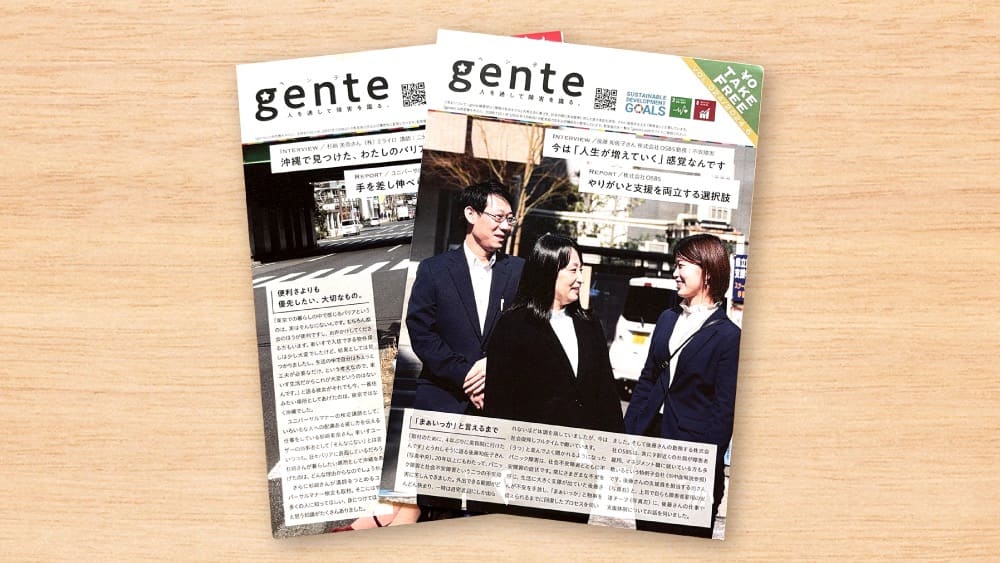
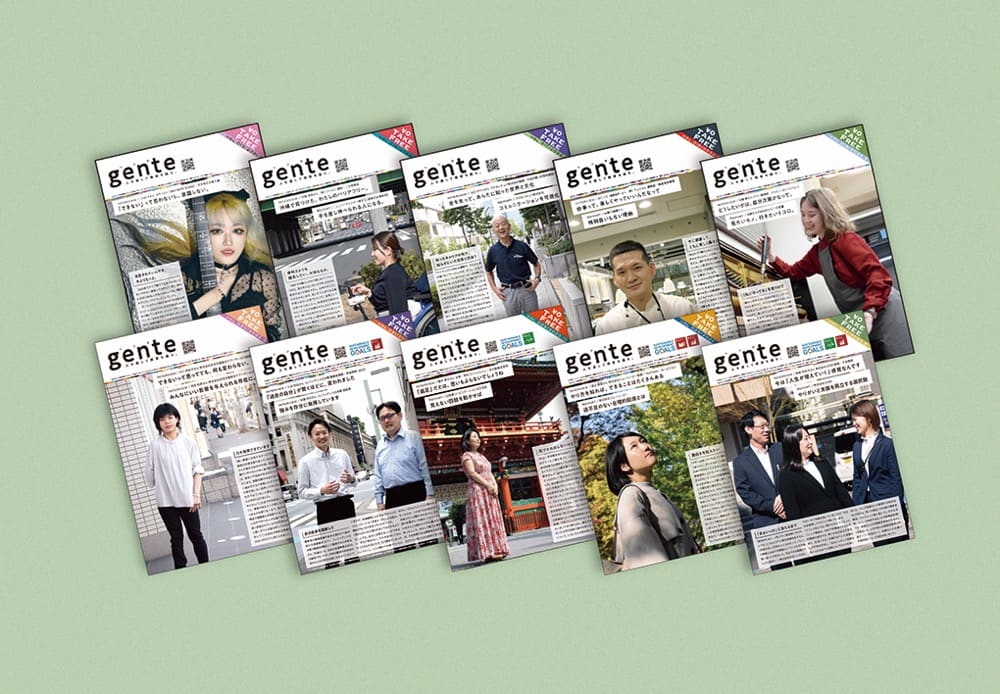
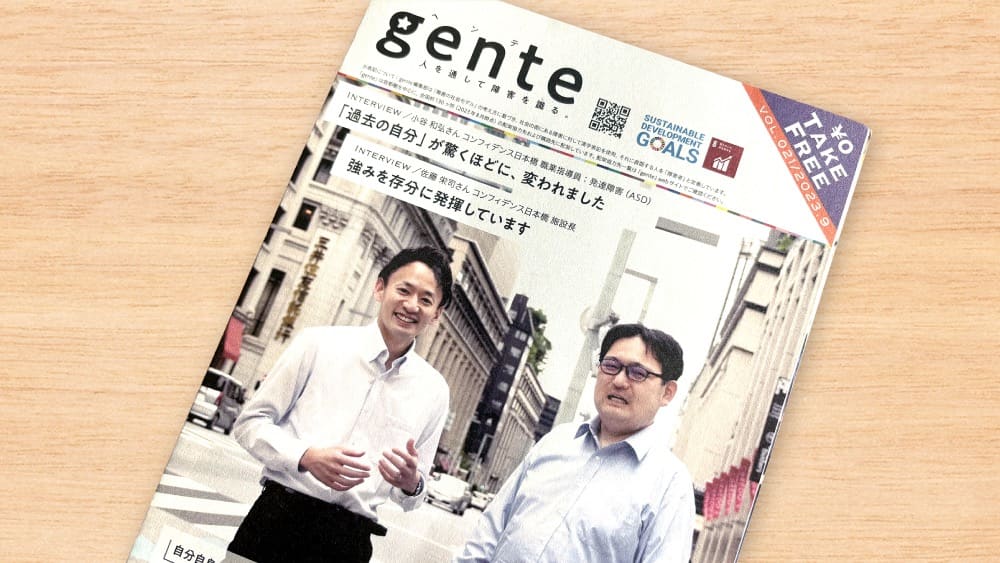
Launched in 2018, the newspaper gente (external link, in Japanese) is distributed free of charge at about 130 distribution spots located mainly in the Tokyo metropolitan area. Published four times a year, the paper features interviews with various persons with disabilities, such as individuals with developmental disabilities, people with limited vision, and prosthetic users.
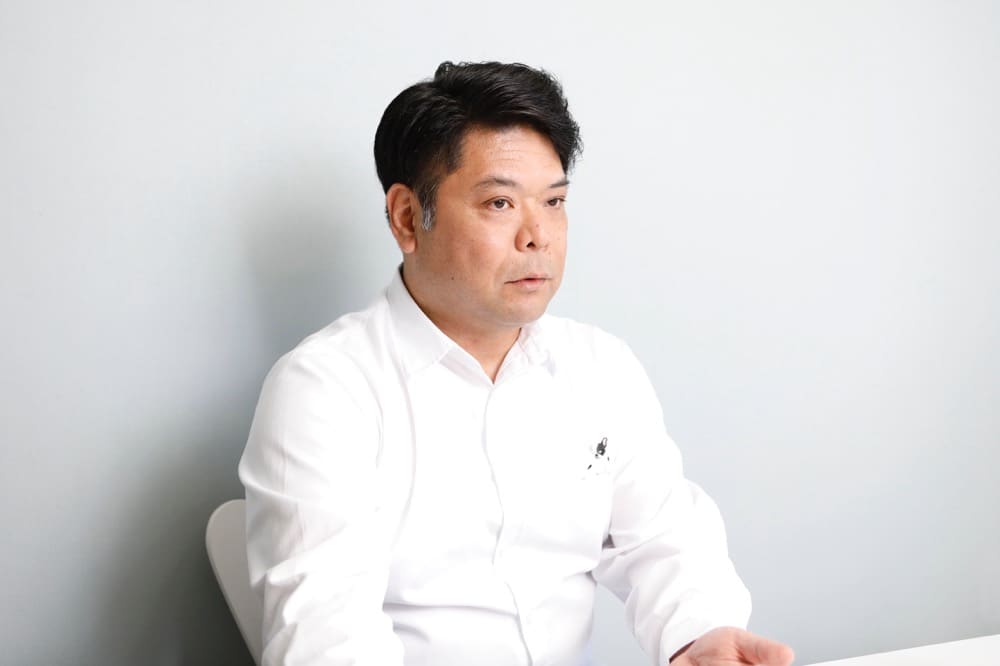
The publisher of gente is Motoki Osawa, whose main line of work is graphic design. He conducts interviews, takes photographs, writes the copy, and designs the paper by himself, through which he continues to disseminate the true nature and lifestyle of persons with disabilities.
His motivation for this initiative is rooted in a realization Mr. Osawa came to as he interviewed persons with various disabilities: “The obstacle lies on the side of society.” That’s why gente reflects Mr. Osawa’s desire — or more like his mission — to ensure that people “not be indifferent to disabilities.”
A society that ignores people with differences is itself disabled
The Nippon Foundation Journal Editing Department: To begin, can you tell us what led you to launch gente?
Motoki Osawa: Originally, I didn’t really want to deal with social issues, I just wanted to create a free newspaper.
I work as a freelance graphic designer, and basically the job is to make printed materials at the request of a client. Of course, it’s an important job, but I had a vague feeling that I wanted to try making printed materials in my own way.
Journal: From that starting point, why did you decide to cover “disabilities”?
Osawa: In the early spring of 2017, I learned about NGOs that publish free newspapers to disseminate information. I thought, “That’s something I might be able to do as well.”
Another reason was that the Paralympic Games were scheduled to be held in Tokyo in 2020. At that time, Paralympic athletes were being introduced in the media, but I realized that there were very few outlets that dealt with what those athletes do when not competing and what kind of lives they live. So, I thought it would be very interesting if I could cover the lives of persons with disabilities and disseminate that information.
Journal: So, there was not any clear concept when you began publishing.
Osawa: That’s right. Currently, gente uses the catchphrase, “understanding disabilities through people,” but when I started, I hadn’t verbalized it that way yet. When I began preparing a pilot version I made before the first issue, I also thought, “A disability is when a person can’t do something.” But as soon as I started interviewing persons with disabilities, my awareness changed, and I realized that “the obstacle lies on the side of society.”
Journal: How did you realize that?
Osawa: For the pilot version, I covered a sign language café, Sign with Me, in Kasuga, Bunkyo Ward, Tokyo. The official languages there were Japanese Sign Language and written Japanese (written language), and the employees were hard of hearing.
When I asked the owner, Mr. Yanagi, “What problems do you face because you are not able to hear?” he replied, “The problem is not that I can’t hear, but that I can’t access society in sign language.” Those words made me realize that the disability lies on the side of society, and persons with disabilities are dealing with it. I felt a strong shock, as if my way of thinking was fundamentally turned upside down.
Journal: I see. So, you have learned a variety of things through your interviews.
Osawa: That’s right. In the first issue, I interviewed Ryoga Yamaguchi, who has limited vision and is also a para-sports goalball player, and something happened that left an impression on me.
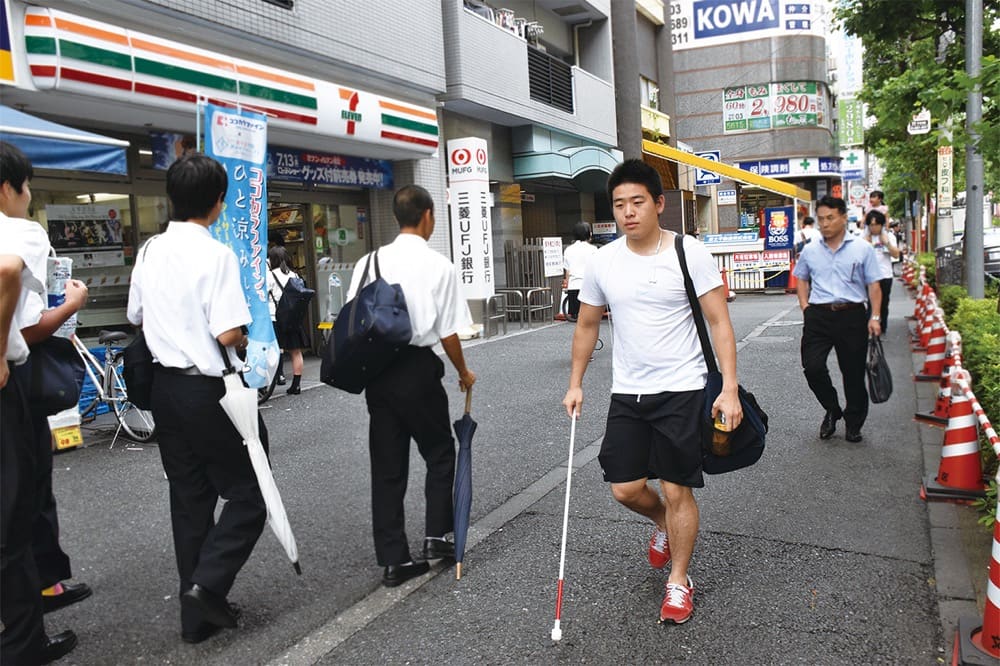
Osawa: When Mr. Yamaguchi entered a convenience store and quickly chose an onigiri rice ball, I asked him, “But you don’t know the taste, do you?” and he replied, “I’ll know it when I eat it. I don’t like pickled plums, so if it turns out to be pickled plum, then that’s a miss.”
He said it with a bright smile, but I didn’t feel like laughing. In other words, for persons with limited vision, it is difficult or impossible to select the flavor of rice balls they want.
It would be nice if society were able to make the kind of preparations that would let people choose the flavor of rice balls even if they have limited vision, but it does not. Far from making those types of preparations, I even felt that society is ignoring the issue.
As I continued to interview people, I had more of these types of experiences, and I gradually got a solid vision.
Journal: What vision was that?
Osawa: It was a shift “from indifference to interest.” There are too few opportunities for people to learn about disabilities, and I feel that many people still think of it as something that is unrelated to them. But I don’t think not knowing is an excuse, and I even feel resentment toward a society that is indifferent to the inconveniences and difficulties faced by others.
I believe that if more people know what is inconvenient and difficult, it can lead to a solution, and this also motivates me to continue publishing.
Journal: Despite those feelings, I do not sense that kind of intensity when I read gente, which I mean in a good way; I feel like you are picking up the real voices and thoughts of the interviewees as they are.
Osawa: Perhaps that is because one of the things I pay attention to in making gente is to have a policy of “not looking for things that people can’t do.” In the beginning, I had a strong desire to know what kind of problems the people I interviewed were experiencing.
But as I continued, I came to think that if I felt that way, I would be turning those people who let me interview them into “people in need” in the finished articles.
What I want to convey through gente is to have readers realize that there are people with differences, and that those people are facing obstacles in society that the readers have never thought of.
Journal: I see.
Osawa: So now, I try to show the way that the person is and how they live. That alone naturally makes the reader aware of how the person interviewed is different from them and what kind of “obstacles in society” that person faces as a result, and from that, they will understand that “the obstacles are on the part of society.” In addition, I am particularly conscious of not imposing the editorial department’s views, not making the reporting fit the story, and respecting the personal thoughts of those who are interviewed.
What we have to do is to get out of the context of “support” and look at the individual.
Journal: It has been six years since you published your first issue. Do you see any changes happening in society?
Osawa: I feel that the existence of persons with disabilities has finally been recognized for the first time. In the past, it seemed that they were almost treated as something “nonexistent.”
Journal: In fact, persons with disabilities are increasingly being cast in TV dramas.
Osawa: Yes. However, I feel that the treatment of persons with disabilities is not evenhanded. I feel that they are portrayed as a special person and are talked about in the context of “support” and “welfare.” I feel it is a bit condescending, like “doing something for persons with disabilities.”
People often ask me, “If I see someone in a wheelchair or holding a white cane on the street, how should I talk to them?” and that makes me feel uncomfortable.
Journal: Why uncomfortable?
Osawa: If you think the person seems to be having some difficulty, you can speak to them, but if not, you should just go about your business. The same applies whether it is a person with a disability or a nondisabled person.
For example, if I’m just walking along, no one would want to call out to me. Wheelchairs and white canes are a necessary means of transportation, and if someone can go out by themselves by using those items, they are basically the same as me walking alone. They are just moving in their own way.
There are probably still a lot of people who think that they really should make a point to speak to those who are in wheelchairs or holding white canes. But that’s not the case.
Persons with disabilities are not always in trouble, and you don’t always have to extend a hand to them. That is the first thing I’d like people to know. If we can get past that idea, both sides can be free from the context of “support” or “protection.”
There is no need to divide everyone into nondisabled people and persons with disabilities. When in trouble, we should talk to one another, and if there is something we can do about differences, then do it. That’s all there is to it.
Journal: That is certainly true.
Osawa: I believe that when you think seriously about addressing the issue of disabilities, in the end, you are dealing with individuals. As I mentioned, even when we talk about persons with disabilities as a group, there are some people who have difficulties and some who do not.
Basically, I think that in order to eliminate the inconveniences, what we need is not some “introduction to the visually impaired” that sums up everything that people with limited vision are having trouble with, but rather to engage with the person who is right in front of us.
Journal: Based on that, what do you see as the role of gente?
Osawa: Even if you are engaging with an individual, I think it is easier to do so if you go into it knowing at least a little bit about disabilities ahead of time. Even if there is a person with a white cane in your town, you don’t necessarily have to do anything. However, if you know what kind of difficulties they might have, it should be easier to imagine, “I think now might be a good time to say something to them.”
However, in today’s society, there are too few opportunities for people to learn about disabilities. So, I think it would be nice if gente provides an opportunity to get people interested in this topic.
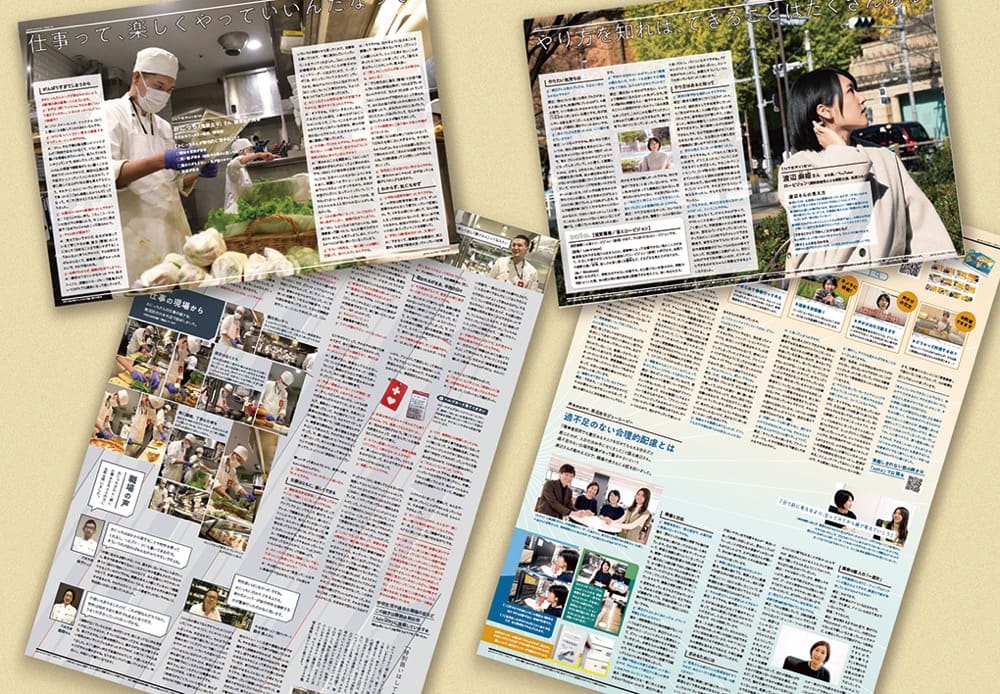
Osawa: With regard to disabilities, I think the problem is that there is a limited supply of information to start with, and a lot of the information out there takes a condescending view like “I’ll do something for you,” and it is not easy to get unvarnished information. It only reaches those who are really interested.
I want to break through that, so I’m particular about disseminating information through free newspapers that can reach even those who are not interested. Sometimes people ask, “Why do you bother to spend money to print free newspapers?” But even if I published it on the internet, in the end, it would only reach those already interested in the issue.
Gente does disseminate information that doesn’t make it into the main newspaper through a separate website, Adicion (external link, in Japanese), so I’m not avoiding the internet, but I think that many people have come to know about gente because it is in the form of a free paper that can be picked up by chance.
Journal: What kind of demographic are you hoping to reach?
Osawa: As long as we are living in the same society, it is relevant to everyone, so I’d like a wide range of people to read it, but in particular I’d like people who work for companies and organizations to read it.
The best way to learn about disabilities is to have direct contact, and I think the workplace is most suitable for that. Let’s say that you work in the same place toward a common objective, but there is something different between you and the person next to you. Based on that, what should each person do to utilize their abilities and complete the task? Thinking about that is what’s meant by reasonable accommodation.[1] I think it is better to say it is about adjusting to the individual.
It’s been said for a while now that we are in the era of diversity, and some companies are starting to work on DE&I,[2] but I feel that there’s still an unconscious demand that we be “like everyone else.” I sense that those people who aren’t able to be the same as others are thought of as “unusable,” “difficult to use,” or “a hassle.”
While there are many people who can utilize their abilities in a different way than the person next to them when there are reasonable accommodations or adjustments to the individual, there are still many who are not given the opportunity to do so “because they are disabled.” I think that if more companies realized this, it could only benefit both sides. That is why I make it a point to cover the companies where the people I interview work.
- Note 1: With regard to barriers in society, if a person with a disability requests the removal of a barrier in a specific situation, this refers to the obligation to take necessary and reasonable measures to remove that barrier to the extent that the burden with the implementation of that removal is not excessive. See: Public Relations Office, Government of Japan, “Businesses Are Required to Provide ‘Reasonable Accommodation’ to Persons with Disabilities” (open in a new tab, in Japanese) ↩︎
- Note 2: Abbreviation for Diversity, Equity & Inclusion. The term refers to the creation of a society where everyone can play an active role, respecting and acknowledging one another’s diversity in terms of race, gender, age, and disability, and placing priority on fairness.↩︎
Osawa: In an era where companies are competing for human resources due to labor shortages, we should be able to pave the way by expanding the scope of employment, but I think there are many companies that are hesitant to do that. I want people to realize how effective it is to employ persons with disabilities.
I want the entry point to be information that does not feel like studying, but rather is something people can enjoy
Journal: What can each individual do to create a society where everyone can play an active role, regardless of whether they have a disability or not?
Osawa: I think it is about learning and being interested. It is counterproductive to have information feel like studying, like “Let’s learn about disabilities. This is what we should do.” That becomes annoying to read. I think it is very important that the entry point be information that can be enjoyed.
This is also why gente focuses on personal stories, and I hope the articles allow people to learn while enjoying themselves. I don’t approach it from the mindset of teaching something, but rather with the idea, “Hey, this person is interesting, so please read it.” I think that’s why the message can be conveyed.
We also offer subscriptions, so I hope everyone will take a look. Because gente covers not only specific disabilities but all types of disabilities across the board, I believe that by continuing to read it, people will gain a broader awareness.
Editor’s Note
Mr. Osawa’s approach in publishing gente produces content that has enabled the Editing Department of The Nippon Foundation Journal, which also publishes articles on social issues, to gain many insights. As more people think about where obstacles are and become aware of them, it creates an environment that can move society. In order to remove the obstacles on the side of society, I would ask our readers to begin by telling your closest acquaintances about gente. You can check the locations where gente is distributed here (external link, in Japanese).
Text: The Nippon Foundation Journal Editing Department
Photo: Emi Enishi
Profile
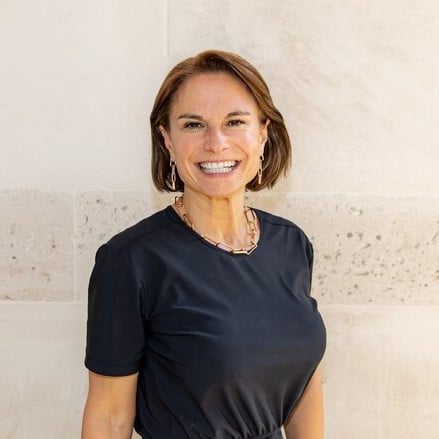
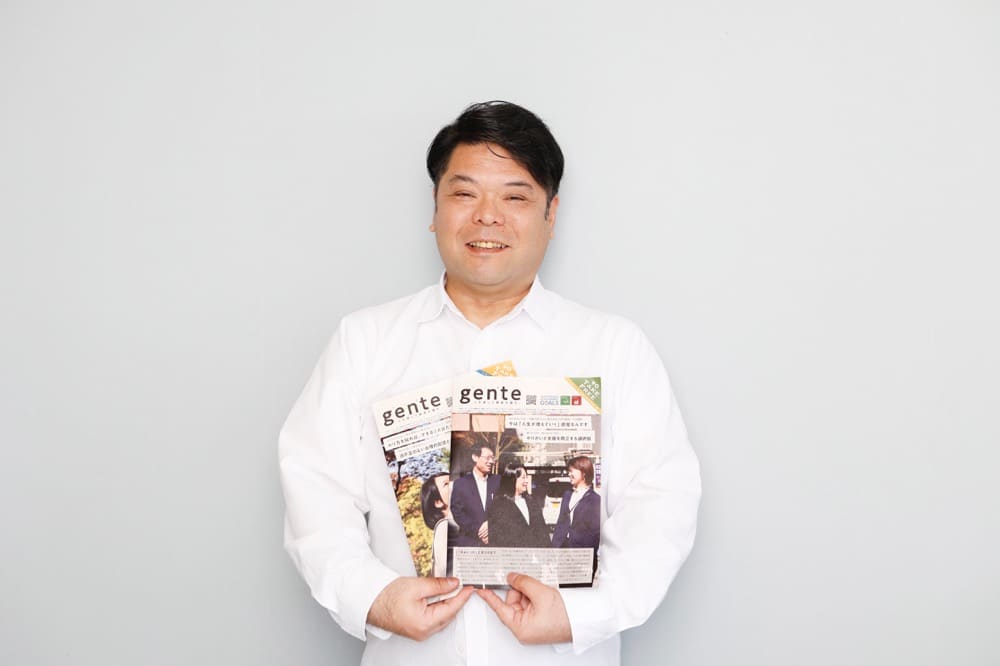
Motoki Osawa
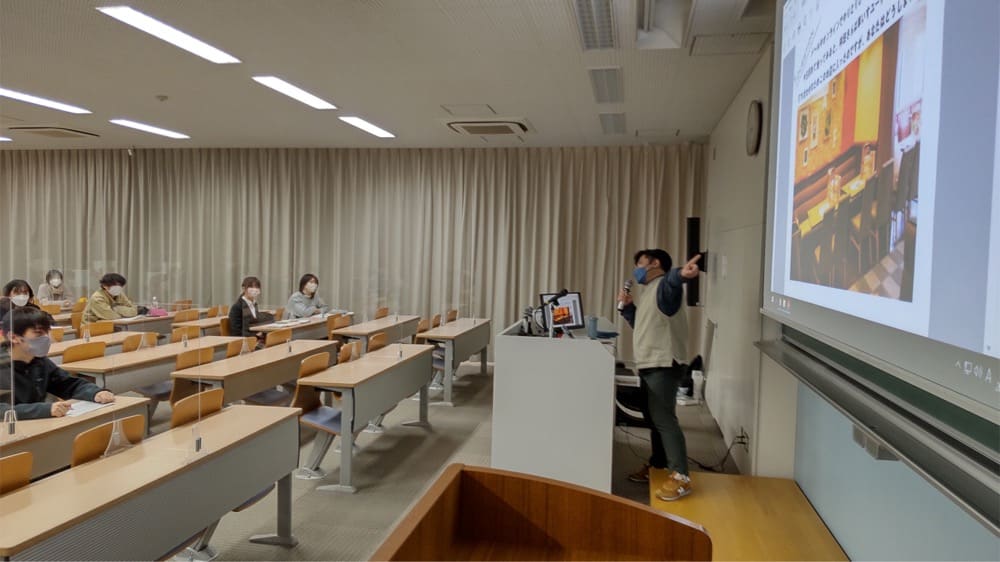
Graphic designer. Osawa published a pilot version of gente in May 2018, having questioned the fact that there are no opportunities to interact with persons with disabilities in daily life. The response was more positive than expected, and so he decided to publish it periodically. Since then, he has continued to publish quarterly, carrying out everything from interviews to editing, photography, and design/layout by himself. Based on the information obtained through the interviews, he is actively working on lectures to promote understanding of disabilities as well as DE&I training programs.