Why Hasn’t Employment of Persons with Disabilities Made Progress in Japan?How working with persons with disabilities can improve the workplace

Key Points
- The Employment Rate System for Persons with Disabilities is set, but many companies are still hesitant to hire.
- Creating a workplace where persons with disabilities can work comfortably benefits everyone.
- To build psychological safety for persons with disabilities, start by taking an interest in them.
Japan has the Employment Rate System for Persons with Disabilities, under which companies above a certain size are required to meet the statutory employment rate. This is an obligation to ensure a certain employment rate of persons with physical, intellectual, and mental disabilities to the number of regular workers.
As of December 2024, the statutory employment rate for private companies is 2.5%. This means companies with 40 or more employees must hire at least one person with a disability. Employers that fail to meet this obligation are ultimately subject to administrative guidance.
- Note: Starting in July 2026, the statutory employment rate for private companies will be revised to 2.7%, and the requirements are expanding to cover companies with 37.5 employees under an amendment to the law.
However, the reality is that some companies are not very proactive about employing persons with disabilities. Some employers seem to think, “We can’t work with persons with disabilities; it’s too difficult.”
Why do they think that way? At the root is a lack of understanding of persons with disabilities. Working to correct that within companies is Fumihiko Kinoshita, who previously served as head of the disability employment division at Mitsubishi HC Capital Inc. and now has established Lagrange Support Inc. (external link, in Japanese) and works as a disability employment consultant.
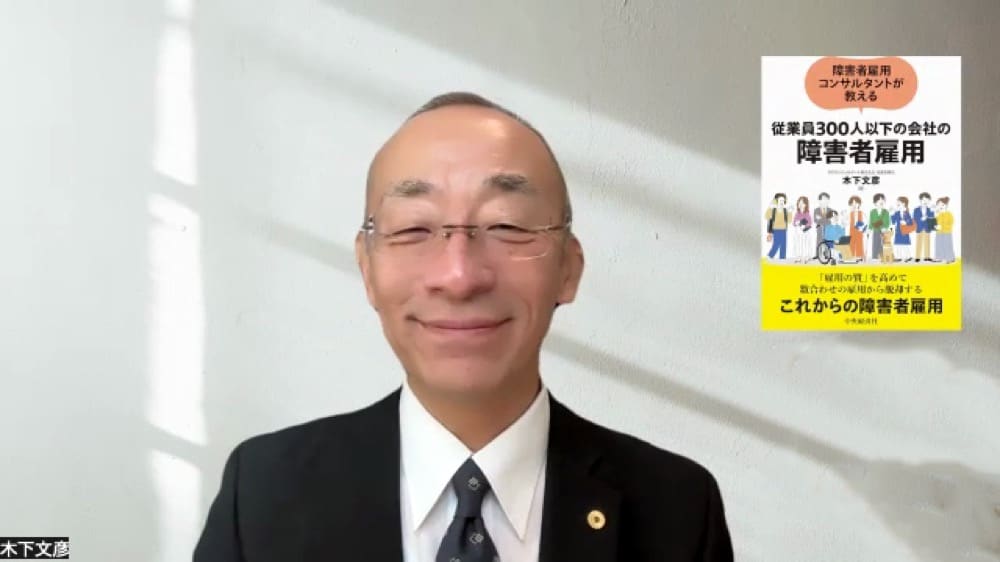
Why, despite the statutory employment rate, has the participation of persons with disabilities in the workforce been slow to advance? We spoke with Mr. Kinoshita, who has worked with many companies, to find out.
Why do some executives ask, “what’s the benefit of hiring persons with disabilities?”
The Nippon Foundation Journal Editing Department: First, please tell us what a disability employment consultant does.
Fumihiko Kinoshita: People often misunderstand and think I support persons with disabilities in finding work, but my role is to approach the employer side, companies that want to hire persons with disabilities. Over a few months, or up to about a year, I propose measures and provide know-how on employment of persons with disabilities.
Ultimately, my job is to make it possible for the company to employ persons with disabilities smoothly even after I’m no longer involved. I also speak at seminars on disability employment and write articles related to it.
Journal: Since the Employment Rate System was established, we’ve seen companies move to hire persons with disabilities more proactively. On the other hand, aren’t there also companies that seem focused only on meeting the number?
Kinoshita: As you said, the reality is that some companies see persons with disabilities only as a number. If a company falls short of the statutory employment rate, it must pay a levy of 50,000 yen per person per month based on the shortfall, and some people even call that a “fine.”
But it isn’t a fine. Paying the levy does not exempt the employer from the obligation to hire. If they keep doing nothing, administrative guidance will eventually follow.
That’s why companies need to think ahead and hire persons with disabilities properly. And to do that, in many cases they need to change how they think.
That said, it’s also true that the Employment Rate System has expanded disability employment. So it may have both positives and negatives.
For now, I’d say social and corporate understanding of employing persons with disabilities still hasn’t caught up …
Journal: We’ve heard some people even ask, “Is there any benefit to employing persons with disabilities?”
Kinoshita: They do. I hear it all the time. Hiring persons with disabilities requires reasonable accommodation*, and the honest truth for some companies is, “It’s a hassle, so we’d rather hire nondisabled people we don’t have to worry about.”
But I think what that really means is executives can’t picture what happens when they hire persons with disabilities. If they have children, parents, or a spouse, they might be able to imagine things like young people working, hiring seniors, or women’s participation in the workforce …
But because they don’t know much about persons with disabilities, it’s hard to imagine. So they can only grasp it in the abstract and end up looking only for drawbacks.
- Starting in April 2024, it became mandatory for government agencies and businesses to provide necessary and reasonable accommodation when a person expresses the wish to have social barriers arising from disability removed.

Kinoshita: That said, among small and midsize business owners, quite a few are seriously thinking about employing persons with disabilities.
In the past, many companies mainly sought male college graduates who didn’t mind transfers, overtime, or working on days off, and they could hire those people. But now the labor pool is shrinking and labor regulations are getting stricter, so companies need to look at a wider range of people. That includes women, seniors, and also foreign nationals.
And within that group are persons with disabilities. I feel more and more people are starting to think that way and to focus on diversifying their workforce.
Taking a proactive approach to disability employment broadens hiring options
Journal: When you’re speaking to people who can’t really picture employing persons with disabilities and don’t yet fully understand it, how do you explain it?
Kinoshita: First, I ask, “Why not try changing your perspective?” Companies have management philosophies and visions. For example, suppose they say, “We will leverage the strengths of diverse talent and create innovation.” In that case, I tell them, “That diverse talent includes persons with disabilities.” That helps them revisit their own vision, and it’s easier to understand.
The other thing I do is encourage what I call an “inventory of tasks.” I ask, “Is there any work you wish someone would take on right now?” That brings up a lot. From there, we identify tasks a person with a disability can do and connect it to a discussion on employment.
After all, even among persons with disabilities, each individual’s characteristics are different. But for people who don’t know much about disability, their image tends to become fixed. That’s why they end up thinking, “There’s no work a person with a disability can do.”
So I interview them about where they’re short-staffed or what kinds of work they want to strengthen, and then we look for what a person with a disability can do within those tasks.
Journal: Going through these steps also helps organize and clarify internal work processes.
Kinoshita: Exactly. And it helps the company function better overall.
And in many cases, it also benefits employees without disabilities. For example, suppose a company introduces a system that lets employees take a half-day off using paid leave, making it possible to work even with shorter hours when hiring persons with disabilities. That system can be valuable not only for employees with disabilities, but also for people who are raising children or going to medical appointments.
Employing persons with disabilities leads companies to rethink how they operate, improves workability for every employee, and can even extend the life of the business.
Journal: What you’re describing applies to society as a whole, too. When services are improved for persons with disabilities, they end up being easier for everyone to use.
Kinoshita: I truly believe that. When you change systems for persons with disabilities, it comes back around and makes life easier for everyone. There’s no downside.

Journal: Could you share an example of a company where implementing disability employment led to positive changes?
Kinoshita: In Chino City, Nagano Prefecture, there’s a company called Miyama Co. (external link, in Japanese). They design and develop materials known as super engineering plastics, which are used as an alternative to metal.
There, when they form molds, they need adjustments in increments of 0.1 millimeters. It’s extremely detailed work, and most people apparently get worn out.
But they hired someone with developmental-disability traits who was good at focusing on fine, detailed tasks and had that person take on the work. Productivity improved. After that, they were able to take on difficult orders that other companies couldn’t accept, so they were no longer exposed to price competition.
What’s more, as word spread that the company was proactive about employing persons with disabilities, applications also increased from young people who do not have disabilities. People likely thought it must be an easy place to work. As a result, they no longer struggled as much with hiring.
The line between persons with and without disabilities is not clear-cut
Journal: What the Miyama example shows is how important it is to build on each person’s strengths and what they can do.
Kinoshita: Yes. I’ve heard that when someone joins Miyama, they first rotate through different departments to determine what kind of work fits them. The key is not trying to fit people to the job, but assigning the job that fits.
Journal: It seems necessary to understand persons with disabilities correctly and create an environment where each individual’s strengths can shine. Beyond that, is there anything else needed so that persons with disabilities can work comfortably and confidently?
Kinoshita: High psychological safety* in the workplace. In my previous job, I held interviews with employees with disabilities, and their minds were full of anxiety.
They’re constantly thinking things like, “Did I make a mistake?” or “Did I say something strange?” That anxiety builds, and then they can’t focus on their work.
So you need to create an environment where they don’t have to carry that kind of anxiety. Eliminate vague instructions that can leave employees with disabilities unsure, create manuals, put everything in writing, and reduce as much as possible the factors that create anxiety.
Also, I think it’s important for each of us who works alongside them to take more interest in persons with disabilities. A great many people assume, “There aren’t any persons with disabilities around me.” But according to a 2021 survey, about 7.6% of the population has a disability, so there should always be someone nearby. We just don’t see it, or we don’t notice because it doesn’t match the disability image we have in our heads.
I hope people will shift their mindset and take even a small interest in persons with disabilities and disability issues.
- A state in which anyone, regardless of position or experience, can share opinions and ask candid questions is described as “high psychological safety.”
Journal: It made me think that what causes persons with disabilities to feel anxious may be a society built as if they don’t exist, and the thinking of each of us as individuals.
Kinoshita: Yes. That’s exactly why we need to start taking an interest and thinking about it from here on.
People often say, “Employment of persons with disabilities is difficult,” and it is, in fact, difficult.
The “creating an environment where people don’t have to feel anxious” that I mentioned earlier may sound like a collection of minor issues. But it’s hard to address them one by one, and I think many people see it as a burden.
But by doing that, the inconvenient truths of the workplace gradually decrease, and in the end, it becomes a workplace where everyone can work more easily. It creates a more workable environment not only for employees with disabilities, but for others as well.
In the long run, it’s all benefit. So I hope we can update how we do things, starting right now, together.
Editor’s Note
For companies aiming to build a diverse society, taking a proactive approach to employing persons with disabilities is essential. Yet the reality is that employment of persons with disabilities is not progressing smoothly. Where does the problem lie, and how should we think about disability employment in the first place? To explore these questions, we spoke with Mr. Kinoshita.
What matters is understanding persons with disabilities correctly and seeing them again as people who are part of our everyday lives. We hope for a society in which everyone can engage with persons with disabilities without treating them as exceptional, and instead relate to them as fellow human beings.
Text: The Nippon Foundation Journal Editing Department
Profile
Fumihiko Kinoshita
Disability employment consultant, Certified Labor and Social Security Attorney, and Certified Small and Medium Enterprise Management Consultant. Born in 1962 in Matsumoto City, Nagano Prefecture. Drawing on his experience overseeing the full scope of employment management for 70 employees with disabilities at his previous company, he established Lagrange Support Inc. in 2023. He shares know-how with companies on employing persons with disabilities. His publications include “Disability Employment for Companies with 300 or Fewer Employees: Lessons from a Disability Employment Consultant” (Chuokeizai-sha Holdings Inc.).