The Common Language Is Sign LanguageWhy Starbucks created a store that embodies diversity
Key Points
- Starbucks Coffee Japan actively hires “challenge partners” with diverse backgrounds
- Starbucks Coffee Nonowa Kunitachi store, the first Starbucks in Japan where sign language is the common language, was created based on employee (“partner”) feedback
- To create a society where everyone can be themselves at work, it is important to have dialogue that transcends status and position and to have diverse experiences
- Note: Starbucks refers to their employees as “partners” and calls partners who have disabilities “challenge partners”
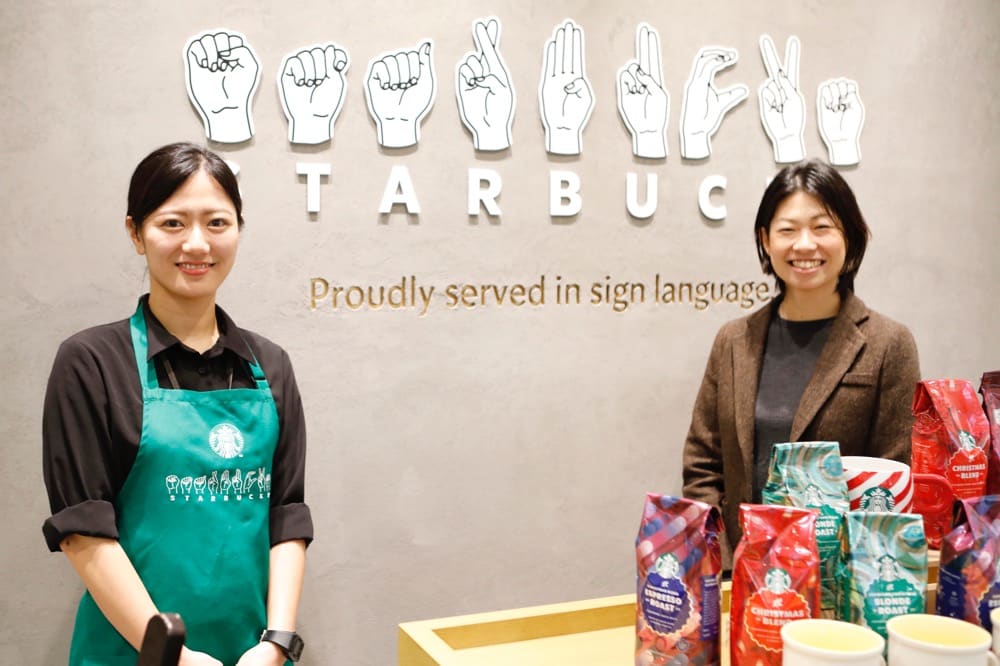
Starbucks Coffee Nonowa Kunitachi store opened in 2020. Over half of its staff members are hard of hearing. It is the company’s first “signing store”* in Japan — a store where sign language is the common language. The store has taken a variety of measures to make communication easier, such as using a pointing board as well as digital signage and displays that teach customers sign language.
- Starbucks’ term for stores where sign language is the common language.
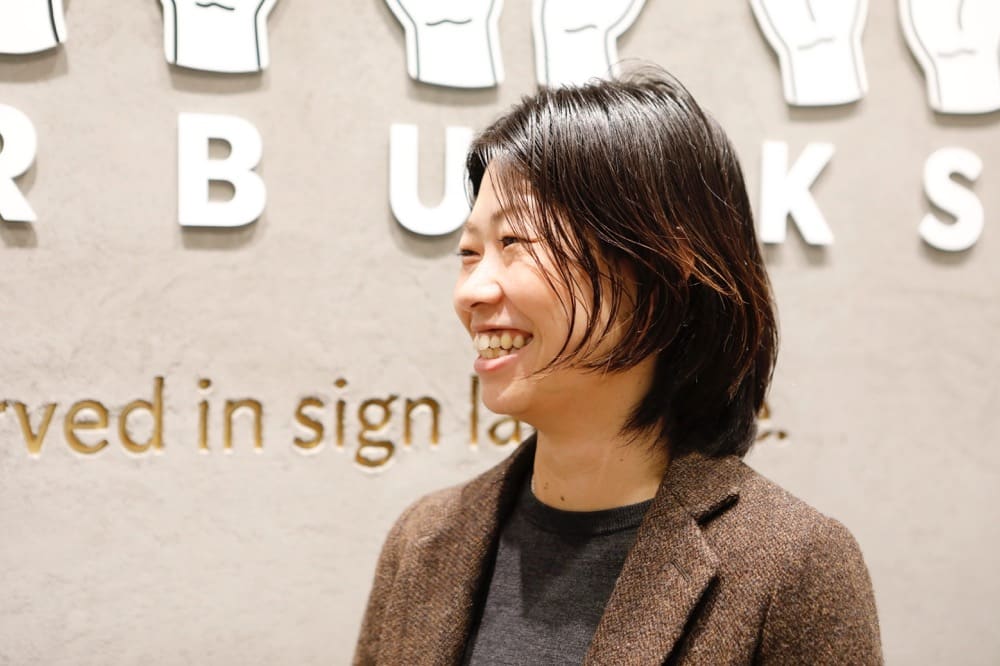
Starbucks Coffee Japan Ltd. (external link, in Japanese) views each employee as a valued partner and strives to create workplaces that are comfortable to work in for everyone, whether they are disabled or non-disabled. We talked with Starbucks Coffee Japan district manager Ms. Kogo and store manager Ms.Yoshida about Starbucks Coffee’s efforts and what is needed to create a society where everyone can work comfortably.
Signing store born from the ideas of enthusiastic partners who are hard of hearing
The Nippon Foundation Journal Editing Department: I know there are partners with a wide variety of disabilities working at Starbucks Coffee, but around how many partners have disabilities?
Kogo: There are about 370 partners with disabilities across Starbucks Coffee’s 2,000 stores in Japan. In most cases there is only one person with a disability at a store, but at the Nonowa Kunitachi store, 20 of the 32 partners who work there are hard of hearing.
Journal: So, many of the partners at the store are hard of hearing. Could you tell us the background behind opening the first signing store in Japan?
Kogo: Partners who are hard of hearing have planned and carried out projects in the past like “Sign Café” and “Sign Coffee Seminar.” After opening our first signing store in Malaysia in 2016, partners in Japan expressed that they wanted to try running a store themselves and build careers in which it wouldn’t matter if one could hear or not, so we decided to try opening a signing store in Japan too.
The reason we decided to open it in the city of Kunitachi was that there was a school for the deaf* nearby, and it already had a community of deaf people. The school bus stops at the traffic circle right in front of us. Some other reasons were that the city is focusing efforts on social inclusion in which diverse people live together, it is very close to the train station ticket gate, and the location is easy for partners to commute to by train and bus.
- Today, the name of the school is Tokyo Metropolitan Tachikawa Gakuen. “Deaf” refers to people who have lost their hearing before learning a spoken language and regularly use sign language. “School for the deaf” refers to a school that educates children who are deaf or have severe hearing loss and provides essential life knowledge and skills to deaf people.
Key in developing the store was ensuring operations were not dependent on hearing
Journal: What are some innovations the Nonowa Kunitachi store has implemented that other stores don’t have?
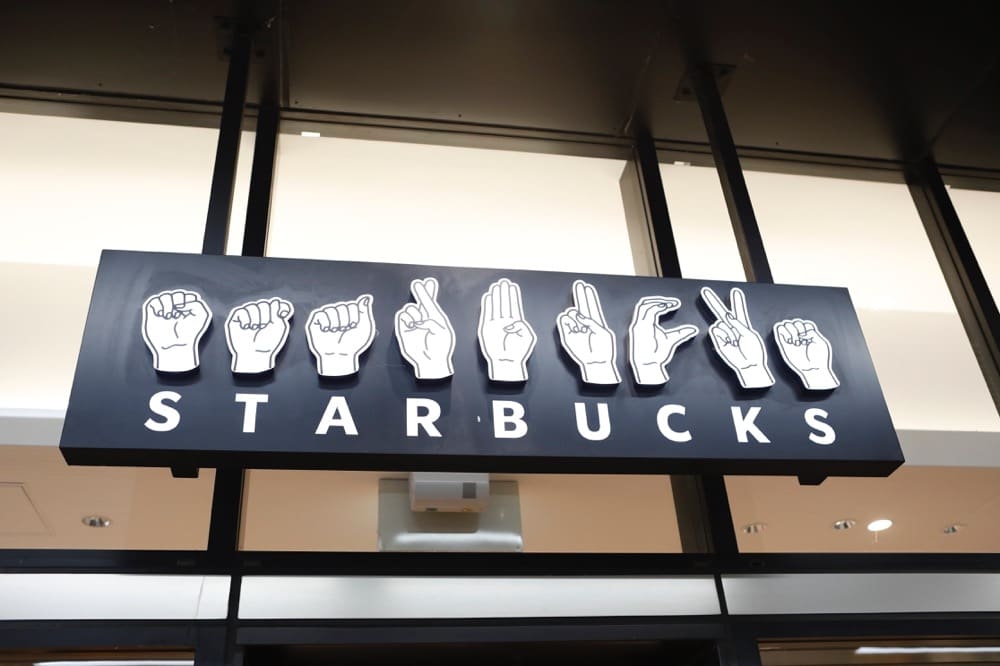
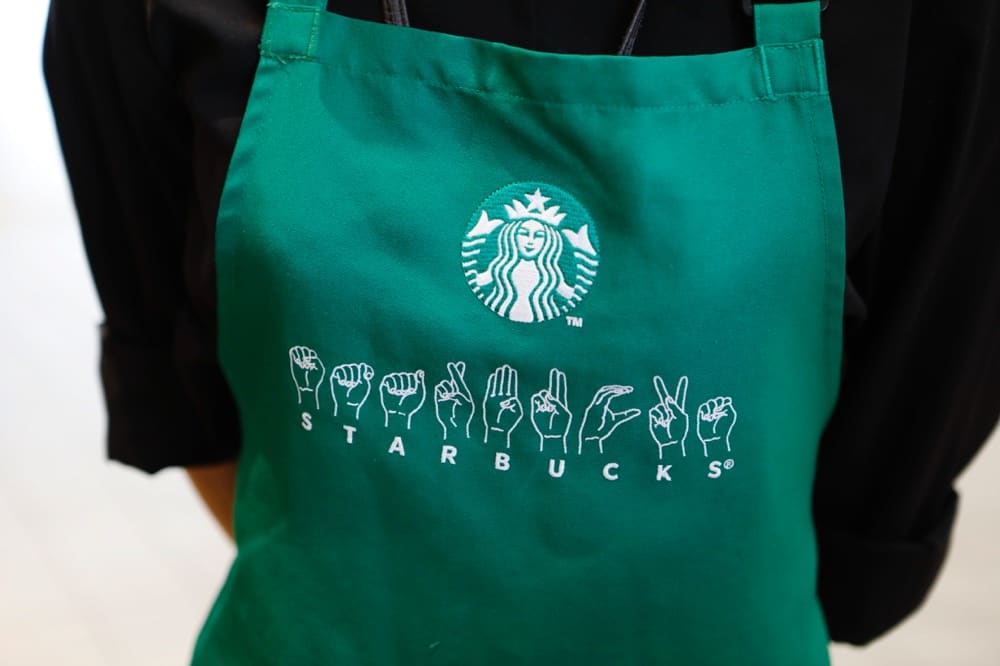
Yoshida: First is the Nonowa Kunitachi store’s original logo design. We have a sign that displays “Starbucks” in fingerspelling and partners wear aprons with the logo embroidered on the chest.
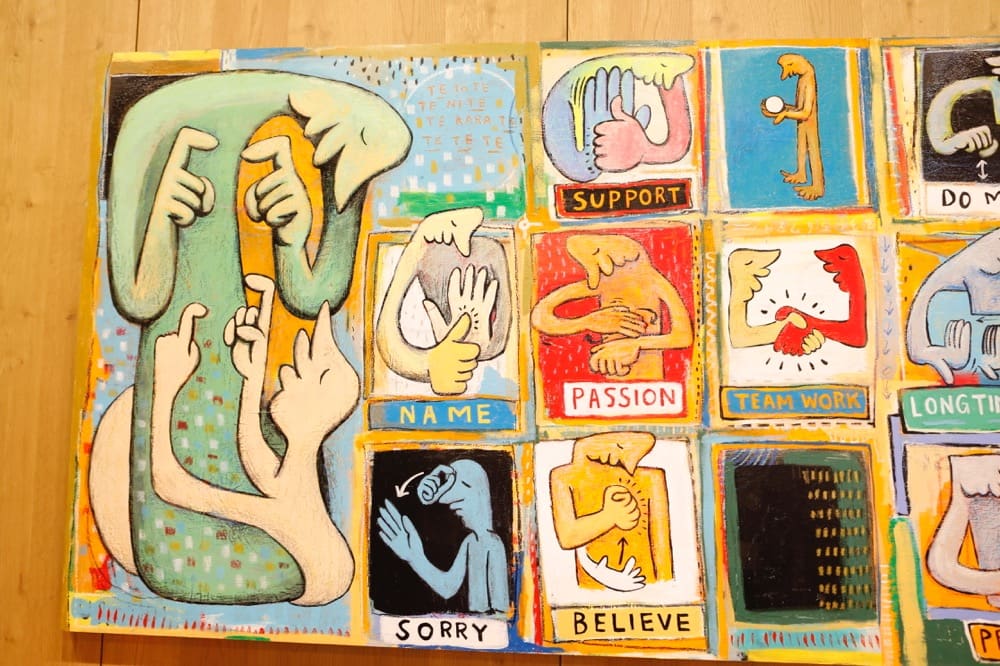
Yoshida: The colorful illustration that covers a wall is by CODA[1] artist Hidehiko Kado. It playfully depicts a variety of sign language signs, and if you look closely, you’ll notice that some signs are related to Starbucks like “latte” and “Frappuccino.”
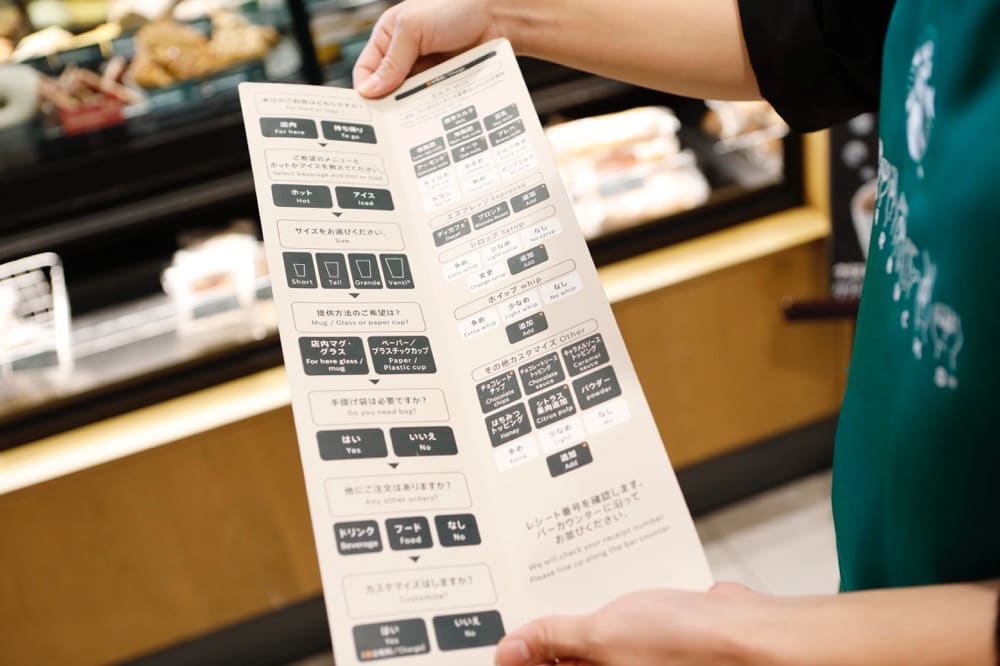
Yoshida: We also have a pointing menu in addition to our regular menu to ensure ordering goes smoothly at the check-out counter. Customers can also use the menu to indicate whether they want to eat in, the size they want, and customization options, all which are clearly written on the menu. Everything is written in English as well to help partners communicate with non-Japanese customers.
When a drink is finished being made, the three-digit number on the receipt appears on digital signage[2]
next to the pickup counter.
Journal: You also installed a device to teach people simple sign language next to the pickup counter, right?
Yoshida: Sometimes when waiting for a drink, people don’t notice that their number is displayed because they are looking down or at their smartphone. We placed it a little higher than customers’ eye level, so they will naturally take notice. We also wanted customers to experience sign language in a fun way.
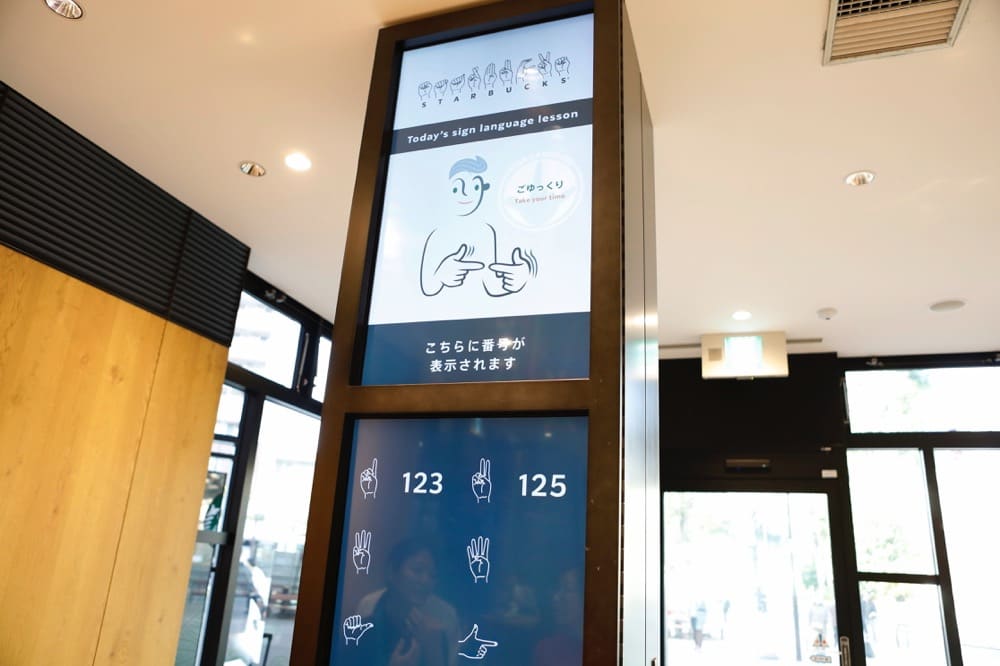
Journal: Seeing that display makes you want to try out sign language.
Yoshida: It does. Many customers practice the signs while looking at the display and when partners see that they show the customers the right way to do it, so it encourages communication. We place importance on customers and partners making direct eye contact and communicating with each other, so the pointing menu and digital signage are merely used as tools to help partners serve customers.
Journal: What other innovations have you implemented?
Yoshida: Sign language is the common language at the Nonowa Kunitachi store, so non-audio communication methods (such as visual and vibration) have been incorporated throughout the store. For example, the tables are low and have rounded corners, so they do not interfere with the movements of signing. We also made the counters and walls white and the lighting brighter than in regular stores to make it easier for people to see each other’s facial expressions.
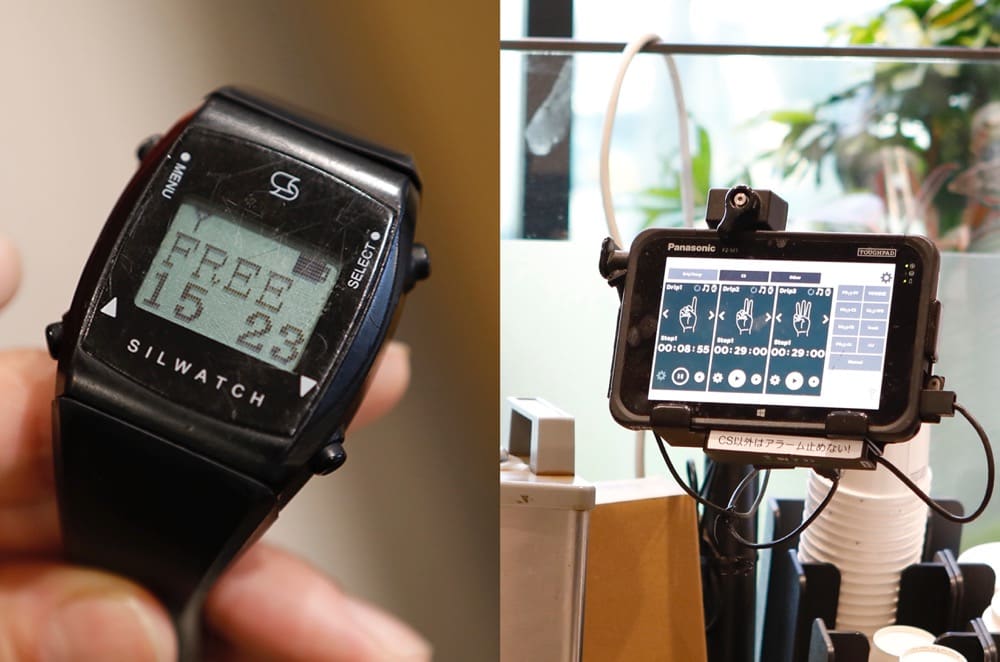
One of the walls in the back room has a big white board to write down the contents of meetings and a mirror to prevent people from bumping into each other. We also use digital watches that notify you with text, light, and vibrations, which partners use to manage the freshness of beans and call for help. We also make efforts to convey information with colors like a traffic light to ensure quick communication.
Journal: How did such innovations come about?
Kogo: Before opening this store, we experimented with “signing hours” and “signing days” at stores for about two years, in which partners who are hard of hearing operated a store for a limited period of time. We created this environment by incorporating the feedback and requests collected from partners in these trial runs.
- Note 1: CODA stands for “Children of Deaf Adults,” that is, hearing children who were raised by deaf parents. “Hearing” is an antonym for deaf, and in this case means a person without an auditory disability.↩︎
- Note 2: A form of media that uses electronic display devices to convey information. It is used in a wide range of locations, including outdoors, in stores, in public spaces, and on public transportation.↩︎
Opening the signing store led to an increase in partner applications
Journal: A workplace where over half are hard of hearing is still rare in Japan. Looking back, was there anything you felt was hard or difficult?
Yoshida: I never felt there was anything hard or difficult about having a higher percentage of partners who are hard of hearing. If I had to say, before becoming manager of this store, I had zero experience with sign language, so I guess it was pretty hard learning it from scratch. But the partners around me taught me, so each day I had fun learning a little at a time.
Journal: What was the response from the partners?
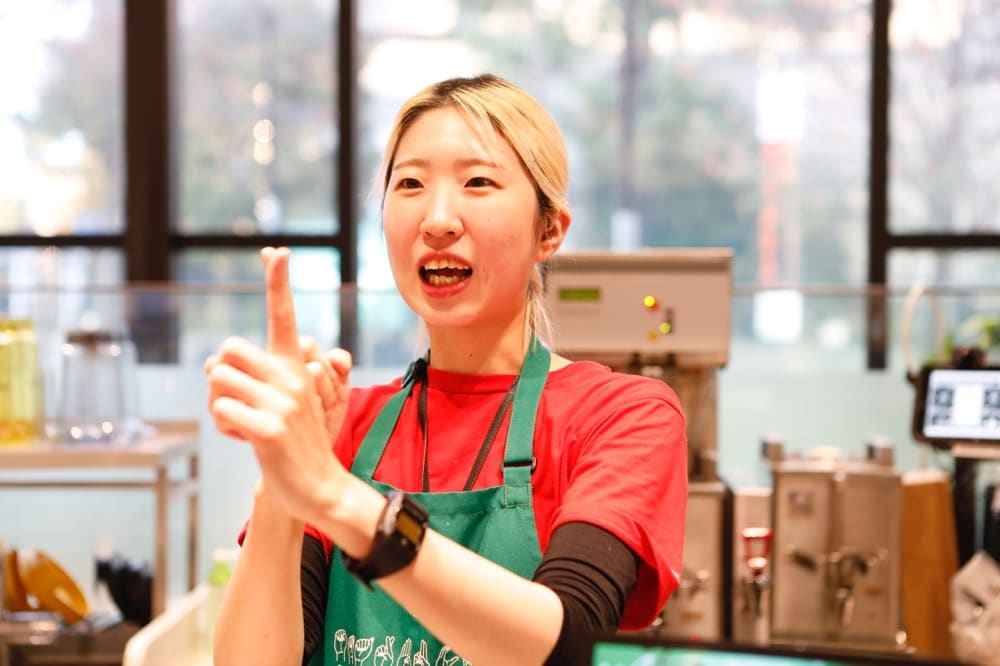
Yoshida: Before joining the company, they were of course nervous about whether they could do well in this new environment, but more than that, they were excited about being able to communicate with customers and overjoyed that they could make beverages they used to drink as a customer. Everyone here is so vibrant.
Journal: Is there anything you realized or noticed since you started working at this store?
Yoshida: It reaffirmed for me how important it is to have the mindset of wanting to convey to and understand others when communicating regardless of language, age, or whether you can sign or not.
It also made me realize the importance of nonverbal communication like eye contact. When I worked at another store, I would often unconsciously look down when working and only communicate verbally, but when you communicate while making sure to look at the other person’s eyes, it really comes across differently. This is something I also hear often from partners who come from other stores to help out.
Journal: What has the response from customers been?
Yoshida: The store has been in the press, and many customers come from far away. There are even people who live nearby who come twice per day because they love the store. And there are people like me who had no experience with sign language before the Nonowa Kunitachi store opened but learned it because they wanted to be able to converse with partners and can now communicate completely in sign language.
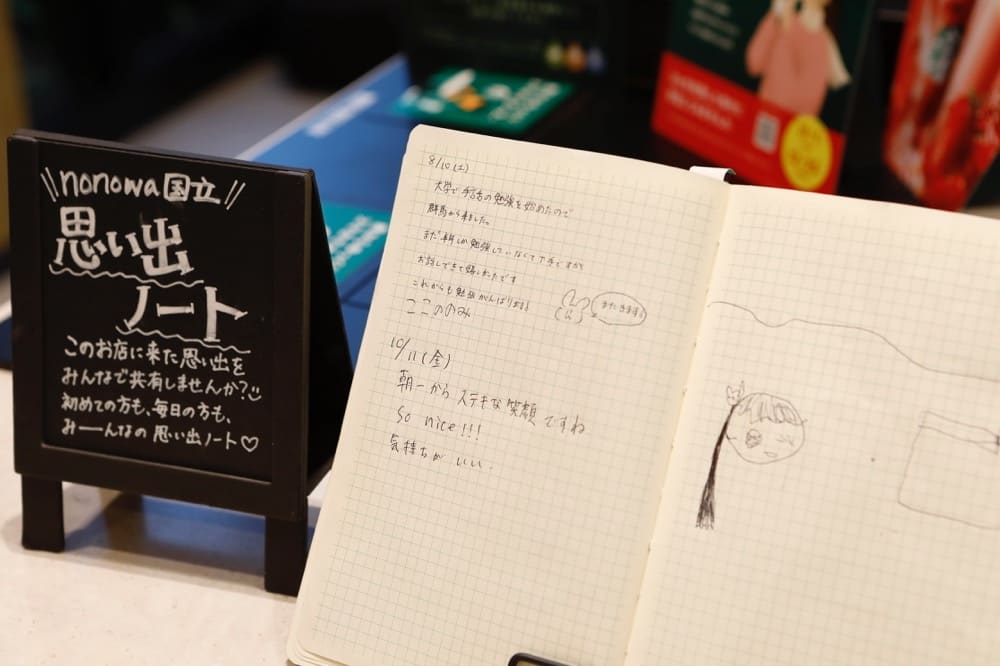
Kogo: Another big change is that many people have applied to work at Starbucks after learning that this store opened. I thought that people who lived nearby and those with similar characteristics would apply, but I was pleasantly surprised to see that so many people—both disabled and non-disabled—who live far away want to work here too.
Striving to create a store that is not for persons with disabilities, but a store where everyone can work comfortably
Journal: Will there be more signing stores?
Kogo: As of now, it hasn’t been decided whether to make more signing stores. The most important thing is to ensure that all stores are places where everyone can be themselves at work and to create work environments where every partner feels they belong.
Journal: Lastly, what do you think can be done to create a society where all people can work vibrantly?
Yoshida: I think everyone needs to consider what they can do to ensure people can live comfortably as an individual in society regardless of whether they have a disability or not. When I heard from a partner who is hard of hearing that if there were an accident where someone was injured while on the train, they wouldn’t know what to do because they would have no idea what had happened. Hearing that, I realized that we live in a society where it is difficult to get information when you cannot hear, and began to think of what I could do.
I realized that information that people who can hear take for granted cannot be taken for granted by those who cannot hear and that society puts up barriers that make it difficult to live for people who cannot hear. To create a society where everyone can work vibrantly and play an active role, every member of society must take ownership, which includes me.
As a manager, I want to hear the ideas of people of different ages, genders, and backgrounds, and build a team where we exchange opinions with each other and consider what to do together.
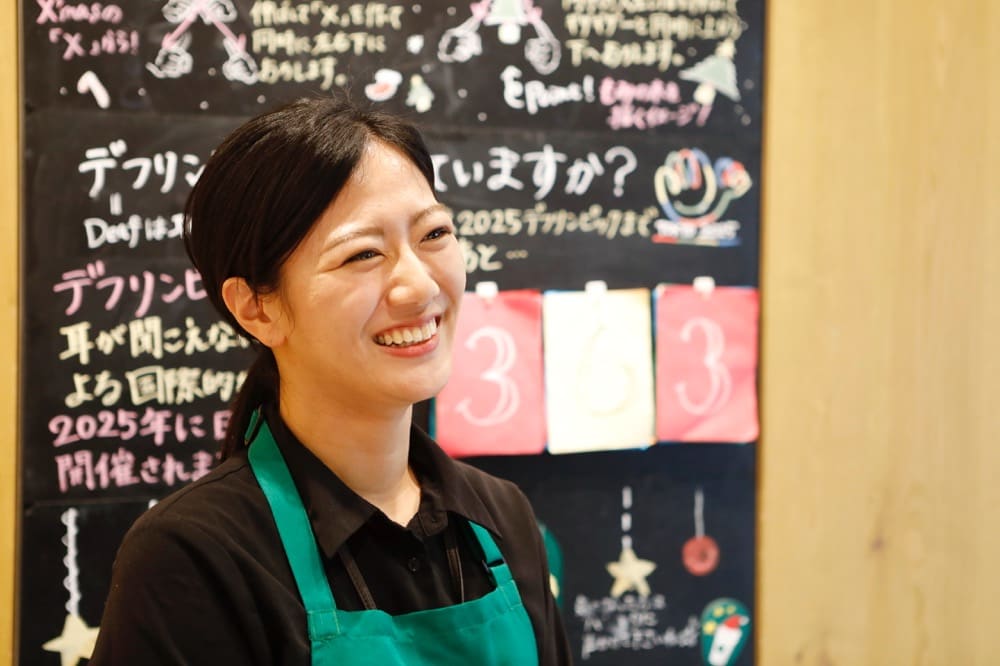
Kogo: As far as people who are hard of hearing are concerned, I think we also need to respect the fact that they have a different language of their own. Communicating while making eye contact is important, but that doesn’t mean you can convey everything by looking at the eyes.
At this store, I often see customers doing their best to communicate by incorporating gestures when they realize that the employee behind the check-out counter cannot hear and partners trying hard to understand what customers want to say. Because people speak different languages, they think together how to communicate on a deeper level. I open the store every day with the hope that such experiences will lead to social change.
Editor’s Note
When I went to Kunitachi Station before, there was a fingerspelling sign that left an impression on me. I looked it up and found it was the Starbucks where sign language was the common language, so I had been interested in it.
On the day of the interview, what impressed me was that every partner I met at the store was smiling and looked like they were enjoying their jobs. It was also a fun experience being able to communicate with the signs I just learned by signing “Hello” and “Thank you.”
At the same time, I realized that I had preconceived notions of what they could or could not do due to their disability. You may feel hesitant when you hear the common language there is sign language, but not being able to do sign language will be no problem at all. Visit the store with the same attitude you would with any other store. Discoveries and questions you have when you do may be a first step in creating a society where everyone can work comfortably.
Text: The Nippon Foundation Journal Editing Department
Photo: Emi Enishi