Businesses Teaming Up with Nonprofit Organizations as the Key to Solving Diverse Social IssuesTalking To the CEO Behind Sustena Net, a Platform Facilitating Collaboration with Nonprofit Organizations
Key Points
- Lack of awareness of the existence of social issues and nonprofit organizations is a major factor behind the slow progress in collaboration between businesses and nonprofit organizations.
- Sustena Net is a platform designed to raise the visibility of diverse social issues and the initiatives pursued by nonprofit organizations to tackle them.
- Collaboration between businesses and nonprofit organizations enables multifaceted approaches to solving social issues.
While there has been a growing sense of expectation in recent years that businesses should be involved in tackling social issues, the rate of collaboration between nonprofit organizations — namely, the experts on addressing social issues — and businesses is a mere 8%. To ensure greater collaboration, it is important for both businesses and nonprofit organizations to see how collaboration can benefit both sides, and to understand each other’s strengths and the value that collaboration can generate for society.
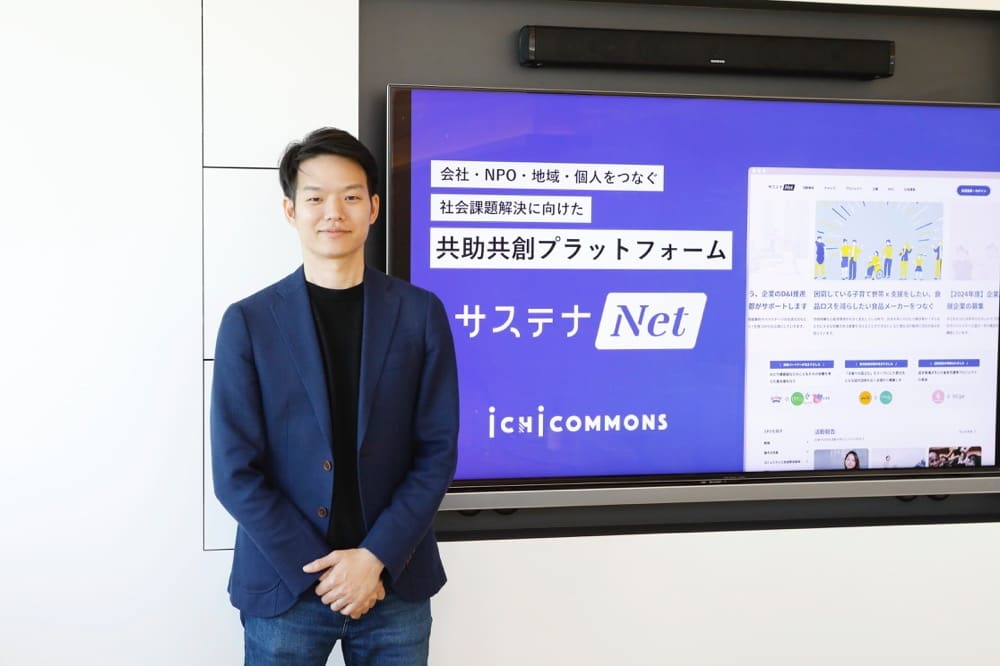
Under its vision of a “a world where everyone can be the protagonist in solving social issues,” the company Ichi Commons Co., Ltd. (external link, in Japanese) operates Sustena Net (external link, in Japanese), a platform that enables nonprofit organizations, social enterprises, businesses, and individuals to meet like-minded people and entities seeking to solve social issues.
In this interview, we spoke with Ichi Commons CEO Takahiro Fushimi about topics such as what can be achieved with the Sustena Net platform, the benefits of collaboration between businesses and nonprofit organizations, and the factors behind the currently low collaboration rate.
A platform inspired by businesses ‘not knowing where to start’
The Nippon Foundation Journal Editing Department: Tell us about your company, Ichi Commons.
Takahiro Fushimi: We registered the startup Ichi Commons on January 31, 2020. Before that, my work involved developing social impact investment — that is, mechanisms for investing in and lending to people engaged in solving social issues.
In that role, I encountered people from various businesses, investors, and nonprofit organizations. As I communicated with them, I began to sense the lack of awareness of the existence of various social issues and of the people who work to solve those issues. I founded Ichi Commons because I was keen to start with solving this key problem by placing social issues at the center and creating infrastructure that fosters mutual understanding.
Journal: Tell us about the kinds of services the Sustena Net platform provides.
Fushimi: The Sustena Net project was launched in 2021, as a mutual assistance and co-creation platform that provides organizations and individuals keen to engage in tackling social issues a forum for learning and connecting.
Fushimi: The Sustena Net platform presents a total of 54 social issues, divided into 12 topics, including education, work-style reforms, and the natural environment and ecosystems. Each issue also has a dedicated page that, in addition to providing information on the background, the stakeholders involved, and strategies for tackling the issue, also introduces the nonprofit organizations tackling that issue. The platform is designed such that by simply checking the page of the issue that it wishes to tackle, a company is able to look for partners it could collaborate with from the around 500 organizations currently registered with our platform.
Journal: Why is the rate of collaboration between businesses and nonprofit organizations so low in the first place?
Fushimi: Making an educated guess, I think that a key factor behind the low collaboration rate is that there has always typically been a lack of opportunities for dialogue between businesses and nonprofit organizations.
While there may be differences from one business to another in terms of the level of importance they each place upon social contribution, I think that businesses generally tended to see nonprofit organizations simply as somewhere to donate to fulfill part of their social contribution efforts. They were unable to make the next step from donating to learning about social issues and discovering new opportunities for the company. Nonprofit organizations were likewise not making proper efforts to ask themselves what kind of value their activities could bring for businesses.
As a result, many businesses are facing the issue that while they might wish to pursue sustainability and be keen to collaborate with nonprofit organizations, they may struggle with the problem that they “do not know where to start,” “do not know which organizations can be trusted” and “do not know what they can do at which organization.”
The Sustena Net service seeks to overcome the division this gave rise to and to match up an organization with a business as partners generating social impact. It is like a matchmaker. We have up until now matched more than 50 businesses.
Numerous unique ideas that were only possible through collaboration between businesses and nonprofit organizations
Journal: How do businesses use the Sustena Net platform?
Fushimi: When an organization first registers with the platform, we always conduct an around one-hour online interview and produce an introductory video compiling information on the organization’s activities.
The Sustena Net platform also hosts the Wakuwaku Kifu Konpe (external link, in Japanese) — literally, the “exciting donation contest.” Businesses first learn about the various issues from the introductory videos and, having heard from those tackling such issues hands-on, put out a call for organizations to collaborate with. There is a project page where employees can vote for which organization the company should work with.
Rather than the company merely donating funds to the cause, after the contest this initiative involves providing a forum for the organization selected and the company to engage in dialogue, and offering assistance in the development of new projects, regional collaboration, and solution of social issues.
Aside from facilitating donations as a means of support, Sustena Net also offers a service called Challenge Market (external link, in Japanese) aimed at enabling numerous businesses and nonprofit organizations to work together to launch and implement projects addressing specific social issues, and to promote awareness of those projects.
Journal: That initiative sounds interesting. What kinds of collaboration have arisen so far?
Fushimi: In one case, transmission and control devices manufacturer Miki Pulley Co., Ltd. (external link), took part in the Wakuwaku Kifu Konpe contest because the company was keen to give back to Yonezawa, the city in Yamagata Prefecture that is home to its factory, by tackling the issue of population decline faced by the city.
The organization selected by the contest for Miki Pulley was an organization providing employment support for people currently going through extreme social withdrawal (hikikomori in Japanese). Miki Pulley created opportunities for such people to tour their factory and in turn opened up possibilities for them to find employment. The company also continued the donation contest on an ongoing basis, thereby strengthening collaboration with the local government and other regional stakeholders.
We were also delighted at the new connection with the city and the regional areas, and this was also an initiative that gave us a sense that collaboration with nonprofit organizations is one valuable approach for a company closely connected to its local community.
Meanwhile, one of the participants of Challenge Market, the company Open Up Group Inc. (external link), which provides career support for human resources in the field of information and communications technology, hosted a Kodomo Tech Caravan (“Kids Tech Caravan”; external link, in Japanese) event in Hiroshima Prefecture, where these technologies were paired with activities to experience the natural environment.
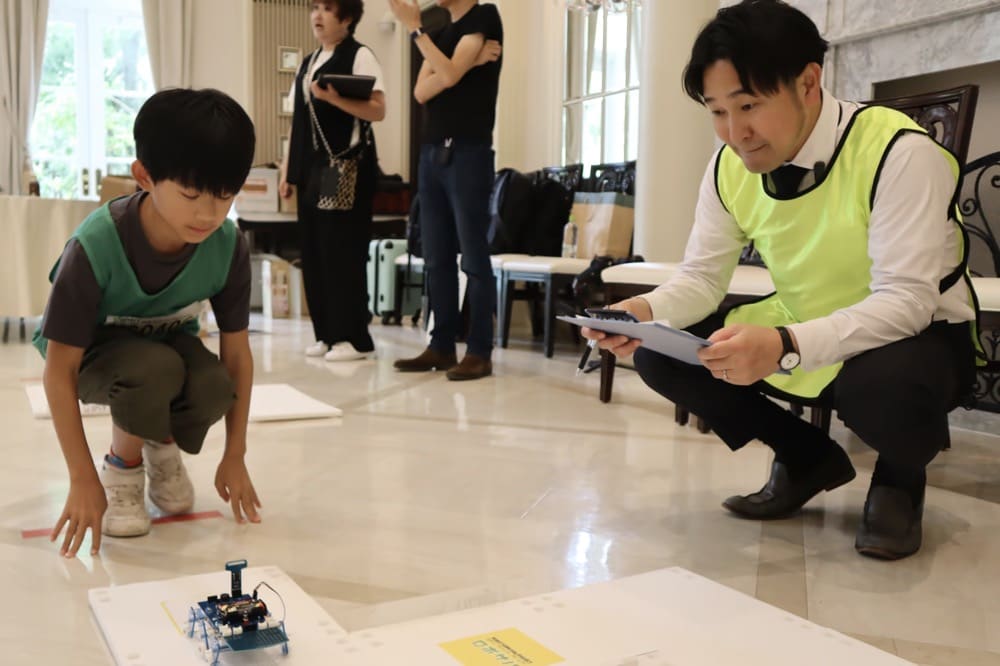
Fushimi: In this project, two organizations engaged in addressing issues faced by villages living sustainably with nearby forest and mountains (satoyama and satoumi) were joined by the company Take and Give. Needs Co., Ltd. (external link), which runs wedding venues across Japan. This meant that on the final day a presentation could be held at one of the wedding venues.
We believe that there are still many other businesses that are similarly capable of drawing on the experience and strengths that they have developed over the years to participate in contributing to society.
Journal: We have heard that there are companies that may wish to engage in social contribution but struggle to secure understanding within the company or fail to make progress due to opposition from upper management.
Fushimi: Yes, this is often the case. I think that from the point of view of such top management figures, the definition of sustainability that has taken prominence in recent years is very broad. It is therefore extremely difficult to define and coordinate the different areas — sustainability management, human capital management and social contribution — and make decisions based on an informed grasp of all initiatives.
We responded to this problem by launching Sustena Samari (“Sustainer Summary”; external link, in Japanese) in 2023, a service to make it visible for companies what impacts their own businesses activities are exerting upon society, and create a report for pursuing sustainability management strategically.
Journal: Ichi Commons also provides a number of services other than Sustena Net, doesn’t it?
Fushimi: Our vision is “a world where everyone can be the protagonist in solving social issues.” We say “protagonist,” but instead of seeking a kind of “hero” figure, we believe that each business, nonprofit organization, municipality and individual has their own unique role to play in solving social issues. And because there is a limit to what each individual or entity can achieve on their own, we assist in ensuring that each of the roles are fully carried out by developing mechanisms for mutual assistance and co-creation from various points of view.
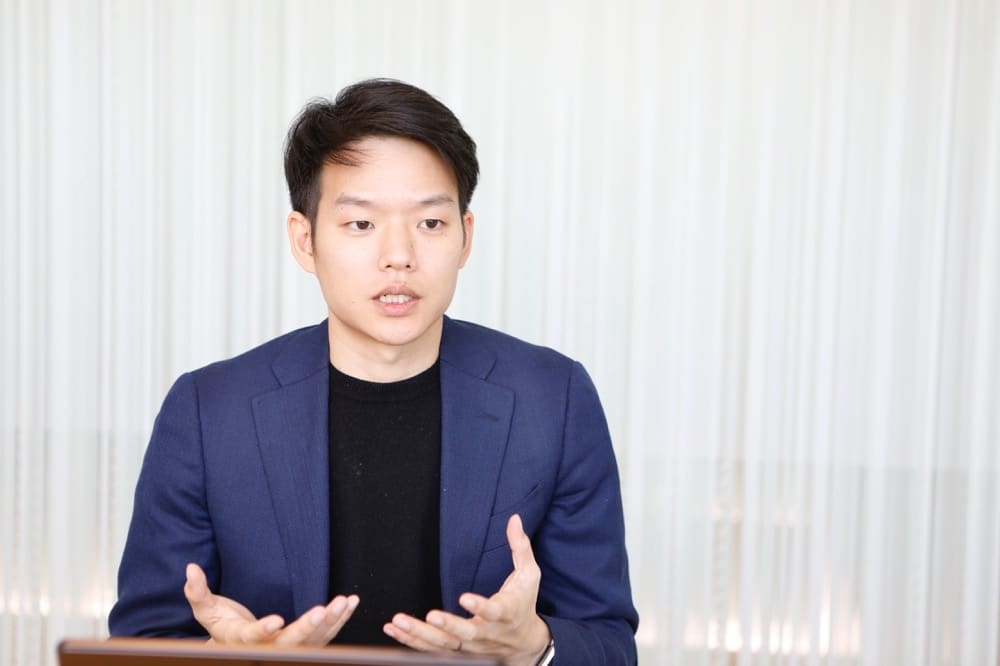
Collaboration above and beyond the set roles of businesses, nonprofit organizations, municipalities, and individuals will become increasingly important in the future
Journal: What, for starters, is necessary to enable businesses and nonprofit organizations to get to know each other and develop greater mutual understanding?
Fushimi: Creating opportunities for dialogue is of course a good place to start. This means first establishing which issue they both wish to address, and then, on that basis, sharing what each side is or isn’t capable of.
When engaging in such dialogue, it is important that each side personally visits the place where the other is tackling the issue hands-on. Such dialogue develops relationships built on trust and opportunities to consider what each side expects of a truly suitable partner. It is a sufficiently worthwhile process even if collaboration fails to develop as a result.
Journal: It really is like an arranged marriage. What kinds of initiatives do you have planned for the future?
Fushimi: If the birthrate decline and population aging continue at their current pace, in turn leading to a drop in the working population, the number of people available to tackle solving social issues will naturally decrease. In that case, unless businesses and nonprofit organizations work together to form constructs that increase productivity, it will be difficult to make progress in solving social issues.
Successfully tackling social issues requires businesses, nonprofit organizations, and municipalities to collaborate in a way that transcends the boundaries of their respective sectors. It is important to support such collaboration with an understanding of the fact that each entity has a slightly different main aim and perspective on the same issue — for instance, businesses may need to prioritize sales and profits, while nonprofit organizations are focused on solving social issues, and municipalities on developing infrastructure.
In future, I would also like to be able to provide support not only for collaboration between businesses and nonprofit organizations, but also for collaboration between nonprofit organizations engaged in tackling the same issue.
Another project for the future is to create a system that collaborates data on each respective social issue and in order to assess to what extent each issue has been solved, and, for individual users to provide Sustena Net with information on the social issues in their area and data, to enable them to support the initiatives of nonprofit organizations and businesses.

Journal: Finally, what can be done to ensure that more players become involved in solving social issues?
Fushimi: The first step is to promote greater recognition of social issues and an awareness across society of the need to solve them. We do in fact often hear from businesses using Sustena Net that they were previously not even aware that such an issue existed.
The next step is to create a platform that allows users to see at one glance which organizations are tackling each of the issues. It would also be great if we could increase the options for both individuals and businesses to be involved in individual initiatives not only by donating money but in various ways such as volunteering or even in basic aspects of everyday life.
Creating opportunities and new options for businesses, municipalities and other entities to take the first step toward social contribution will surely in turn help to increase the number of players tackling social issues.
Editor’s Note
Something that all of the services provided by Ichi Commons have in common is that they entail reaching out to those in front of them — whether they are businesses or nonprofit organizations — and listening carefully to what they need. The businesses and organizations that use the services invest time in developing relationships built on trust, and this has surely allowed for unexpected matches and unique ideas.
Mr. Fushimi recalls that before founding the company he conducted a field survey of around 1,200 nonprofit organizations, which included interviews on the current developments and challenges in terms of human resources, publicity, organizational management, and various other perspectives. He is still tackling challenges today, saying there is “still much to do.” Such a stance is in itself the first step toward solving social issues.
Text: The Nippon Foundation Journal Editing Department
Photo: Emi Enishi
Profile
Takahiro Fushimi
Takahiro Fushimi is a graduate of the Faculty of Law at Keio University. While still a student, he played a role in founding the education-related nonprofit organization HLAB. After joining General Electric in 2014 and engaging largely in corporate finance projects as part of the financial management program, he became executive director of C4, a general incorporated association providing intermediate support for impact investing. Around this time, he had a role arranging investments in listed companies as part of the investment banking division of the U.S. fund Evolution Financial Group. He founded Ichi Commons Co., Ltd. in 2020. Through Sustena Net, a platform providing information on the who, what and where of addressing social issues in Japan, he supports businesses in their efforts to pursue sustainability and facilitates efforts by nonprofit organizations and social enterprises to tackle social issues.
Related Themes
Related Link
Related Articles
Field Notes