DAC CO2 Capture Technology in SpotlightNew measure against global warming
Key Points
- CO2 is a cause of global warming. DAC is technology that captures CO2 directly from the atmosphere.
- Captured CO2 can be stored underground, reused for agriculture, etc.
- Even if DAC expands, the climate will not return to its previous state. It is important to concurrently engage in small efforts to reduce CO2.
Extreme weather such as increased average air and sea temperatures, record rainfall, typhoons, and large-scale forest fires are all said to be related to global warming.
- For further information, see this article: If Global Warming Progresses, Are There Many Who Will No Longer Be Able To Live Where They Do Now? (external link; in Japanese.)
However, CO2 (carbon dioxide) emissions from fossil fuels—one of the causes of global warming—are increasing worldwide. Total CO2 emissions in 2024 were forecast to come to a record 41.6 billion metric tons.
A variety of initiatives are being taken to reduce CO2 emissions. One initiative that has drawn particular attention is Direct Air Capture (DAC), which leverages new technology to capture CO2 in the atmosphere. DAC is one of the means being used to accelerate carbon neutrality, and one of the companies developing the technology is Planet Savers Inc. (external link; in Japanese. ) Under its vision to “save the planet for the next generations in 100 years,” the company has been developing DAC technology since 2023.
We talked with Kei Ikegami, CEO of Planet Savers, about how DAC works, the impact DAC would have if it became widespread, and what individuals can do to reduce CO2 and slow global warming.
DAC captures and stores CO2 in the atmosphere safely and at low cost
The Nippon Foundation Journal Editing Department: Let’s start by telling us how DAC works.
Kei Ikegami: DAC is technology that captures CO2 directly from the atmosphere. By combining efforts of the international community to reduce CO2 emissions with capturing CO2 that is already in the atmosphere, we believe the technology has the potential to take us beyond net zero[1] and to carbon negative.[2]
- Note 1: Net zero emissions refers to a state where the amount of greenhouse gases produced from all human activity is balanced by reducing greenhouse gas emissions itself through implementing renewable energy and conserving energy and by absorbing and fixing the gases produced through efforts such as afforestation and forest conservation, resulting effectively in zero emissions.↩︎
- Note 2: Carbon negative emissions refers to a state where the amount of carbon dioxide and other greenhouse gas emissions is less than the amount absorbed by forests and afforestation activities.↩︎
Journal: What is the difference between this technology and green and blue carbon where CO2 is absorbed and stored in forests and marine plants?
Ikegami: It is the same in terms of reducing CO2 in the atmosphere, but the process in which CO2 is captured is different. Forests and marine plants capture and store CO2 via photosynthesis, but DAC uses specialized equipment and adsorbent that adsorbs CO2.
- For further information, see this article: Marine Plants Reduce CO2? Blue Carbon Mitigates Global Warming, What Is It? (open in a new tab, in Japanese)
Journal: How does the DAC technology under development by Planet Savers capture CO2?
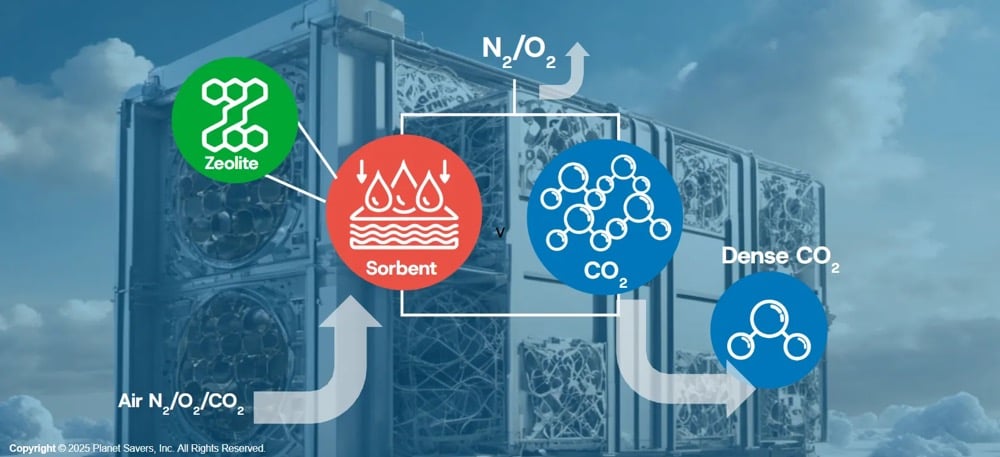
Ikegami: The DAC technology we are developing uses a method based on a mineral called zeolite. Put simply, zeolite has small holes in its molecular structure that adsorbs CO2 when air flows through it. The technology separates only the CO2 from the zeolite by lowering the pressure.

Ikegami: There are other minerals that can adsorb CO2, but zeolite has a unique advantage. It can keep the energy consumption and costs required to remove adsorbed CO2 down. Conventionally, most DAC equipment uses organic matter for the CO2 adsorbent. The problem with that is it deteriorates quickly.
And adsorbent itself is often expensive. But zeolite is inorganic, so it is highly durable, lasting around 10 years. It is also inexpensive because it is found in nature. This way, the adsorbent does not have to be frequently replaced and promises to reduce operational costs over the long term.
Moreover, zeolite is very safe. Some adsorbents are hazardous substances that need to be handled carefully, but touching or breathing in zeolite has no negative impact on health. Safety is an important matter to consider in implementing DAC, so I believe using zeolite will provide extremely high usability.
Captured CO2 can be stored underground for over 1,000 years and also be used in agriculture
Journal: How is the captured CO2 processed?
Ikegami: There are two methods to process captured CO2. The first is storing it underground. There is established technology to pipe CO2 from above ground to strata underground where it is mineralized and remains for over 1,000 years. The US, Norway, and Australia already store CO2 underground.
Japan may have less places to store CO2 than other countries, but demonstration experiments have actually been carried out in Tomakomai, Hokkaido since 2016. It has been verified as safe, and rules are now being developed for its practical application.
Another method is carbon recycling[3]. One application that has gained attention as being potentially compatible is the reuse of CO2 in greenhouse horticulture. Fruits and vegetables need CO2 to promote photosynthesis. Today, many farmers purchase CO2 gas cylinders and inject the gas into vinyl greenhouses. It is surprisingly expensive.
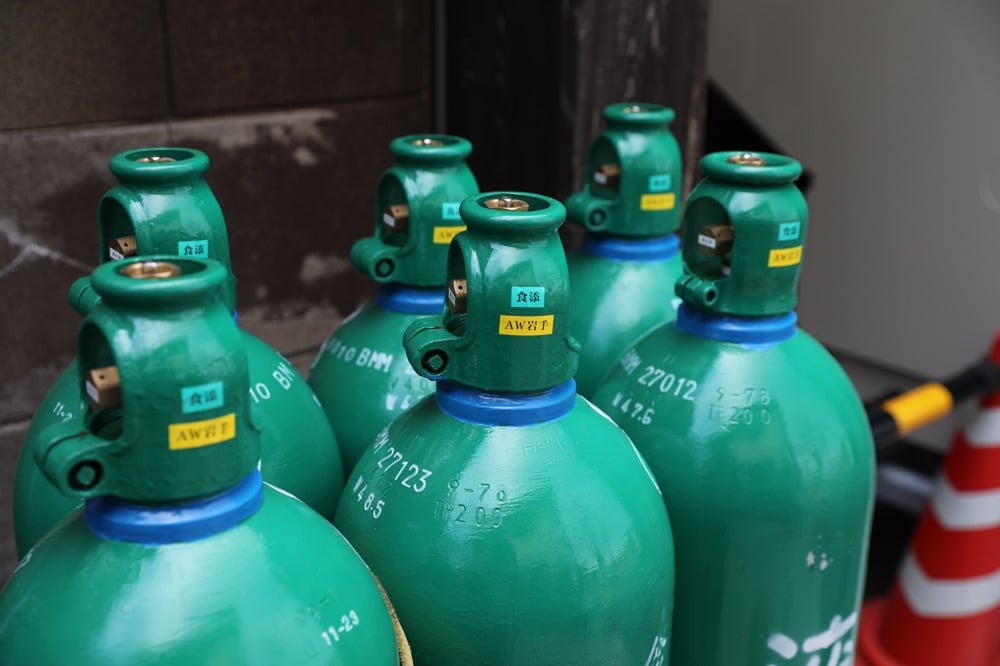
Ikegami: If DAC systems could be installed at farms, CO2 in the atmosphere could be captured and possibly used to cultivate crops. Unfortunately, DAC systems take up a lot of space, so installing one can be difficult regardless of the size of the farm, but I think farms could be an effective initial supply destination for CO2.
- Note 3: “Carbon recycling” means to separate and capture CO2 and reuse it in a variety products and fuels. In carbon recycling, CO2 is treated as a resource.↩︎
The importance of simultaneously capturing and storing CO2 and reducing emissions
Journal: What made you start tackling solutions to global warming issues?
Ikegami: When I was a child, I visited a developing country. There, people begged me for money, and my grandfather told me about war. That experience filled me with a strong resolve to find solutions to social irrationality. I think my interest in solving social problems was high from my student days. Then I joined the Japan International Cooperation Agency (JICA). When I experienced the West Japan Heavy Rain Disaster in 2018, it made me keenly realize the need for addressing global warming and climate change. Someone must do something, I thought, and established Planet Savers Inc. with co-founder Kenta Iyoki.
Journal: There are many ways to tackle solutions to global warming, but what made you start doing so by establishing a for-profit company?
Ikegami: When the national government takes the initiative in taking action, it usually starts by forming rules and systems. There is of course value in developing new technology after establishing systems, but it is more in my nature to take the approach of first developing technology that will lead to solving societal problems and then establishing the rules and systems. Above all, to me, taking the initiative to move things forward is rewarding. That is why I chose to address the problem by establishing a for-profit company.
Journal: You established the company in 2023 and I think for the last two years, you have been conducting a variety of demonstration experiments, but how far along are you in the development process?
Ikegami: We are working hard day in and day out to complete our DAC prototype by September 2025. Two years of research has given us great data that has brought us closer to implementation, so we will work even harder to be able to release it into the market as soon as possible.
Journal: I hear there are other companies around the world that have been involved in the DAC business since around 2010.
Ikegami: That’s right. There is a company outside Japan building a facility that will be able to capture and store 1 million metric tons of CO2 per year, so they may have a lead on us. That said, although companies like this are scaling up, the cost of implementation remains high. Also, there are over 100 DAC competitors in other countries, but only four are developing DAC based on zeolite, including us. I think we have plenty of potential to catch up to DAC businesses that have the lead around the world.
Journal: Do you think that if DAC technology advances, in the future, Earth’s climate can return to how it was before global warming gained so much attention?
Ikegami: That would be difficult. Global CO2 emissions are much higher than they were originally expected to be, and in order to return Earth’s climate to how it was before, we would have to spend an exorbitant amount of money to capture the CO2 in the atmosphere. Also, there are other factors that cause global warming, such as the increase in greenhouse gases that include CO2 and changes in the environment and ecosystems, so it would be impossible to return Earth to how it was before just by capturing CO2. That’s why it is important to not only use and promote DAC but also carry out a wide range of measures to combat global warming at the same time.
I don’t want future generations to see the world breaking down
Journal: What problems does the DAC business currently face?
Ikegami: Energy consumption. Right now, it consumes a large amount of energy, so unless we use renewable energy, we would end up producing even more C02 emissions and the cost would also increase. In addition, the bigger the DAC system, the higher the cost. To achieve practical application, we must create a framework to enable us to operate with little energy and at low cost. There are also issues with the adsorbent. Currently, our system also captures chemicals that are structurally similar to CO2, so we have a process for separating CO2 from other chemicals, but this also increases costs. Now, Mr. Iyoki and I are working to create a new adsorbent that will be able to distinguish CO2 from other chemicals and capture only CO2.
Journal: I see you’re overcoming a wide range of problems and getting closer to implementation. What is the driving force behind your passion to solve climate change problems like global warming?
Ikegami: I figure you only live once, and I have a strong determination to have a major impact on society and do something for the world. In that respect, I think that climate change is the most important issue for human beings. Of course, there are many other problems we must solve, such as the declining birth rate, increasing aged population, and growing inequality in Japan, but nothing terrifies me more than natural disasters caused by the destruction of the environment, undoing all efforts humans have accomplished so far. I don’t want to see this happen and I don’t want my children and future generations to either. I have a strong desire to, at the very least, leave future generations with an environment that is not very different from what it is like now.
Journal: There are many who have the same sense of urgency as you about global warming. What is something people can do as a first step?
Ikegami: This applies to anything, not just societal problems, but just try taking action no matter how small it may be. If you do, you are sure to discover other problems and new perspectives that will lead to the next step. I say this in part because I head a startup, but I recommend starting by joining a startup or other organization that is addressing climate change, even if it is pro bono or as a side job. Or you could start by doing something in your everyday life like working to conserve energy at home or the workplace, replacing your gas-powered car with a hybrid or electric car, or putting solar panels on your home. Also, subsidy programs offered by the national government and local governments have become more substantial. And if you search online, you can find many organizations working to combat global warming around the country. There are a wide range of activities to participate in, such as forest conservation, cleanup activities, and environmental education events. Just try taking part in something where your live or that matches your interests. I hope that as many people as possible tackle these problems with the same mindset.
What we can do to protect Earth from global warming
- Join a startup or other organization that addresses climate change, even if it is pro bono or as a side job.
- Work to conserve energy at home or the workplace by buying a hybrid car, installing solar panels, etc.
- Learn more about the current situation and possible solutions by participating in activities of an NPO or community-based organization that is tackling global warming.
I first heard about DAC on the radio. The technology didn’t seem to be very well known yet, so I requested this interview. Recently, the threat against the global environment has become so dire that global warming is being referred to as “global boiling.” Considering this, I believe that DAC technology has the potential to become a new secret weapon to slow the progress of global warming. I hope that this article encourages many to learn about DAC technology and leads many to be involved in its further development and implementation into society.
Text: The Nippon Foundation Journal Editing Department
Profile
Kei Ikegami
Born in 1987, Kei Ikegami is the CEO of Planet Savers Inc., Japan’s first direct air capture (DAC) startup. After earning a bachelor’s degree from Kyoto University’s Faculty of Law and a graduate degree from the university’s School of Government, Mr. Ikegami joined Japan International Cooperation Agency (JICA) as a new graduate. There he was involved in providing support for infrastructure development and policy in the Middle East, including power, energy, transportation, water supply, and sewerage. He then received an MBA from Cambridge Judge Business School, after which he joined SoftBank Robotics where he worked to expand AI robotics globally. In 2021, he established MIRAIing Inc., which provided leadership training to over 2,000 students. He sold the business and established Planet Savers in 2023 based on an idea to launch an impactful startup that strives to stop climate change. He is still in his current position
Related Themes
Related Links
- World’s 1st Successful ‘Zero-Carbon’ Voyage
- Japan’s 1st Dual-Fueled Hydrogen Tugboat Enters Service (October 24, 2025)
- The Nippon Foundation Zero Emission Ships Project (September 4, 2024)
- Japan’s Largest1 Offshore Wind Power Human Resource Training Center Opens
Related Articles
From Streets to the Sea: How The Nippon Foundation Turns Cleanup into a National Movement
Field Notes